
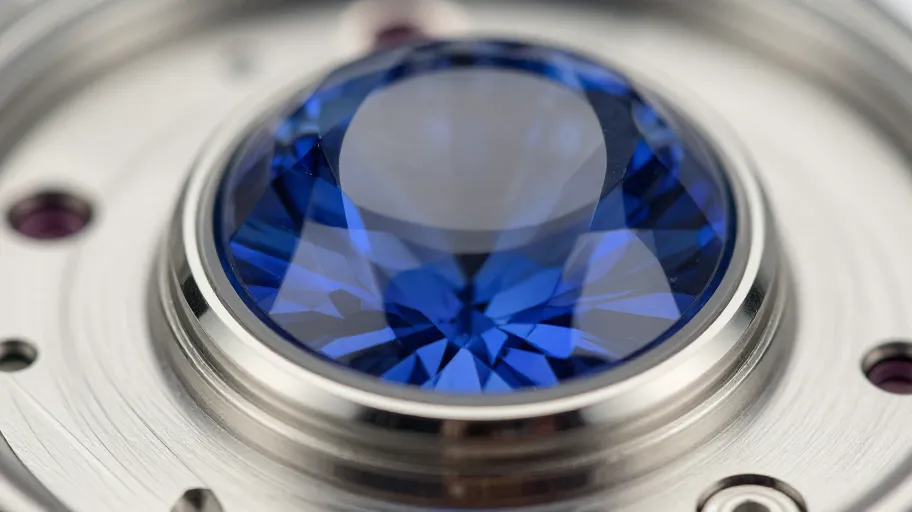
A revised domed sapphire watch glass sample deserves a structured verdict, not a gut reaction. Compare the new sample against your documented reference points — curvature profile, edge fit, optical behaviour and surface condition — using one repeatable protocol. Most issues you flag can be handled as targeted corrections rather than a full restart, provided your feedback is specific, measured and tied to an agreed reference. This article gives you that protocol.
Why revised domed samples get misjudged
Curvature is the hardest attribute to evaluate by eye. A domed sapphire watch glass changes appearance dramatically with lighting angle, viewing direction and the dial beneath it. Two samples from the same production run can look different on a bench under different lamps. And when a revision arrives, the natural question — "is this closer to what we asked for?" — cannot be answered unless you recorded what the previous sample actually measured and photographed.
The failure mode is predictable: a buyer notices something slightly off, describes it vaguely ("the dome still looks a bit flat on one side"), and the supplier makes a second, equally unanchored adjustment. Each loop costs a revision cycle and erodes trust on both sides. The alternative is not harsher rejection. It is better documentation.
That is the purpose of the framework below.
The REVISE framework for reviewing a domed sapphire watch glass sample
R — Reference. Before touching the new sample, pull up the record from the previous round: your written specification, the prior sample's photos, and any notes from your designer. If you did not document the previous round, document this one now — the framework only compounds if you start keeping records.
E — Evidence. Photograph and, where possible, measure the revised sample before forming an opinion. Shoot the dome from fixed angles under the same lighting each round: straight-on, profile (side silhouette against a diffuse backlight), and a raking-light view across the surface. Keep the camera height and distance constant. The profile shot is your best friend for domed sapphire watch glass, because it turns a subjective "looks flatter" into a comparable silhouette.
V — Verify. Check each attribute against your specification list rather than against memory:
- Dome profile and apex position (centred? symmetric?)
- Height relationship to the case bezel
- Edge finish and seating in the case or gasket
- Optical clarity across the curve, including any distortion band near the edge
- Coating presence and behaviour, if a coating was specified
- Surface condition: scratches, chips, inclusions visible to the naked eye and under magnification
Where a numerical tolerance was agreed, compare against that agreed figure. Where none was agreed, do not invent one silently — raise it as a question for the supplier (see the approval questions below).
I — Iterate. Classify every finding as either a correction (adjustable within the current sampling path) or a redesign issue (a change to the specification itself). "Apex sits slightly off-centre" is a correction. "We want a different dome family altogether after seeing it in the metal" is a redesign decision — and it deserves an honest conversation rather than being disguised as a defect claim.
S — Sign-off. Approve in writing, and state exactly what you are approving: which drawing revision, which sample, which observations were accepted as-is. A sentence like "approved as sample #3, drawing rev B, with the noted light edge distortion accepted" protects both parties later.
E — Evaluate. After two or three rounds, ask whether the loop is converging. If each sample is measurably closer to the reference, you are iterating well. If feedback keeps reinterpreting the spec, the problem may be in how the requirement is written, not in the samples.
Decision table: approve, correct, or restart
| Finding | Evidence quality | Recommended path | Action |
|---|---|---|---|
| Dome profile matches documented reference across fixed-angle photos | Strong (profile shots + notes) | Approve | Written sign-off referencing drawing and sample number |
| Minor, localised issue (e.g. slight apex offset, one edge seat) | Measured or clearly photographed | Correct | Send targeted correction with reference photos and the specific location |
| Spec ambiguity discovered mid-review (e.g. dome-to-bezel relationship never defined) | Gap in documentation | Correct spec, then sample | Redraft the requirement with the supplier before next sample |
| Repeated divergent interpretation of the same requirement across rounds | Documented non-convergence | Escalate the dialogue | Request a curvature review call or joint measurement session |
| Fundamental design change of mind | Not a defect | Restart as a conscious decision | Treat as a new specification, not a failed sample |
Note what is absent from this table: any claim about what a supplier will adjust, how many rounds anything takes, or what any correction costs. Those are project-specific facts. Confirm the current policy directly.
Concrete approval questions to send with your feedback
Vague feedback produces vague revisions. Attach these questions (edited to your project) to your next sample review:
- "Does the current sample reflect drawing revision B? Please confirm which revision this sample was produced to."
- "Here is the profile photograph. Does our dome height reference match your measurement method? If our measurement approaches differ, how should we align them?"
- "The apex appears offset toward [X] in the attached photo. Can this be corrected within the current sampling path, or does it require a tooling change?"
- "What dimensional references do you recommend we both record so future rounds are comparable?"
- "If we approve this sample as the production reference, what should we document together so the production parts are reviewed against the same reference?"
- "Regarding samples, adjustments and shipping arrangements for the next round — what is your current policy?"
The last question is deliberate. This article does not state what any supplier's policy includes, because none was supplied. Confirm the current policy directly.
Documentation practice that shortens every future round
Three habits, none requiring special equipment:
- A fixed photo station. A phone, a diffuse lamp, a marked position for the sample and the camera. Same setup every round makes silhouette comparisons meaningful.
- A one-page sample card. Sample number, date, drawing revision, what changed since the last round, your verdict, open questions. One card per sample.
- A shared vocabulary. Agree with the supplier on the terms you will both use — dome profile, apex, height, seating edge, distortion band — so "slightly off" never enters the record again.
FAQ
How do I compare two domed sapphire watch glass samples from different suppliers fairly? Use the identical photo station and measurement approach for both, and compare profile silhouettes rather than top-down impressions. Record every observation on separate sample cards so your comparison survives later scrutiny. Differences in appearance under different lighting are not, by themselves, evidence of a quality difference.
Should I measure the sample myself or ask the supplier for their measurements? Do both, and compare. Your measurement tells you what you see; theirs tells you what they produced to. If the two disagree, the conversation is about aligning methods — which is far more productive than arguing about the sample.
When is rejecting a sample and restarting the right call? When the issue is a change in your own requirement, not a shortfall in execution. A dome that matches the agreed reference but no longer suits the design is a design decision. Treating it as a supplier defect damages a relationship without fixing anything.
What should written sign-off include? Sample number, drawing revision, the observations you reviewed, anything you accepted with reservations, and the date. Keep it short; a few sentences suffice.
How many revision rounds should I expect? This article makes no claim about revision counts — that depends entirely on your specification quality and the project. What you can control is whether each round converges, which is what the REVISE framework measures.
Request a curvature review. Send JadeZone Sapphire your profile photographs, sample cards and open questions, and our team will review your domed sapphire watch glass curvature references alongside you before the next sampling decision. Confirm the current policy directly for samples, adjustments and shipping arrangements.
Low-friction checklist CTA: Before your next sample review, run the five-point bench check — fixed-angle photos, profile silhouette, edge seating check, optical sweep, written verdict on a sample card. Download nothing, register nothing: just bring the completed card to your next supplier conversation.