
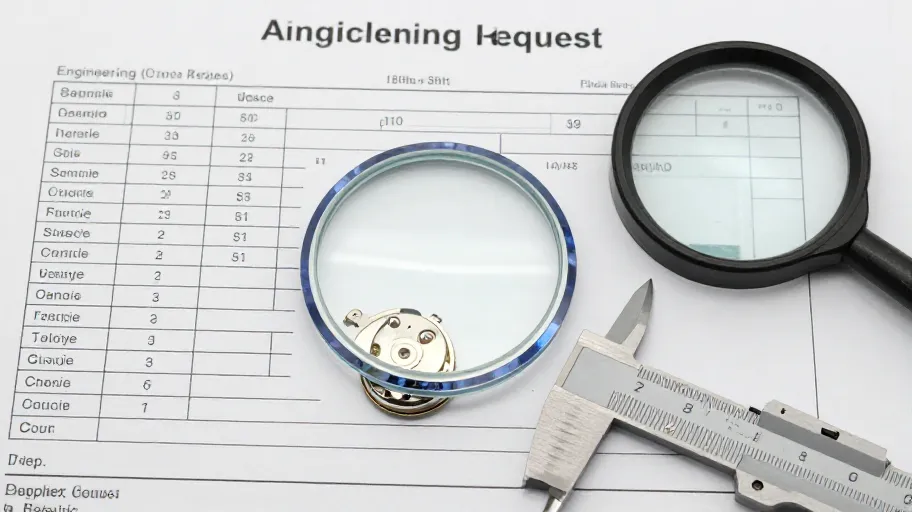
When a supplier proposes changing the material specification on your custom sapphire watch crystal, treat it as a formal engineering change, not a courtesy notification. The right response is a written comparison covering composition, dimensions, optics, durability, coatings, compliance and commercial impact. Use a structured gate — the SPEC-CHANGE Gate below — so nothing is approved on assertion alone.
Why a material change proposal deserves a formal gate
Material change proposals arrive for many reasons: a raw material source shifting, an internal process adjustment, an engineering recommendation, or a substitution offered to solve a production problem. Whatever the motivation, the proposal changes the basis on which you originally approved the part. A custom sapphire watch crystal sits at the intersection of optics, mechanics, sealing and finish — a change to the material or its treatment can ripple into areas your assembly, warranty position and brand reputation depend on.
The risk is not that suppliers act in bad faith. The risk is asymmetry of information: the supplier knows why the change is proposed; you know what your product must survive. Without a structured exchange, neither side's knowledge reaches the other in a form you can file, compare and audit later.
A formal gate also protects the relationship. When you ask for documents rather than reassurance, you make it easy for a capable supplier to demonstrate capability — and you make it visible quickly if a proposal cannot be substantiated.
The SPEC-CHANGE Gate framework
Run every material change proposal through nine questions before approving anything:
- S — Specification. What exactly changes? Material grade, growth method, orientation, coating, or treatment? Request the before/after specification sheets side by side.
- P — Proof. What evidence supports the change? Request written comparative data — not verbal assurance — for the properties your design depends on.
- E — Exposure. Where in your product does this part operate? Which failure modes matter most: scratching, chipping, sealing, thermal cycling, UV exposure? Rank them before reviewing evidence.
- C — Consequences. What downstream effects could the change trigger — fit, gasket compression, adhesive bonding, coating adhesion, rework of fixtures or tooling?
- H — Hardening. What protective steps are available — inspection criteria, incoming checks, first-article verification — and who performs them?
- A — Agreement. How will the change be recorded? A revision number, an updated drawing, a signed deviation, or a formal engineering change notice.
- N — Notification. How far in advance will future changes be flagged, and through which channel?
- G — Governance. Who on your side approves a material change, and who can reject one? Decide this before the pressure of a schedule.
- E — Evidence retention. Where will the documents live so that a dispute or warranty question months later can be answered from the file?
The gate's purpose is not to slow sourcing down. It is to convert a supplier's proposal into an auditable record that both sides can rely on.
Decision table: risk area, demand, documentation
| Risk area | What to demand from the supplier | What to document on your side |
|---|---|---|
| Material identity and grade | Written before/after material specification, including growth method and any treatment or coating revisions | Updated internal part specification and revision history |
| Optical performance | Comparative clarity, colour and, if relevant to your design, anti-reflective behaviour — presented as measured values with methods stated | Acceptance thresholds agreed in writing before approval |
| Mechanical robustness | Test approach and results for the failure modes your product must survive, with conditions described | Which tests you accept as gating, and which as informational |
| Dimensions and fit | Updated dimension sheet and drawing revision; explicit statement of any dimensional differences | Your own incoming inspection plan keyed to the drawing revision |
| Sealing and assembly | Confirmation of surface finish, edge geometry and flatness consistent with your case and gasket system | Assembly trial plan for the first parts received |
| Compliance and declarations | Current declarations, test reports or certificates relevant to your markets and obligations | Copies filed with the change record; expiry and renewal owners assigned |
| Commercial impact | A written statement of any effect on quoted scope, tooling, order quantities or logistics | Cost impact reviewed by procurement before sign-off, not after |
| Continuity | Commitment to notify you of any further material or process change in writing | Notification clause or agreed process recorded in the change file |
Where a supplier cannot yet supply a row, that absence is itself information: it tells you which verification step must happen before approval.
Concrete approval questions to send
Copy these into your next supplier thread when a material change is proposed on a custom sapphire watch crystal:
- Please provide the current and proposed material specifications side by side, including any coating or treatment changes.
- Which properties differ between the two, and what measured evidence can you share for each difference?
- Does the change affect any dimension on the approved drawing? If yes, please issue a revised drawing and dimension sheet.
- Which tests were performed to support this proposal, under what conditions, and may we review the raw results rather than a summary?
- Does the change affect compatibility with our case, gasket, adhesive or assembly process as specified in our documents?
- What compliance declarations or test reports will be reissued, and when can we expect them relative to first shipments?
- What is the commercial impact — on quoted scope, tooling, order quantities or logistics — stated in writing?
- Will you commit to written advance notification of any further material or process change on this part?
- Who is your technical contact for questions during our evaluation, and can they walk our team through the evidence on a call?
For any question where the answer depends on current terms rather than engineering — samples, fees, shipping, production arrangements — confirm the current policy directly.
Documenting the outcome
An approval without a paper trail is a future dispute. Close every gate with three artefacts: a revised drawing or specification carrying a new revision identifier; a short internal memo recording what was evaluated, what evidence was accepted, and who approved it; and a confirmation from the supplier that the revised specification is now the basis of the order. If the proposal is rejected, file the rejection with the same care — it becomes the baseline for the next conversation.
FAQs
Does a material change always mean the part gets worse? No. Some changes improve consistency, sourcing stability or performance. The gate exists to establish which is true in your specific case, using evidence rather than assumption.
Our supplier says the change is minor and nothing will differ. Should we still run the gate? Yes — and run it faster. A "minor" change should be easy to document. The framework takes minutes when the evidence exists and surfaces problems precisely when it does not.
What if we cannot get measured comparative data before deciding? Escalate before approving. Ask which specific evidence is missing, when it can be produced, and whether a verification lot, first-article inspection or witnessed test can bridge the gap. If none is available, that constraint belongs in your risk file.
Who should sign off a material change on our side? Whoever owns product performance — a product developer or engineering lead — plus procurement for commercial impact. Assign both names before the first proposal arrives, not during one.
How do we handle repeated change proposals on the same part? Treat repetition as a signal to review the part's specification and the supplier relationship. Consolidate into a single current specification and require all future changes to reference it.
Next step
Submit a drawing or dimension sheet and ask for the material specification to be confirmed in writing against it — the fastest way to turn this framework into a documented answer for your specific part.
Prefer a lighter first step? Use the nine approval questions above as your checklist for the next supplier proposal. Keep it in your sourcing file.