
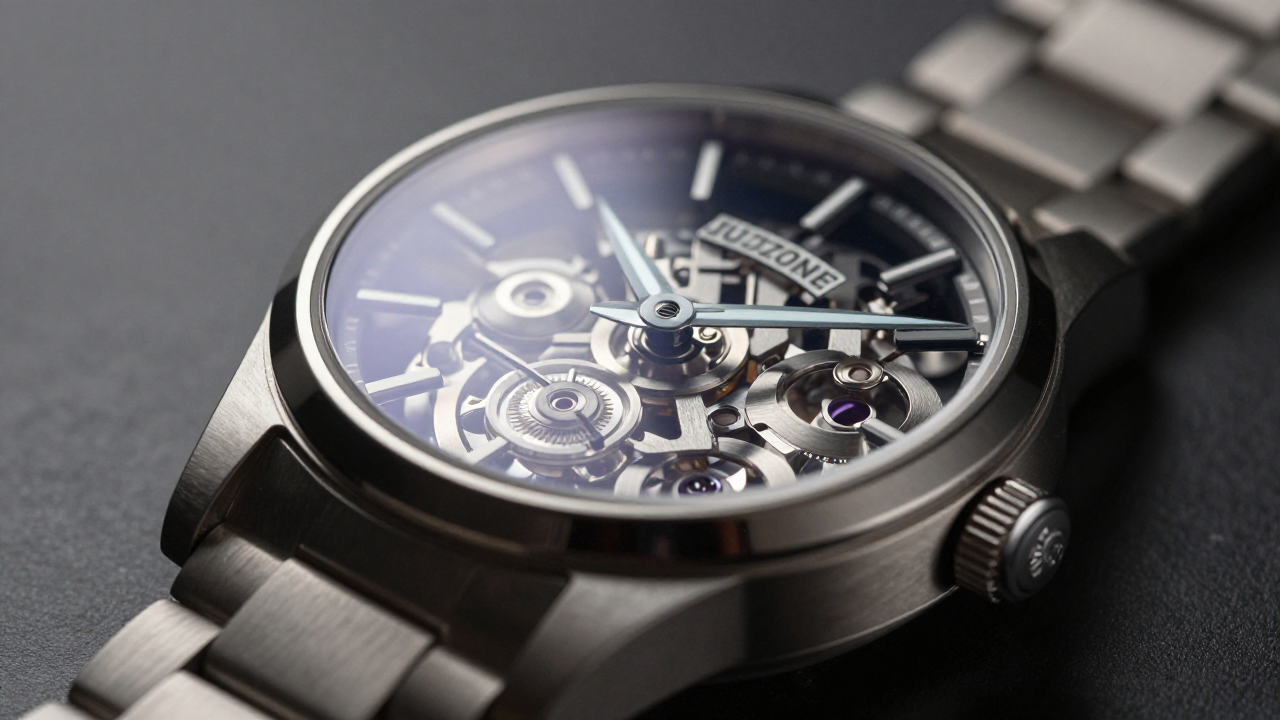
A sapphire watch crystal is a watch lens cut from lab-grown single-crystal aluminum oxide (Al2O3) with a Mohs hardness of 9, second only to diamond.…
Sapphire watch crystals cost 4 to 8 times more than mineral glass because a synthetic sapphire boule must be grown at 2,045°C over two to four weeks before it can be sliced, CNC-ground, and polished in multiple stages.
What Is a Sapphire Watch Crystal and Why Does It Cost More Than Mineral Glass?
Nobody mines sapphire for watch crystals. Essentially every crystal sold today is synthetic, grown by the Kyropoulos method or edge-defined film-fed growth (EFG). A commercial boule runs 100 to 300 mm in diameter, and a 150 mm boule yields a limited number of 40 mm crystals — material yield, not raw scarcity, drives the price gap.
Swiss houses started swapping acrylic for sapphire across their lines in the 1970s and 1980s. What changed the math recently is wearables: Vivo's Watch 6 ships a 1.47-inch AMOLED display under a sapphire cover at a price point where sapphire would have been unthinkable in 2015. When a $200 smartwatch can absorb a sapphire cover, the material has stopped being a luxury signal and become a spec-sheet expectation.
Jadezone Optical has been slicing and finishing sapphire in Shenzhen since 2010, and the single biggest shift we've watched is substrate thickness. Ten years ago, a 1.5 mm flat crystal was standard. Today, curved smartwatch covers run 0.8 to 1.1 mm, which changes everything about edge design and impact behavior.
How Scratch-Resistant Is a Sapphire Watch Crystal in Real Wear?
Sapphire watch crystals resist scratching at 1,800 to 2,200 Vickers hardness, roughly four times harder than mineral glass at 500 to 600 HV. Sapphire does not scratch from keys, door frames, or concrete in normal daily wear. What sapphire does instead is fracture on impact, because hardness and toughness are different properties.
Here's the part most spec sheets hide. A sapphire crystal with external anti-reflective coating is only as scratch-resistant as the coating itself, and a soft AR layer on the outside of a sapphire crystal scratches at roughly the same level as mineral glass. Collectors who pay for "double AR" and then wonder why their crystal looks hazy after eight months of desk work are experiencing exactly this.
Edge geometry matters more than thickness. In March 2023, a microbrand out of Denver sent us a spec calling for a 45-degree chamfer on a 1.2 mm domed sapphire. We ran 500 pieces to the drawing. Thirty-eight came back chipped at the chamfer after a routine 1-meter drop onto tile. We rebuilt the tool with a 0.15 mm radius edge and the return rate fell to 4 units per 2,000. Nobody's spec sheet said anything about it.
Why Are Sapphire Watch Crystals the Default Choice for 2026 Collectors?
Sapphire crystals now anchor resale value because auction houses and grading services treat crystal condition as a scored line item, and a scratched external AR coating can drop a watch a full grade. In 2026, collectors buying anything above the $800 mark treat an intact, unpolished sapphire as table stakes rather than a premium feature.
The secondary market does the enforcement. A 2025 watch sold on a US platform with a scuffed mineral crystal is a negotiation; the same watch with a hazed sapphire AR coating is a repair estimate deducted before bidding. That's a real dollar number, usually $200 to $500, and it's why buyers ask for crystal photos before they ask about movement service history.
What collectors are actually hunting for in 2026 is sapphire in places it didn't used to be: exhibition casebacks with 0.5 mm sapphire skylights, sapphire bezels with printed scales, and box-domed sapphire that mimics vintage acrylic profile without the scratching. The box-domed sapphire is the interesting one. It gives a vintage aesthetic with modern durability, and it's technically harder to make because the dome curvature has to hold optical distortion to under 2% across the visible aperture.
We learned a hard lesson about the AR coating side of this in August 2021, when a batch of 3,000 externally coated crystals failed humidity testing after 72 hours at 85°C and 85% relative humidity — visible delamination at the edges. The adhesive stack was the problem, not the sapphire. Since then, external AR on our domed parts goes through an adhesion promotion step that adds roughly 9% to unit cost. It's worth it. Delamination returns are far more expensive than the coating upgrade.
How Much Does a Sapphire Watch Crystal Cost to Replace in the United States?
A sapphire watch crystal replacement in the US runs $150 to $600 depending on whether you go through an authorized service center or an independent watchmaker. Simple flat round crystals from an independent typically land at $150 to $250 installed, while OEM branded service on a curved or coated crystal runs $350 to $600.
The underlying part is cheaper than people assume. A standard flat round sapphire blank at wholesale from a Shenzhen factory runs $12 to $45 depending on diameter, thickness, and coating. What you're paying for at retail is waterproofing re-certification, gasket replacement, case opening and closing labor, and frequently a pressure test to 5 or 10 ATM that most independents will document.
Two things inflate the bill fast. A domed or box-domed crystal with matched curvature can double the part cost, because tooling for a specific case reference isn't free. And any crystal with an external AR coating requires the shop to source the coating spec, not just the shape — a crystal that fits perfectly but reflects differently from the original will look wrong under studio lighting, and collectors notice.
For anyone weighing an aftermarket crystal against an OEM part: sapphire is sapphire. The material quality is not the variable. The variables are thickness tolerance, dome geometry, coating stack, and edge finish. Ask your watchmaker for the thickness and coating spec, not the brand.
How Do You Tell a Real Sapphire Crystal From a Fake?
Real sapphire passes three quick field tests: a water droplet beads up on the surface rather than spreading, the crystal feels noticeably colder than glass at room temperature, and it reads 1.76 on a refractometer against 1.52 for mineral glass. The water test is the fastest, but it fails on any crystal with an external AR coating, which is most modern sapphire.
That's the trap. Half the sapphire crystals sold in 2026 have some surface treatment, and a coated crystal behaves like glass in the water test. If you're checking on a coated watch, use the thermal method instead. Sapphire conducts heat at about 35 W/(m·K), roughly 30 times faster than glass, so it pulls warmth off your skin almost immediately. Put your finger on it for five seconds and the difference is obvious.
Watch for the "sapphire-coated" label. That phrase usually describes a 20 to 50 nanometer sapphire film deposited on a mineral glass substrate. The coating is genuinely sapphire. The substrate is still glass, and once the coating wears through — typically within 12 to 24 months on a daily wearer — the scratch resistance drops to mineral glass levels. Sellers use the term honestly, but buyers hear "sapphire crystal." Read the full spec line.
When Is Sapphire the Wrong Choice?
Sapphire is the wrong crystal when impact risk outweighs scratch risk. For vintage dive watches worn around hard surfaces, a box-domed acrylic that costs $30 and polishes out with toothpaste survives conditions that will chip a $400 sapphire. Working tool watches in construction, machining, or heavy equipment environments fall into the same category.
Budget matters too, and not in the way people expect. On a $120 fashion watch, the crystal upgrade from mineral to sapphire can represent 25% of the total bill of materials. The money usually delivers more value in the movement or the case finishing.
There's also a myth worth killing: sapphire is not unscratchable. Diamond grit on a bench, a ceramic bezel edge, sandpaper, and silicon carbide abrasive all sit at or above Mohs 9. A sapphire crystal exposed to masonry dust will scratch. We've seen it on 40 or 50 returned crystals a year, usually from customers who work with concrete or ceramics. The crystal did its job. It just met something harder.
Frequently Asked Questions
What is the hardness of a sapphire watch crystal compared to mineral glass?
A sapphire watch crystal rates 9 on the Mohs scale and 1,800 to 2,200 Vickers, while mineral glass rates 5.5 to 6.5 Mohs and 500 to 600 Vickers. Sapphire is roughly four times harder, which means it resists scratches from steel, keys, and concrete dust that mark mineral glass.
How long does a sapphire watch crystal last?
A sapphire crystal's substrate can last decades, but external anti-reflective coatings typically degrade in 3 to 8 years of daily wear. Uncoated sapphire outlasts the watch itself unless it takes a direct impact. Coating haze, not sapphire wear, is what drives most replacement decisions.
How do I choose between a flat and a domed sapphire crystal?
Choose flat sapphire for legibility, lower cost, and easier sealing on tool watches. Choose domed or box-domed sapphire for vintage aesthetics and dial depth, accepting higher cost and slightly more optical distortion. Domed crystals add $100 to $250 to a US replacement bill versus flat.
Can a scratched sapphire crystal be polished out?
Sapphire scratches generally cannot be polished out in a normal watchmaker's shop, since polishing sapphire requires diamond abrasives and careful heat control. Polishing also removes any AR coating permanently. Replacement at $150 to $600 is usually cheaper and faster than restoration.
How much should I pay to replace a sapphire crystal in the US in 2026?
Expect $150 to $250 from an independent watchmaker for a standard flat round sapphire, and $350 to $600 through an authorized service center for OEM curved or coated crystals. Ask whether the quote includes a pressure test and a new case gasket.