
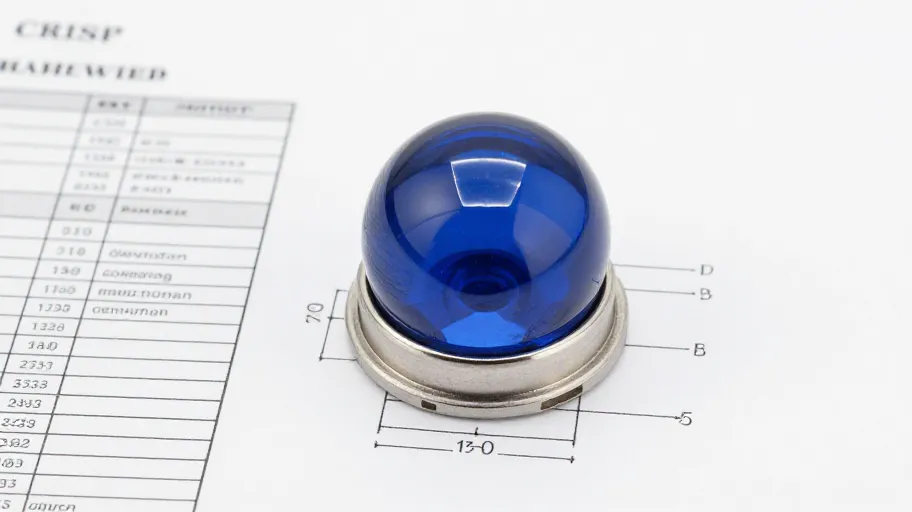
Turning buyer requirements into a clear RFQ for domed sapphire watch glass starts with separating five spec families — Curvature, Reference dimensions, Interface, Surface treatment and Production evidence — the CRISP framework. Define each in writing, attach a drawing, and confirm the supplier's current policies before requesting a quote.
What "domed" means in a sourcing document
In a sourcing context, "domed" is not one geometry. It can describe a continuous spherical rise across the crystal face, a raised centre with a flatter rim, or a compound curve that follows the watch bezel. Suppliers interpret vague phrases differently, and each interpretation changes machining approach, edge treatment and how the finished part is measured.
Before drafting the RFQ, document which geometry family you need, and how it will be verified. That documentation — not adjectives — is what makes a comparison between suppliers meaningful.
Flat vs domed: a comparison for the sourcing decision
| Criterion | Flat sapphire crystal | Domed sapphire watch glass |
|---|---|---|
| Drawing definition | One primary plane plus thickness | Requires base curve, dome height or radius, and edge profile |
| Measurement complexity | Fewer reference points | Needs agreed measurement points for curvature and centre height |
| Interface risk | Gasket seat defined mainly by diameter and thickness | Gasket seat, side wall and dome transition must all be specified |
| Design intent | Slim, instrument-like dials | Vintage feel, reflected-light character, hand clearance |
| RFQ effort | Lower | Higher — geometry section dominates the enquiry |
| Approval focus | Thickness, diameter, finish | Curvature consistency, edge profile, optical distortion zones |
Neither form is inherently superior. The decision is a design and documentation trade-off, and the domed option simply demands more precise geometry communication. Frame your RFQ accordingly.
The CRISP framework: five spec families to write down
C — Curvature. State the dome form (spherical radius, centre bulge or compound curve), the reference plane it rises from, and the measurement points you will use at approval. Ask: "Which points will you measure to confirm curvature, and will you document them?"
R — Reference dimensions. Nominal diameter, thickness at centre, thickness at edge, and height of the dome above the gasket plane. Avoid embedding numerical tolerances in the first enquiry if they are still assumptions; instead ask, "What tolerance range can you hold for each of these dimensions, and what evidence do you provide?"
I — Interface. How the crystal seats: gasket fit, tension ring, adhesive seat, or press fit. Define the seat diameter and edge geometry. Ask: "Which edge profile options do you offer, and how should the interface be drawn to avoid ambiguity?"
S — Surface treatment. State whether you need anti-reflective coating, and on which faces, plus polish level and any colour or tint intent. Coating naming varies between suppliers, so describe the function you want and ask, "How do you designate and verify your coating options?"
P — Production evidence. Request the documentation you require for approval — inspection methods, measurement reports, first-article confirmation. Ask: "What inspection documentation accompanies a first article, and can it be tailored to my drawing?" Do not assume any certification or test result exists; ask for current evidence and confirm the current policy directly.
Packaging the RFQ
A supplier can only quote as precisely as the enquiry. Include:
- A dimensioned drawing marking the curvature definition and measurement points
- The CRISP fields completed as far as your design allows, with open questions flagged
- Case, dial and hand clearance context where relevant to dome height
- Your approval stages: drawing sign-off, first article, series confirmation
- A request for the supplier to state which items they cannot meet, rather than defaulting to acceptance
For quantities, schedules, sampling arrangements and terms, ask the supplier to state their current position in their response. Confirm the current policy directly.
Approval-stage checklist
- Drawing signed off, curvature definition and measurement points agreed in writing
- Supplier has stated the tolerance ranges it can hold for diameter, centre thickness, edge thickness and dome height
- Interface (gasket, tension ring or adhesive seat) drawn and confirmed
- Surface treatment and coating designation documented by the supplier
- Inspection and first-article documentation scope agreed before production
- Any item the supplier cannot meet is recorded, not silently omitted
- Quantities, sampling, terms and schedules confirmed in the supplier's own written response
FAQ
Do I need a full drawing before requesting a quote for domed sapphire watch glass? A dimensioned drawing with the curvature definition produces the most useful response. If your drawing is incomplete, send what exists and flag open items — a curvature review can help close gaps before quoting.
How should I specify the dome itself? Give a spherical radius, a centre-height-over-reference-plane value, or a compound-curve description, plus the measurement points you will use at approval. Whichever you choose, keep it consistent between drawing and text.
What if my tolerance expectations are tighter than the supplier can hold? Ask the supplier to state achievable ranges per dimension rather than assuming them. Then either adjust the design, relax the tolerance, or compare suppliers on documented capability.
Can I compare flat and domed options in one RFQ? Yes. Ask both to be quoted against the same case and dial context so the comparison reflects real interface differences, not spec gaps.
What documentation should accompany a first article? Agree this before production: measurement points for curvature, thickness reports, and surface-finish confirmation as applicable. The supplier should confirm what it can provide.
Next step
Request a curvature review — send your drawing or sketch and have the geometry, reference dimensions and interface reviewed before you commit to a full RFQ. It is the fastest way to turn a design intent into a quotable specification.
Prefer to start smaller? Use the approval-stage checklist above as your RFQ template and confirm each item in writing with your supplier as you go.