
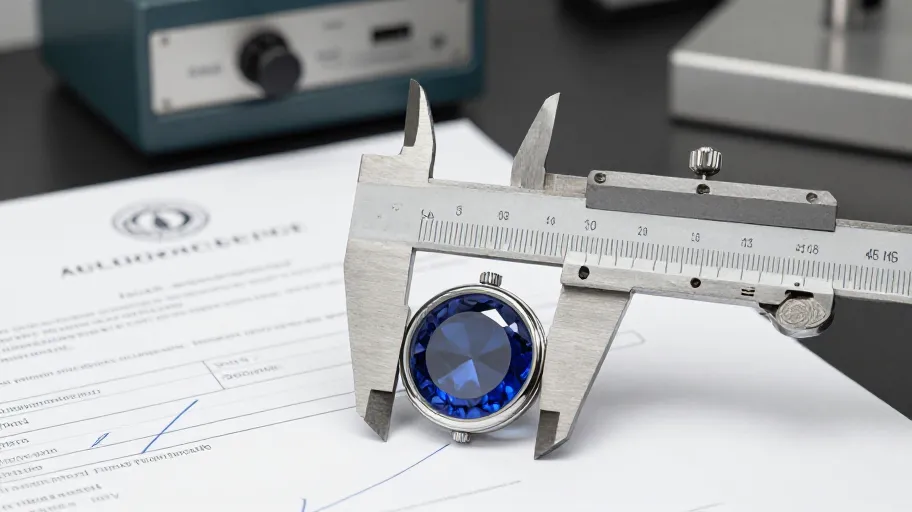
Before you sign off on a custom sapphire watch crystal order, hold evidence in four areas: dimensional agreement with your case, material verification, process and inspection documentation, and written commercial terms. The Evidence Gate Framework below turns each area into a gate you can pass or fail on paper — before tooling, before deposit, before disputes.
Why sign-off needs evidence, not reassurance
A custom sapphire watch crystal is not a catalogue part. It is cut, ground and finished against your case geometry, your dial height, your bezel tolerance stack and your assembly method. That means the supplier cannot "guarantee" fit in the abstract; fit is proven by documents that tie the part to your drawing. The same logic applies to material grade, coating behaviour, and the commercial terms around samples and revisions.
Most sourcing problems at this stage are not caused by bad suppliers. They are caused by approvals given on the basis of a quotation and a conversation, with the technical evidence never written down in a form either party can check later. The Evidence Gate Framework exists to close that gap.
The Evidence Gate Framework
The framework splits approval into four gates. Each gate has a question it answers and an artefact it should produce. If a gate produces no artefact, the gate has not been passed.
Gate 1 — Dimensional evidence. The artefact is a supplier-acknowledged dimension sheet or marked-up drawing: your case reference, crystal diameter or shape, thickness, bevel or step geometry, crown height if domed, and how each dimension will be measured. Ask the supplier to state which dimensions they will inspect on every batch and which they will verify only at first article. Do not accept a numeric tolerance claim in conversation; ask where that tolerance is written and how it is verified.
Gate 2 — Material evidence. The artefact is documented material identification for the sapphire itself — the orientation of the crystal plane where it matters for your application, and any coating or treatment applied to the surface, described in writing. If a supplier mentions a coating, ask for a written description of what the coating is specified to do and how conformance is checked. Statements about hardness or scratch resistance belong in your file only when tied to a test method and a documented result for your actual part, not for sapphire in general.
Gate 3 — Process and inspection evidence. The artefact is an inspection regime: what is measured, with what equipment class, at what point in production, and what happens when a part fails. Ask for the first-article process explicitly — what you receive, in what documented form, and what you are expected to approve before series production begins. Also ask how batch traceability works if you need to investigate a field issue later.
Gate 4 — Commercial evidence. The artefact is a written record of the terms you actually care about: sample policy, MOQ for your specific part, revision charges, tooling ownership, and lead-time commitments tied to a defined specification revision. None of these can be assumed; every one is project-specific and must be confirmed in writing with the supplier before sign-off. Where any term is unclear, the correct move is to ask for it in the quotation document, not to infer it.
Evidence decision table
| Evidence category | Decision it supports | Artefact to hold before sign-off | If the artefact is missing |
|---|---|---|---|
| Dimensional | Approve geometry for tooling | Supplier-acknowledged drawing or dimension sheet with inspection method per critical dimension | Do not release tooling; request written dimensional plan |
| Material | Approve sapphire grade and plane orientation | Written material specification naming orientation and any surface treatment | Request a specification sheet tied to your part number |
| Coating / surface | Approve optical treatment | Written description of coating purpose and conformance check | Treat coating as unapproved until documented |
| Process / inspection | Approve first article and series release | First-article process description and inspection regime | Hold series approval until process is on paper |
| Commercial | Approve order placement | Quotation stating sample policy, MOQ, revisions, tooling terms for this project | Confirm each term directly before any commitment |
Approval questions to put in writing
These questions are deliberately phrased so that only project-specific answers are valid. Any answer that comes back as a generality is a signal to ask again, in writing.
- Which dimensions on our drawing will you inspect on every production batch, and with what measurement method?
- What crystal plane orientation will be used for this part, and where is that recorded?
- If we specify a coating, what does your documentation say it does, and how do you verify conformance on our parts?
- What does your first-article submission include, and what do you need from us to consider it approved?
- What is your current sample policy, MOQ and revision charge for this specific part — confirmed in writing?
- Which specification revision does your quotation reference, and how are changes controlled after sign-off?
Keep the answers attached to the project file. If a later batch dispute arises, the file — not memory — is what settles it.
What to keep after sign-off
Retain: the acknowledged drawing, the material specification, the inspection regime, the first-article record, and the quotation with its commercial terms. Together these form the baseline against which you receive goods and resolve any disagreement. They also make your next custom sapphire watch crystal project faster, because the evidence structure already exists and only the geometry changes.
FAQ
Do I need a full technical drawing, or is a dimension sheet enough to start? A dimension sheet with case reference and critical dimensions is enough to open a technical conversation; a full drawing becomes necessary before tooling. Submit what you have and let the supplier identify what is missing.
How do I verify a supplier's sapphire material claim? Ask for written material identification tied to your part, including crystal orientation, plus any test documentation referenced to your actual component. Confirm current documentation directly rather than relying on general material descriptions.
What should I check before approving a first article? Check the first article against the acknowledged drawing with your own measurement where possible, confirm the inspection report matches the agreed regime, and record your approval against a named specification revision.
How do I compare two custom sapphire watch crystal suppliers fairly? Give both the same drawing and ask both the same written questions from the Evidence Gate Framework. Compare artefacts, not adjectives: which supplier documents dimensions, material, process and terms more completely for your specific part.
Who should hold the sign-off evidence internally? Nominate one owner — in sourcing or product development — who holds the file and gates revisions. Approvals scattered across email threads are the most frequent cause of mismatched expectations.
Next step
If you have a drawing, a dimension sheet, or even a partially defined geometry, submit it to JadeZone Sapphire for technical review. The team will tell you what evidence is needed to move your custom sapphire watch crystal from enquiry to approval.
[Submit a drawing or dimension sheet]
Prefer to prepare first? Work through the four gates in the decision table above and list the answers you already hold. That one-page checklist makes your submission faster and your first technical exchange more productive.