
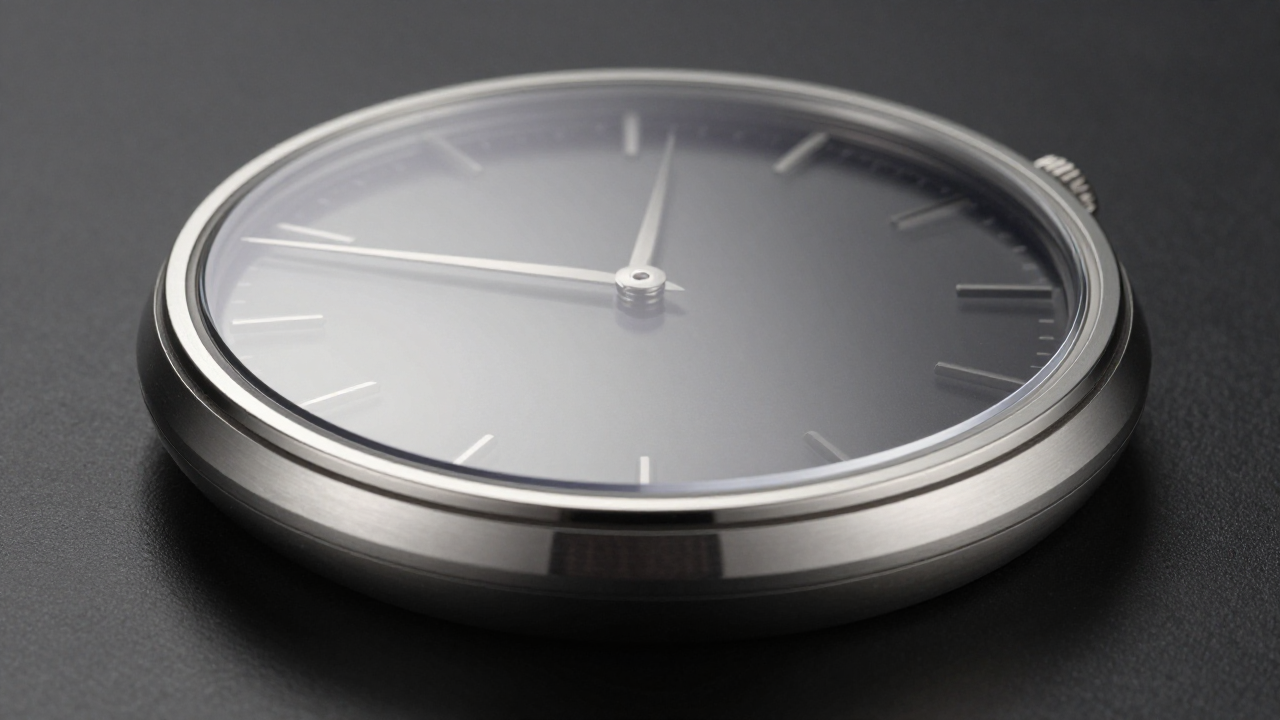
Yes on scratches, no on impact. A sapphire watch crystal measures Mohs 9 and roughly 1,900–2,200 Vickers, so keys, beach sand, and car-door scrapes leave nothing behind. Mineral glass sits at Mohs 5.…
5 and hazes over within 6 to 18 months of daily wear. Sapphire chips where mineral glass dents.
Do Sapphire Crystals Actually Outperform Mineral Glass in Real Wear?
That flip side catches people. Sapphire is a single crystal of aluminum oxide, and single crystals are brittle. Mineral glass and acrylic deform under a hit. Sapphire reaches its fracture point and lets go. Anyone who has heard a 1.2 mm domed crystal pop off a doorframe at 30 mph remembers the sound.
Two numbers worth keeping. Uncoated sapphire reflects about 15% of visible light across both surfaces, which is why a bare crystal over a black dial reads slightly gray from an angle. Double-sided anti-reflective coating drops that under 1% — and tints whatever reflection remains, usually blue, sometimes green or purple. That tint is not cosmetic trivia. Put a purple-AR crystal over a silver dial and the watch looks cold at the counter. We've watched a brand push a launch date four weeks over exactly that.
Where mineral glass still wins: cost, and impact absorption. On a $99 kids' watch or a gym beater, a hardened mineral lens is the rational pick. Above $300 retail, it stops being rational.
Which Sapphire Watch Crystal Type Wins at Your Price Point?
Match the crystal to the case, not to the price tag. Flat double-AR sapphire fits 34–42 mm cases under $500 retail. Double-domed box sapphire belongs on dress and vintage-style pieces above $800. Edge-armored domed sapphire is the only sane choice for dive and field watches rated past 200 meters.
The table below reflects volume quotes we've issued and received between Q3 2025 and Q1 2026, in USD, at 5,000-piece runs. Small runs of 300–1,000 pieces typically add 35–60% to unit cost.
Notice the fracture toughness column. The material value is the same for all three sapphire options, which is the point most buyers miss. You are not buying a tougher crystal when you upgrade to edge-armored. You are buying a different edge.
What Actually Kills a Sapphire Crystal in the Field?
Installed failure rate — how many crystals chip or crack between press-fit and the 90-day mark — is the metric that predicts warranty cost, and almost no spec sheet lists it. Lab hardness data tells you nothing about a crystal pressed into a case at 40 pounds of force against a rubber gasket.
Here is the case that taught us this. In August 2022, a dive-watch company in Bellingham, Washington shipped 1,200 units of a 300-meter diver. By January 2023 their warranty claim rate hit 6.1%, and nearly every claim was a chip along the bezel edge. Not one scratch. We pulled six returned units and measured the chamfers. The spec drawing called for a "sharp break" edge. The case had been designed around a 0.15 mm × 0.15 mm chamfer at 30 degrees. Press-fit interference was running 0.045 mm, well inside tolerance, but hoop stress concentrated at a 90-degree corner behaves nothing like hoop stress on a chamfer. Redrawing the crystal with the intended chamfer took the next production run's claim rate to 0.7%.
Water resistance lives in the gasket, but crystal flatness decides whether the gasket can seal. A crystal with 0.03 mm of warp will weep at 10 ATM even with a perfect gasket. ISO 22810:2010 gives you the test method; it does not give you a flatness tolerance. Ask your supplier for the wavefront number in wavelengths. If they cannot produce it, they are not measuring it.
The second silent failure is the coating. In November 2021, a brand in Chicago started getting returns at month 14 — iridescent blotches spreading across the crystal, visible only at certain angles. The coating had been applied by plain e-beam deposition in a chamber that had not been properly sealed between runs. Ion-assisted deposition, where an ion beam densifies the film as it lands, costs about $1.80 more per crystal at volume. It roughly triples coating life. Our Shenzhen plant moved every AR line to ion-assisted deposition in 2019 after losing a 9,000-piece order to delamination, and I would not quote a coated crystal any other way now.
One more thing nobody benchmarks: hydrophobic top coats. They make fingerprints wipe off, and they are gone in 6 to 12 months. Do not put a hydrophobic claim in your marketing copy unless you want to field that question in year two.
How Do You Switch Suppliers Without Blowing Up Your Launch?
Treat a supplier switch like a re-tooling, not a re-order. Budget 8 to 14 weeks and $3,000 to $9,000 in NRE for a domed crystal, because dome radius, chamfer geometry, AR tint, and edge polish all have to be re-matched to your case CAD before a single production unit ships.
Five things belong on the spec drawing, and most brands send us three of them:
That last one is where cheap crystals give themselves away. Sapphire is birefringent — refractive index 1.76–1.77 with a birefringence of about 0.008 — and a crystal cut 2 or 3 degrees off-axis will show a faint double image on a printed dial under direct light. Most wearers never notice. Collectors notice immediately, and they post about it.
There is a US-specific cost layer here too. Since the Section 321 de minimis exemption closed for China-origin shipments in May 2025, small US brands that used to air-freight 300-piece runs duty-free now pay full landed cost on every batch. Landed cost on a Chinese-made sapphire crystal has moved 8–15% since 2024 depending on classification. If you also stamp "American Made" on the caseback, read the FTC's standard before you do — the rule covers significant parts, and an imported crystal is a significant part.
Which Sapphire Crystal Should You Pick?
If you build sub-$500 tool watches at 2,000-plus units a year, spec flat sapphire with double-sided AR and spend your remaining budget on a proper chamfer. If you are a microbrand doing 300-piece runs of a dress watch, pay for double-domed box sapphire — customers at that price point are buying the dome, and they will touch it.
If you are on a dive watch rated to 300 meters, edge-armored domed sapphire, no debate. If you are shipping sub-$150 watches into a big-box channel, hardened mineral glass is honest, serviceable, and saves you $4 to $28 per unit that you can put into the movement instead. And if your retail price sits between $400 and $700, you are in the awkward middle: flat sapphire with excellent coating beats a mediocre dome every time, because buyers notice haze and blotches long before they notice curvature.
Frequently Asked Questions
How long does a sapphire watch crystal last?
A well-made sapphire watch crystal lasts the life of the watch. The material itself does not degrade — Mohs 9 does not wear down from fabric or sand. The anti-reflective coating on top is the first thing to go, typically showing haze or iridescent blotches at 18 to 36 months of daily wear.
Is a sapphire watch crystal worth the extra cost?
Above roughly $300 retail, yes. A sapphire watch crystal adds $4 to $30 to your bill of materials and removes the most common cosmetic warranty claim on a watch. Below $150 retail, hardened mineral glass is defensible, especially on a watch buyers treat as a beater.
How much does it cost to replace a sapphire watch crystal?
Expect $90 to $350 at a US service center, including labor and pressure testing. The crystal part itself runs $8 to $45 depending on dome geometry. What moves the bill is whether the case needs full disassembly, which adds about two hours of bench time.
How can you tell whether a watch crystal is real sapphire?
Tap it. Sapphire gives a sharp, high-pitched click; mineral glass sounds duller. Breathe on it and sapphire sheds the fog in about one second while mineral glass takes three or four. A jeweler's diamond tester works too, since sapphire and diamond sit close together on thermal conductivity.
Can a sapphire watch crystal scratch?
Almost never from normal wear, but diamond, silicon carbide, and tungsten carbide will cut it. Beach sand is mostly quartz at Mohs 7 and cannot touch sapphire. A tungsten wedding band dragged across the crystal, however, will leave a visible line you cannot polish out.