
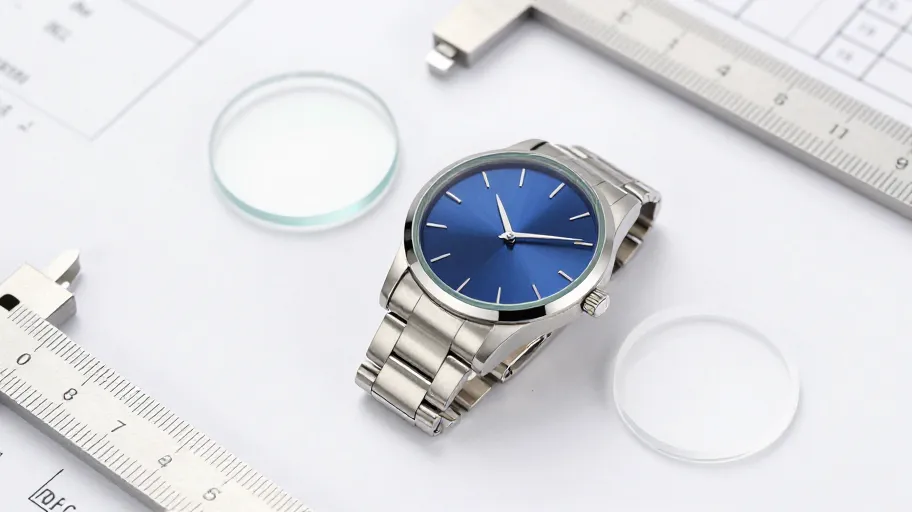
A sapphire crystal watch is more expensive than watches with alternative crystals, but for a buyer the real question is what drives the price of your specification: geometry, coating, finishing and approval rework — not the material alone. Control cost by locking specifications, verifying through samples, and gating release on documented approval.
What the question means for a sourcing manager
If you are a consumer comparing two finished watches, "is a sapphire crystal watch expensive?" is a price-tag question. If you are a watch brand, component buyer or product developer, it is a specification question. The same blank of synthetic sapphire can become a modest commodity component or a precision-engineered, multi-process part depending entirely on decisions you make — or fail to make — before the first quote.
That distinction matters because most cost surprises in sapphire crystal sourcing do not come from the raw material. They come from:
- Undefined specifications that get re-quoted mid-project after first articles.
- Acceptance criteria that were never written down, so every inspection becomes a negotiation.
- Rework loops where a crystal fails assembly or aesthetic review for reasons the drawing never addressed.
The way to answer "is a sapphire crystal watch expensive?" is therefore not to look for a cheaper supplier first. It is to make your specification precise enough that any quote you receive is comparable, and your approval process tight enough that the quoted cost is the delivered cost.
The Spec–Sample–Approve framework
Use a simple three-gate framework — Spec–Sample–Approve (SSA) — to keep sapphire crystal cost under control:
- Spec gate. Write the drawing and acceptance criteria before requesting a quote. Every geometry feature, coating, surface treatment and edge finish must be a documented decision, not a supplier default.
- Sample gate. Verify the spec against physical samples, inspected against the written criteria — dimensionally, optically and in your actual case and movement environment.
- Approve gate. Freeze the specification, record the approved sample as the reference standard, and document the inspection method for every future lot.
The framework does not make sapphire cheap. It makes the cost knowable — which is what a sourcing manager is accountable for.
Decision table: where crystal cost actually lives
Each row below is a decision you own. Verify each one against your product requirements and confirm with your supplier how it affects the quotation.
| Cost lever | Decision you must make | Verify before quoting | Approve only when |
|---|---|---|---|
| Crystal geometry | Flat, domed, double-domed or compound curve | Which geometry your case design actually requires | Drawing states geometry unambiguously |
| Coating | Anti-reflective coating: none, one side, both sides | Whether coating is cosmetic or functional for the product | Coating scope, side and inspection method are in writing |
| Edge treatment | Edge profile and finishing method | How the crystal seats in your case or bezel | Edge profile is dimensioned on the drawing |
| Surface finish quality | Polish and optical clarity acceptance level | What your brand's visual standard requires | A boundary sample is agreed as the reference |
| Dating / printing | Logos, markings, or indices on the crystal | Whether decoration is on the crystal or dial side elements | Printing method, position and adhesion test are specified |
| Dimensional acceptance | Fit tolerances into your case, gasket and movement | What your assembly process can absorb | Tolerance and measurement method are confirmed by the supplier in writing |
None of these rows has a universal answer, and none of them should inherit an assumed default from a supplier. Each one is a documented choice that either stabilises or inflates the final cost of the watch.
Specifications that move cost — as questions, not assumptions
Because no project-specific pricing, dimensional tolerance, lead time or capacity data was supplied for this article, treat the following as questions to put to your supplier rather than facts:
- Which crystal geometries can you produce in-house, and which are subcontracted?
- What dimensional tolerance can you hold for this specific drawing, and how is it measured?
- What anti-reflective coating options do you offer, and how is coating quality inspected?
- What surface-finish acceptance standard will you commit to in writing?
- What is your process for first-article approval, and what documentation accompanies it?
- How do you handle a lot that fails the agreed acceptance criteria?
Confirm the current policy directly on any question about samples, fees, shipping arrangements, minimum order quantities or timelines. Do not accept verbal answers on these points; ask for them in the quotation document.
The sample and approval gate
The sample stage is where cost certainty is won or lost. A disciplined approval sequence looks like this:
- Request samples against the frozen drawing, not against a verbal description.
- Inspect against written criteria — dimensional fit in the actual case, optical clarity against the agreed standard, coating performance as specified, edge finish against the boundary sample.
- Test in the real product environment: case assembly, gasket seating, hand clearance, and any sealing or pressure requirements your watch carries.
- Record the approved sample as the physical reference standard for all future production, with the inspection method attached.
- Document the escalation path if a future lot deviates from the approved reference.
Concrete approval questions to close before releasing any order:
- Has the supplier confirmed in writing which dimensional tolerances apply to this part?
- Is the approved sample physically retained by both parties as the reference standard?
- Is the inspection method for each acceptance criterion documented and repeatable?
- Has the supplier stated how deviations from the approved sample are handled?
- Are all sample, fee, shipping and order policies confirmed in the current quotation? (Confirm the current policy directly.)
Crystal sourcing approval checklist
Work through this checklist before approving any sapphire crystal supplier — including us. It is free to use and requires nothing beyond your own product documentation.
- Drawing issued with geometry, edge profile and acceptance criteria defined
- Coating scope and inspection method documented
- Supplier has confirmed tolerances and measurement methods in writing
- Samples inspected against written criteria, not verbal description
- Crystal tested in the actual case, gasket and movement environment
- Approved sample retained as reference standard by both parties
- Deviation and escalation path documented
- All commercial policies confirmed in the current quotation
If you can tick every box, you have answered the cost question for your project — whatever the material costs, you will know it before you commit.
Frequently asked questions
Is a sapphire crystal watch expensive compared with other crystal types? Sapphire sits at the upper end of watch crystal materials in cost, and for good engineering reasons: hardness, scratch resistance and optical clarity. But the meaningful comparison for a buyer is between suppliers quoting the same specification. Normalise the drawing first, then compare.
What part of a sapphire crystal quotation is negotiable? Nothing should be negotiable after approval — that is the point of the SSA gates. Everything is negotiable before specification: geometry, coating scope, finishing level and acceptance criteria all trade against cost. Negotiate the spec, then freeze the spec.
How do I compare two sapphire crystal suppliers fairly? Give both the identical drawing and acceptance criteria, ask both to state tolerances, measurement methods and inspection documentation in writing, and evaluate both sets of first articles against the same checklist. A quote that omits tolerance commitments is not comparable to one that includes them.
What should I do if a delivered lot does not match the approved sample? Refer to the deviation and escalation path you documented at the approval gate. This is why the approved sample and inspection method must be retained by both parties — the reference standard, not memory, settles the question. Confirm the current policy directly for handling of any specific lot.
Do I need to specify coatings and edge treatments, or can the supplier decide? You should decide. Supplier defaults become your cost and your quality risk. Each unspecified element is an open door to re-quoting, rework and inconsistency between lots. Document every choice before the first quote is requested.
Get the sourcing brief
The fastest way to control sapphire crystal cost is to walk into the first supplier conversation with the specification and approval questions already structured. 获取采购 Brief — request the JadeZone Sapphire sourcing brief and use it to frame your spec, sample and approval gates before you compare any quotation.