
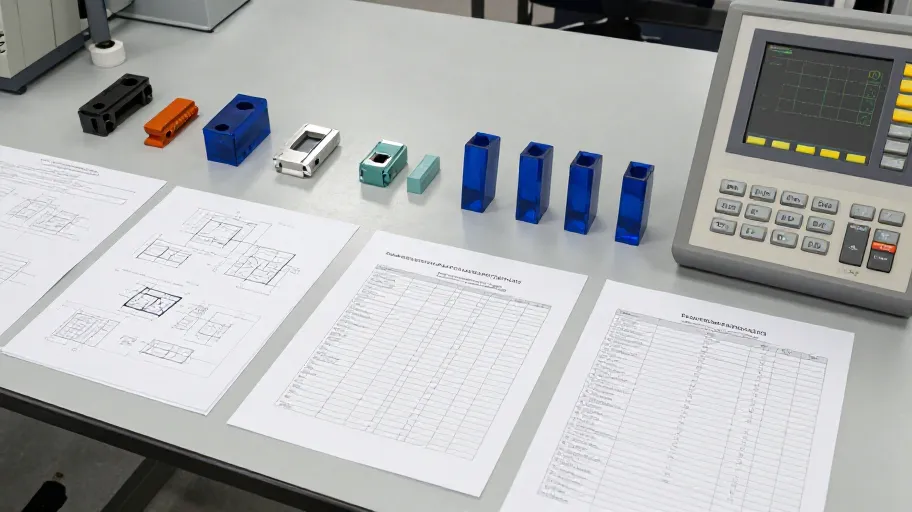
A credible sapphire crystal manufacturer is judged on evidence, not claims: verify process capability against your drawing, confirm how artwork and geometry are locked before tooling, inspect their control documentation, and test their revision discipline during quoting. Use the CAPA framework below to score every candidate before approving tooling spend.
Why evaluation method matters more than supplier claims
Every sapphire crystal manufacturer will tell you they can produce your part. The question is whether they can prove it in a way you can audit. In a private-label project, your brand carries the warranty exposure while the supplier holds the process knowledge. That asymmetry is the real risk, and it is manageable only if you evaluate with structured questions rather than impressions from a sales call.
This article gives you a repeatable method. It does not tell you what any specific supplier offers — pricing, sample terms, lead times and tolerances are all project-specific facts you must confirm in writing with each candidate. Treat that as a feature of the method: a supplier's willingness to answer precisely is itself a data point.
The CAPA framework
C — Capability. Can this manufacturer actually produce your geometry, coating and finish at the volumes your launch requires? Capability is not a logo wall or a machine list; it is the ability to show how your specific part will be processed, inspected and held to the drawing you issued.
A — Artwork-to-tooling alignment. Custom crystals fail when a drawing, CAD file or coating note is interpreted differently on each side. Alignment means there is a documented, signed interpretation step between your specification and their tooling.
P — Process control. Ask how the supplier controls variation between the first article and mass production: measurement methods, inspection points, how out-of-spec parts are contained, and what records you receive with each shipment.
A — Approval discipline. How are revisions handled? Who signs off a drawing change, a coating change or a re-run? Weak approval discipline is the most expensive hidden defect in private-label projects, because it surfaces after tooling exists.
Decision table: qualifying vs. disqualifying signals
| Evaluation area | Qualifying signal | Signal to investigate or walk away from |
|---|---|---|
| Technical review | Supplier questions your drawing before quoting | Quotes immediately without querying geometry, coatings or fit |
| Drawing control | Offers a signed drawing or spec freeze step | Works from informal chat messages with no version control |
| Inspection | Explains measurement methods and what records ship with lots | "We check every piece" with no method, sampling or documentation |
| Revisions | Has a written change-request and re-approval process | Verbal changes accepted directly on the line |
| Documentation | Provides evidence of relevant certifications when asked and confirms current scope | Vague references to certificates that never arrive in writing |
| Communication | Precise, written answers during quoting | Answers drift, deadlines in replies slip repeatedly during the sales phase |
| Traceability | Can describe how a defective lot would be traced and contained | No idea how a complaint would be isolated to a batch |
| Samples and terms | States current sample, cost, shipping and production policies clearly in writing | Policies change depending on who you ask, or are avoided |
For any policy row above, the rule is simple: confirm the current policy directly, in writing, from the supplier before making commitments.
Concrete approval questions by project stage
During supplier screening:
- Which of our part features drive your process risk, and why?
- What measurement method will you use for each critical feature on our drawing?
- What inspection records will accompany each production lot?
- How do you contain and report an out-of-spec batch discovered after shipment?
- Can you describe the documentation you hold that is relevant to our destination market's requirements?
Before tooling:
- Who on your side signs the frozen drawing, and who on ours do you recognise as the approval authority?
- If we change a dimension or coating after tooling exists, what is your documented change process?
- What first-article approval gate exists before production runs?
During quoting:
- What assumptions does your quote make about volume, packaging, finishing and freight responsibility — stated explicitly so quotes are comparable?
- What are your current sample, cost, shipping and production policies for a project of our profile? Confirm the current policy directly.
Pre-production:
- Can we witness or receive photographic/video evidence of first-article inspection?
- What ongoing certificates or test summaries accompany repeat orders?
Documentation to request
Ask each candidate to state which of the following they can provide today, and to send current evidence:
- Material composition documentation for the sapphire and any coating
- Relevant quality-management certification, with current scope stated in writing
- Coating process description relevant to your specified finish
- First-article inspection reports matched to your drawing features
- Lot-level inspection summaries for production shipments
- Packing, marking and traceability scheme
A supplier's answer to "which of these can you send this week?" is more informative than any brochure.
Comparing suppliers honestly
If you are evaluating manufacturers in Shenzhen and Hong Kong, resist ranking by region. Cluster advantages differ supplier by supplier, and your decision should rest on the CAPA evidence, written policies and communication discipline you documented — not on geography. Score at least two or three candidates with the same question set so comparisons are like-for-like.
Pre-qualification checklist
- Supplier reviewed and questioned our drawing before quoting
- Measurement method stated for every critical feature
- Signed spec-freeze step agreed before tooling
- Written change-request and re-approval process confirmed
- Inspection documentation scope defined per lot
- Current sample, cost, shipping and production policies confirmed in writing
- Traceability and containment process described
- Certification evidence requested and scope stated
FAQ
How many sapphire crystal manufacturers should I evaluate before shortlisting? Score at least three candidates with the identical CAPA question set. The number matters less than comparability: same questions, same documents requested, same written answers, so your scoring reflects the suppliers rather than the conversations.
What is the single most important evidence to request? A matched pair: the frozen drawing or spec they will build to, and the inspection method and records that prove conformance to it. Tooling without that pairing is where private-label projects accumulate silent risk.
Should I visit the factory before approving tooling? If the project scale justifies travel, a visit lets you verify what documents alone cannot — housekeeping, measurement equipment actually in use, and how staff handle a live change request. If travel is not practical, request live video walkthroughs and first-article inspection evidence. Either way, document what you saw.
How do I compare quotes from different suppliers? Ask each supplier to state their quote's assumptions in writing: included processes, packaging, freight responsibility, and revision handling. Two numbers are meaningless until the assumptions behind them match. Confirm the current policy directly on every assumption.
What if a supplier avoids answering policy questions during quoting? Treat it as a leading indicator. The quoting phase is when a supplier is most attentive; ambiguity here about samples, costs, shipping or production terms rarely improves after a deposit. Either obtain written clarity or continue evaluating other candidates.
Score the suppliers, not the promises
Evaluating a sapphire crystal manufacturer for a private-label project comes down to evidence you can file: signed specs, stated measurement methods, documented change control and written policies. Download the Supplier Scorecard to run every candidate through the same CAPA criteria and record the answers that will protect your brand long after the tooling is cut.
Just starting? Use the pre-qualification checklist above in your next supplier email — it takes one message and immediately shows which manufacturers respond with precision.