
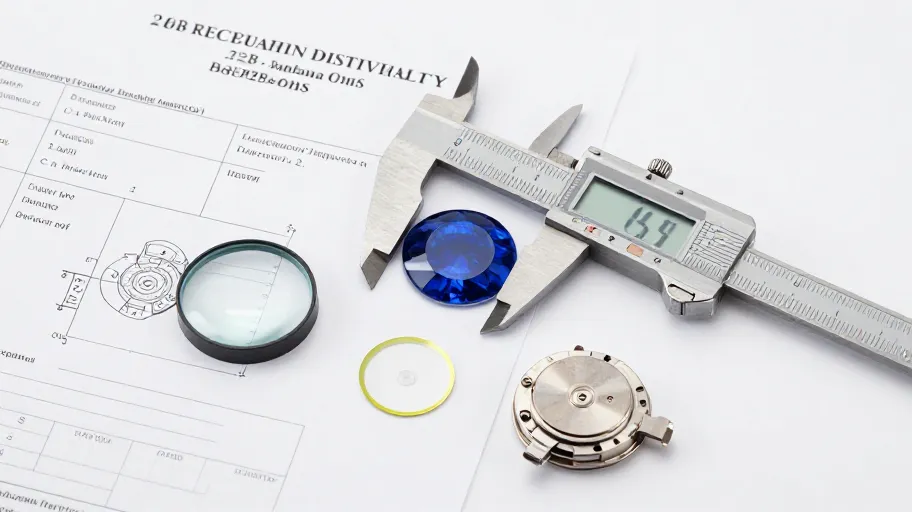
There is no single answer to "how much does it cost to replace a sapphire watch crystal?" in a B2B context, because a replacement crystal is quoted against your specifications: geometry, coating, finish, quantity and approval protocol. Cost is settled by a documented spec package and a supplier quotation you verify and approve — not by a published rate.
Why the consumer framing of this question misleads B2B buyers
Most search results for this question address a walk-in repair customer replacing one crystal on one watch. That is a different job from yours. If you are a watch brand, component buyer, product developer, sourcing manager or watchmaker sourcing custom or OEM sapphire crystals, the cost question has three layers:
- Unit economics — what each crystal costs at your volumes, against your drawing.
- Project costs — sampling, tooling, inspection and approval steps that sit outside the unit price.
- Risk costs — what a spec mismatch or rushed approval costs in rework and schedule.
A single-number answer from the internet cannot cover these layers. What you can do — and what this guide helps you do — is build a quotation input package so that every supplier prices the same object, and so you can compare, verify and approve with evidence.
The S-C-A-R.E. Check: a framework for crystal cost drivers
Use this framework when preparing an RFQ or evaluating a quotation:
- S — Specs. Diameter, thickness, doming, edge geometry, hole or date-window cut-outs, printing or indices. Every open dimension is a place where two suppliers will assume different things and return different prices. Ask each supplier to quote against your written drawing, and ask what dimensions they will hold and how they verify them.
- C — Crystal geometry. Flat, domed, double-domed, box or stepped profiles differ in material removal, polishing time and yield. Complex geometry is not "expensive" in the abstract — it changes processing steps. Ask the supplier which geometry features drive their process and cost model for your part.
- A — AR coating. Whether you specify coating, coating on one or both faces, and how coating adhesion and performance are tested and documented. Confirm what test evidence the supplier can provide for your specified coating, and how it is approved before volume production.
- R — Requirements for approval. Define first-article inspection, dimensional reports, visual inspection criteria and coating verification before mass production. An explicit approval protocol prevents the most expensive failure: discovering a mismatch after tooling is cut.
- E — Evidence. Ask for the documents you need: inspection reports, process capability statements the supplier can stand behind, and sample sign-off records. Evidence converts a price into a defensible decision.
- Check — Confirm commercial terms directly. Sample policy, tooling terms, MOQ, lead time, packaging and shipping must all be confirmed with the supplier in writing. No article — including this one — can state these for you.
Decision table: specification choices and what to confirm
| Decision point | Options to consider | What it affects | What to confirm with the supplier |
|---|---|---|---|
| Crystal geometry | Flat, domed, double-domed, box, stepped | Polishing complexity, material yield, cycle steps | Which features drive their process cost for your drawing |
| Surface finish | Polished faces, edge finish, facet quality | Inspection criteria, yield | Finish standards and how they are inspected and approved |
| Coating | Uncoated, single-side AR, double-side AR | Additional process steps, testing | Coating test methods and documentation available |
| Features | Date windows, holes, printed markers | Machining and printing steps | Feasibility review of your drawing before quotation |
| Quantities | Prototype run, pilot, production volume | Unit economics, tooling approach | MOQ and volume breakpoints — confirm current policy |
| Samples and approval | First article, dimensional report, visual sign-off | Project timeline and risk | Sample policy, costs and approval sequence — confirm in writing |
| Logistics | Packaging, incoterms, shipping method | Landed cost | Who arranges and pays for shipping — confirm directly |
Samples, approval and evidence: the part of "cost" buyers forget
The cost of a replacement crystal program is not only the per-piece price. Sampling and approval are where budgets are protected or lost. Before releasing any order, work through this checklist:
Approval checklist
- Written drawing released to supplier with revision number
- Supplier has confirmed every feature is manufacturable as drawn
- Critical dimensions and inspection method agreed in writing
- Coating specification, test method and acceptance criteria documented
- First-article samples approved and signed off by your team
- Visual inspection criteria (defect classes, viewing conditions) agreed
- Sample policy, tooling terms, MOQ, lead time and shipping confirmed directly with the supplier
- Change-control process agreed: what happens if a later revision changes geometry
None of these steps has a universal price or timeline. Each is a project-specific term to confirm with your supplier before you commit.
Concrete approval questions to put to any supplier
- "Please quote against drawing revision X. Which dimensions will you hold, and how will you verify them?"
- "What is your sampling sequence for a new crystal, and what do you need from us to start it?"
- "What coating test evidence can you provide at sample stage, and what acceptance criteria do you propose?"
- "If first articles do not meet the agreed criteria, what is your correction process?"
- "What are your current terms for samples, tooling, MOQ, lead time and shipping — and where are they documented in the quotation?"
- "Who signs off the approval record on your side, and who is our escalation contact?"
These questions do not presume any answer. They force the commercial and technical unknowns into writing, which is the only place a cost can be verified.
FAQ
Does an original equipment crystal cost less to replace than a custom one? It depends. An OEM replacement for a known reference may reuse existing tooling, while a custom crystal requires quotation against your drawing, sampling and approval. Confirm with your supplier which case applies to your project and how each is priced.
How do I compare quotations from different sapphire crystal suppliers? Release the same drawing revision and the same approval protocol to every supplier, and ask each to itemise: unit price, tooling, samples, inspection documentation and logistics terms. Quotes that are not itemised cannot be compared — only accepted or rejected.
What makes one sapphire crystal specification more expensive than another? Cost drivers include geometry complexity, finish requirements, coating specification, features such as date windows, and the inspection and approval burden. Ask your supplier which of these dominates their process for your specific part — the answer is part-specific, not general.
Can I get samples before committing to production? Sample policy — including any costs, shipping arrangements and the approval sequence — varies by supplier and must be confirmed directly in writing before you rely on it. Build the sampling step into your project plan and budget as a confirmation item, not an assumption.
How do I avoid rework costs after tooling is cut? Approve geometry, finish and coating at sample stage against written acceptance criteria, and document the sign-off. An explicit approval protocol is the cheapest insurance in a crystal program.
Request the sourcing brief
获取采购 Brief → — Download the JadeZone Sapphire sourcing brief and structure your next crystal RFQ so every supplier quotes the same object.
Low-friction next step: Start with the approval checklist above. Tick off the items you can answer today, and bring the open questions to your next supplier conversation — you will get a firmer answer to "how much does it cost to replace a sapphire watch crystal?" in one round instead of three.