
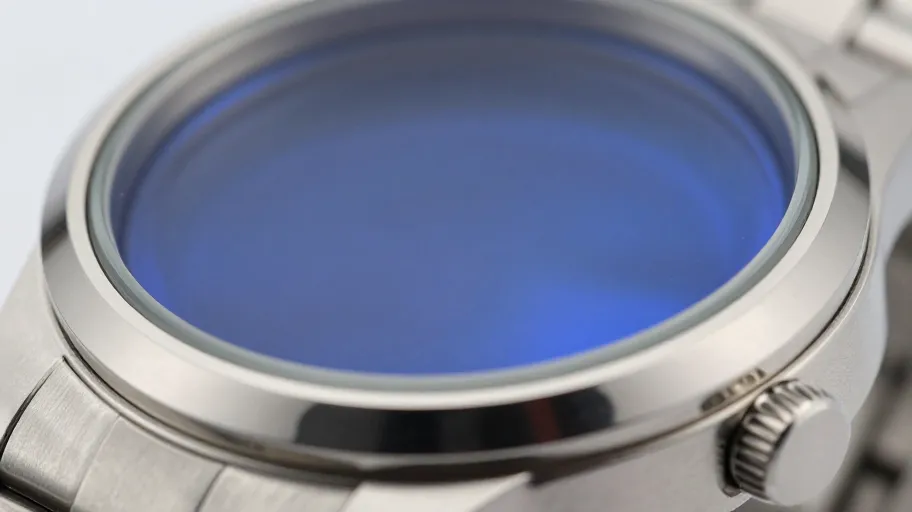
A sapphire crystal is extremely hard — synthetic corundum resists scratching better than almost any practical watch-crystal alternative — but hardness is not the whole story. For a sourcing team, "toughness" means three things: scratch resistance, resistance to fracture under impact, and correct fit within the case. Spec all three, then approve against samples.
Use the Hardness–Toughness–Fit (HTF) framework
When buyers ask "how tough is a sapphire crystal?", they are really asking three separate questions bundled into one. The HTF framework separates them so each can be specified, tested and approved independently:
- Hardness — resistance to scratching and surface abrasion.
- Toughness — resistance to chipping and cracking under impact, bending or point load.
- Fit — how the crystal's geometry, edge finish and mounting interface interact with the case, gasket and bezel.
A crystal that scores perfectly on hardness can still fail in the field because of an edge that chips under a bezel press, or a mounting that transfers shock into the crystal. Treating the three as one undifferentiated "quality" is how specification gaps survive until warranty returns. Treating them as three spec lines forces each one into documentation and approval.
Hardness: what the number does and does not tell you
Synthetic sapphire used in watch crystals is crystalline aluminium oxide. On comparative hardness scales it sits near the top of materials practical for watchmaking, which is why it resists scratching from everyday contact that would mark mineral glass or polymer.
But hardness alone answers only one question. For procurement purposes, hardness tells you about the surface; it says nothing about:
- How the crystal behaves when struck edge-on by a doorframe.
- Whether a thin cross-section flexes under pressure in a diver or pilot watch.
- Whether the coating, if specified, is matched to the intended use.
A useful habit when comparing suppliers is to ask not "is it sapphire?" but "what material grade and growth process do you use, and what documentation comes with it?" Different suppliers will describe material origin differently; your job is to make the answer auditable, not assumed.
Toughness: the levers a buyer actually controls
Toughness in service depends heavily on design decisions that you, the buyer, influence:
- Thickness. Thicker sections resist impact and flex better but change case height and aesthetics. Ask the supplier to review your target thickness against the watch's intended use rather than copying a drawing forward from an old model.
- Edge geometry. Chamfered and profiled edges distribute stress differently than sharp edges. Edge design also affects how the crystal seats into the gasket or bezel.
- Coating. Anti-reflective coatings change surface behaviour and add an inspection step. Clarify whether coating is one-side or two-side, and what acceptance criteria apply to coating defects.
- Mounting interface. Compression fit, adhesive bonding and gasket seating each transmit shock differently. A crystal and case designed in isolation can create failure points neither party anticipated.
None of these has a universal correct answer; they are application-specific trade-offs. The right process is to state the intended use — dress watch, sports watch, tool watch, smartwatch — and have the supplier respond with engineering recommendations you can compare in writing.
Fit: where good crystals fail
A significant share of crystal failures trace back to fit, not material. Mismatched gasket seats, uneven bezel pressure, case tolerance stack-up and assembly force can all induce stresses the crystal itself cannot be blamed for. This is why the approval process should include case-side information: gasket specification, assembly method, and any dimensional interaction the watchmaker already knows about.
Confirm the current policy directly with the supplier on how dimensional feedback is exchanged and revised during development.
Decision table: application risk to spec questions
| Application risk | What to specify | Approval questions for the supplier |
|---|---|---|
| Everyday scratch exposure (dress watches) | Material grade, surface finish, coating choice | What material documentation accompanies each lot? How is surface finish verified? |
| Impact exposure (sports, everyday-wear tool watches) | Thickness rationale, edge geometry | What thickness do you recommend for this case and use, and why? How are edges finished and inspected? |
| Pressure or flex (divers, pilot watches) | Thickness, flat vs domed profile, mounting method | What profile do you recommend for the pressure case? How should mounting be designed to avoid point stress? |
| Coated crystals | Coating side(s), coating inspection criteria | What coating defect acceptance criteria do you propose, and how are they checked on samples? |
| Rework or legacy cases | Reverse-engineered dimensions, interface confirmation | What do you need from our existing case or sample to match fit? |
Sample evaluation and approval workflow
A disciplined sample process turns "tough enough" from opinion into a signed record:
- Define the use case in writing before requesting samples — intended wear conditions, case type, coating requirement.
- Request engineering dialogue on thickness, edge and profile rather than only quoting a drawing.
- Evaluate samples against agreed criteria — visual inspection, dimensional checks, edge finish, coating quality if applicable.
- Assemble and test in the real case, including the actual gasket and assembly method, before sign-off.
- Document deviations and corrections in a revision log shared with the supplier.
- Approve in writing, referencing the sample batch and criteria, so production has a defined reference.
Sample approval checklist:
- Intended use case documented and shared
- Material grade and documentation confirmed with supplier
- Thickness and profile reviewed against application risk
- Edge geometry specified and inspected on samples
- Coating (if any) specified with acceptance criteria
- Sample fitted and assembled in the production-intent case
- Dimensional feedback loop and revision log agreed
- Approval recorded in writing against a defined sample batch
Questions to put to any sapphire crystal supplier
- What material documentation is provided with production lots?
- How do you recommend balancing thickness, profile and case height for this model?
- What edge finishing options are available, and how are they inspected?
- What coating configurations do you offer, and how are coating defects assessed?
- What information do you need from our case or gasket to confirm fit?
- What is your process for dimensional revisions during development?
- Confirm the current policy directly on sample arrangements, costs and production terms.
FAQ
Does a harder crystal mean a tougher watch? Not on its own. Hardness resists scratches; toughness under impact depends on thickness, edge geometry and mounting. Use the HTF framework so hardness is not mistaken for overall durability.
Can a sapphire crystal crack or chip? Yes. Any brittle crystalline material can chip at edges or crack under sufficient impact or point stress. The buyer's levers are thickness, edge design and mounting — all application-specific, and all worth discussing with the supplier before finalising drawings.
What should I check on sapphire crystal samples before approving? Surface quality, dimensional conformity to drawing, edge finish, coating condition if applicable, and — most importantly — fit and assembly behaviour in the actual case with the actual gasket.
How do I compare two suppliers whose quotes look identical? Compare what is written beneath the line item: material documentation, thickness recommendation, edge options, coating criteria and revision process. Ask each supplier the same approval questions and compare the written answers.
Do coatings affect durability? Coatings change surface behaviour and introduce their own inspection requirements. Whether and how to coat is a design decision to make with the supplier based on the watch's intended use.
Get the sourcing brief
Turn this guide into a working document. Get the sourcing brief (获取采购 Brief) and use it to specify hardness, toughness and fit in a format your engineering and procurement teams can both sign off on.
Prefer to start smaller? Download the sample approval checklist above and take it into your next supplier call — it works even before you request the full brief.