
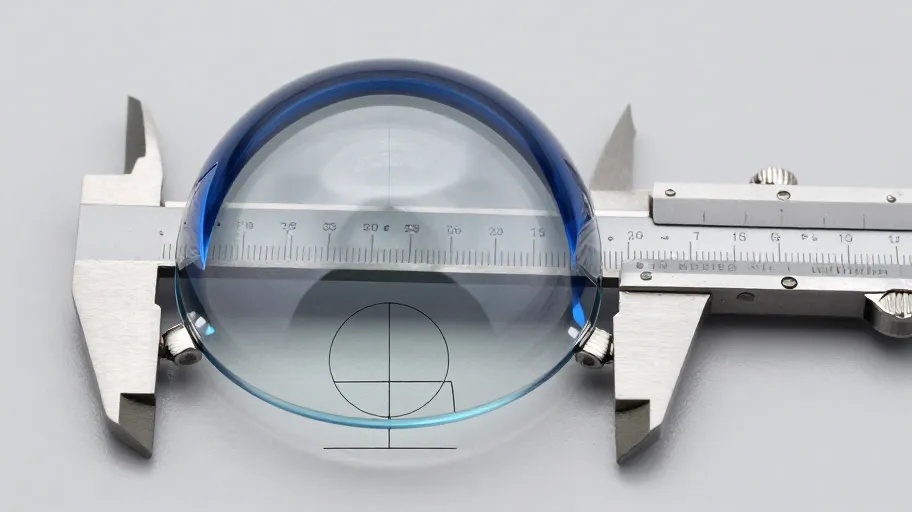
A double domed sapphire crystal is a watch crystal curved on both its upper and lower surfaces, producing a lens-like cross-section rather than one flat underside. For buyers, the practical consequence is that both radii, the thickness at crown and edge, and the seating geometry must be specified and confirmed in drawings before samples are ordered.
Why the Term Causes Confusion in B2B Sourcing
The phrase "double domed" appears in RFQs, supplier quotations and watch forums, but it is not always used to describe the same geometry. One supplier may mean a crystal whose outer surface is domed while the inner surface is also gently curved to reduce thickness or improve the view of the dial. Another may use the term loosely for any pronounced dome. When the drawing does not state the radii explicitly, two quotations that look identical on paper can describe different parts.
This is why the sourcing conversation should move from vocabulary to geometry. The word matters less than the numbers, the reference surfaces and the measurement method attached to it.
The Geometry: Single Dome vs Double Domed
A single domed crystal has one curved surface — the outer face — and one flat inner surface. A double domed crystal curves both faces. The result is a cross-section resembling a lens: a rising outer arc and a corresponding inner arc.
For a component buyer, three geometric consequences deserve attention:
- Two radii, not one. The outer and inner curves each have their own radius, and they need not match. Both belong in the drawing.
- Variable thickness. Thickness at the centre and at the edge can differ; both points need defined values.
- Seating interface. The inner curve changes how the crystal sits on the case, the gasket and any retaining geometry. Confirm the contact surface in the assembly drawing.
None of these points implies a universal value or a standard tolerance. Every one of them is project-specific and should be documented as such.
The SPEC-Confirm Framework
Before approving any double domed crystal specification — from any supplier, including JadeZone Sapphire — apply the SPEC-Confirm framework:
- S — Surface geometry. Outer radius, inner radius, dome height, thickness at centre and edge, and the reference plane from which all are measured.
- P — Profile dimensions. Overall diameter, shape (round, cushion, tonneau), and how the profile is dimensioned in the drawing.
- E — Edge and finishing. Edge treatment, polish quality expectations, and inspection method for the finished surface.
- C — Coating and treatment. Whether any coating is applied, on which surfaces, and how it is verified at inspection.
Each letter produces a line item the supplier must confirm in writing. If a line cannot be confirmed, that is a discussion point — not an assumption.
Decision Table: Does a Double Domed Profile Fit Your Project?
| Project factor | Favors double domed | Favors reconsidering | Confirm with supplier |
|---|---|---|---|
| Dial legibility priority | Curved inner surface can reduce inner reflection and distortion at angles | Design already solved with coating alone | Coating options and inner surface finish |
| Case design | Vintage-inspired or high-dome case built to receive a lens profile | Case seat dimensioned for a flat underside | Seating geometry and gasket interface |
| Thickness budget | Design accommodates centre thickness | Overall height is tightly constrained | Thickness at centre and edge achievable for your profile |
| Hands clearance | Hands sit well below the inner curve | Hands or dial furniture approach the crystal | Minimum clearance under the inner apex |
| Assembly method | Retaining geometry suits a curved underside | Retaining ring or bezel expects flat contact | Assembly drawings and contact surfaces |
| Cost sensitivity | Buyer accepts the machining scope of two curved faces | Budget assumes a single curved face | Current quotation basis and what it includes |
Use this table to structure the conversation with your supplier rather than to reach a verdict alone — the right answer depends on your case geometry and the manufacturer's confirmed capability for your specific profile.
Approval Questions to Put to Any Supplier
- What radii define the outer and inner surfaces, and from which reference plane are they measured?
- What thickness values apply at the centre and the edge of the crystal?
- What inspection method verifies the dome profile on production parts, and what documentation accompanies it?
- How is the seating interface dimensioned, and what case-side assumptions does the drawing make?
- What dimensional tolerances apply to each critical dimension in this specific project?
- If a first sample deviates from the drawing, what is the correction process, and what is re-quoted versus re-made?
- What is the current sample policy — cost, shipping arrangement, and terms — and what does it cover?
That final question cannot be answered by this article. No sample policy, fee, shipping arrangement or refund treatment was supplied for publication, and policies change. Confirm the current policy directly with the supplier in writing before ordering samples.
Sample and Approval Checklist
Use this checklist as your approval gate before authorising production:
- Drawing states outer radius, inner radius, dome height, and reference plane.
- Thickness at centre and edge defined and dimensioned.
- Seating interface and gasket contact surface drawn and agreed.
- Coating specification confirmed, including which surfaces are treated.
- Measurement and inspection method for the dome profile agreed.
- Tolerances for every critical dimension confirmed in writing for this project.
- Sample compared against drawing, dimension by dimension, with results recorded.
- Deviations logged and corrected drawings issued before approval.
- Current sample, pricing, shipping and production terms confirmed directly with the supplier.
- Approval issued in writing against a revision-controlled drawing number.
A sample is not an approval. Approval is a signed comparison between a physical part and a revision-controlled drawing.
Frequently Asked Questions
Is a double domed crystal better than a single domed one? Neither is universally better. A double domed profile serves designs that want a lens-like character and a curved inner face; a single dome may suit cases dimensioned for a flat underside. The decision belongs to your case geometry and dial layout, confirmed against drawings.
How do I make sure my supplier and I mean the same thing by "double domed"? Put the geometry in the drawing: two radii, dome height, centre and edge thickness, and the reference plane. Once numbers replace vocabulary, the ambiguity disappears.
Does a double domed crystal require special case preparation? The inner curve changes the seating interface, so the case, gasket and retaining geometry should be reviewed together with the crystal drawing. Ask your supplier what case-side assumptions the crystal drawing makes.
What should I check when a sample arrives? Measure against the drawing, not against expectation: outer radius, inner radius, dome height, thickness at both defined points, diameter, edge finish and coating. Log every measurement and treat deviations as revision items, not judgement calls.
Can JadeZone Sapphire produce double domed crystals to my drawing? JadeZone Sapphire manufactures custom sapphire watch crystals from Shenzhen and Hong Kong. Whether your specific profile, tolerances and coating requirements can be met is a project-specific question — submit your drawing and confirm current capability, terms and sample policy directly.
Get the Procurement Brief
[获取采购 Brief →] — request the JadeZone Sapphire procurement brief and structure your next crystal RFQ around a complete, unambiguous specification.
Or start lighter: [Download the SPEC-Confirm sample approval checklist] and use it on your very next supplier conversation.