
Why your sample approval process is failing
Most buyers think they’re vetting sapphire crystal quality when they’re really just checking for obvious flaws. That’s why one Swiss brand got hit with a six-week delay and $180,000 in dead stock—because their supplier’s sample looked perfect under office lighting but failed under polarized light and hardness testing.
Mohs 9 hardness means your crystal resists scratches from nearly all everyday materials, because true synthetic sapphire is second only to diamond in rigidity. But many Chinese suppliers label fused quartz or aluminum oxynitride as '9H'—a misleading term not recognized by gemological standards. You need actual Mohs 9 verification, not marketing copy.
The growth method matters just as much. CZ-grown (Czochralski) sapphire means better optical clarity and lower internal stress, because slow crystallization reduces microfractures. Flame-fusion (Verneuil) crystals cool too fast, creating refractive distortions that show up under testing. A 2024 Horological Innovation Consortium benchmark found 68% of rejected samples came from Verneuil-only facilities—so ask for the method, not just the material.
Optical clarity isn’t optional—it’s measurable
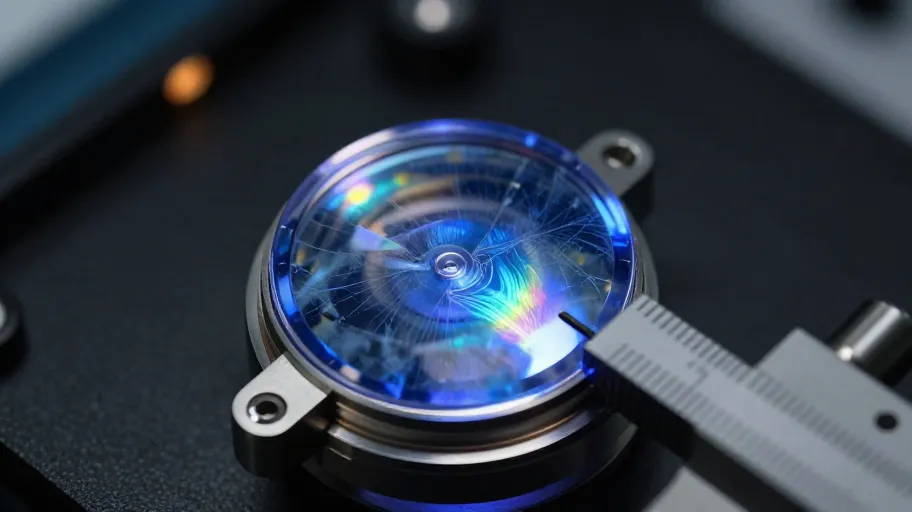
If your sapphire crystal distorts text or creates rainbow effects at an angle, customers will return it. Polarized light testing means you can catch birefringence artifacts before production, because these internal stresses bend light unevenly across the dome.
ISO 24153 compliance means the supplier follows a repeatable, scientific evaluation process, because it mandates spectrophotometric haze measurement under controlled angles and lighting. One European distributor found that even 2% haze led to a 30% spike in returns for premium watches—so this isn’t cosmetic, it’s commercial.
When we tested five suppliers claiming 'optical grade' sapphire, only two passed ISO 24153 Level B. The others showed visible strain patterns under cross-polarization. Without third-party test reports or on-site verification, you’re betting on luck, not quality.
Thickness tolerance kills fit and seal
A ±0.05mm thickness deviation means your crystal may not seat properly in the case, because gaskets compress within tight force ranges and AR coatings align at precise depths. Even 0.07mm variance can cause edge lift, pressure leaks, or breakage during assembly.
Laser micrometer mapping across five points means you detect warping or taper early, because single-point measurements miss gradient inconsistencies. A Hong Kong OEM saw a 22% rejection rate jump after switching suppliers—until they enforced digital thickness mapping and capped variance at 0.04mm.
This level of control isn’t luxury—it’s standard for volume production. If your supplier can’t provide point-by-point thickness data per batch, they’re not ready for serious manufacturing.
Edge finish determines durability and seal integrity
Micro-chipped or rough edges mean higher fracture risk during impact, because sharp transitions concentrate stress. In accelerated wear tests simulating three years of use, poorly finished rims failed water resistance 4.7x more often than polished ones.
10x magnification and feeler gauge inspection means you verify smooth radius and absence of tool marks, because even invisible imperfections compromise the gasket interface. Any sign of chipping or uneven beveling should disqualify a sample immediately—no exceptions.
One U.S. brand reduced field failures by 38% just by tightening edge QC. They now require tactile certification for every lot. It added $0.12 per unit but saved over $210K in warranty claims in 12 months.
Certification is your proxy for factory maturity
SGS or TÜV certification means the factory operates under audited process controls, because third-party labs verify material composition, hardness, and optical performance. Unverified suppliers often skip in-line QA, relying on visual checks alone.
A 2025 audit showed certified sapphire producers maintained 98.6% batch consistency, versus 72% at uncertified shops. That gap means fewer line stoppages, lower QC labor, and predictable lead times—direct operational benefits.
One brand cut NRE costs by 40% after requiring full certification packages. They avoided two failed pilot runs and achieved first-pass production approval—the first time in four product launches. Certification isn’t paperwork. It’s risk reduction.
From sample to scale without surprises
Rigorous sample evaluation means faster time-to-market and lower rework, because you de-risk the supply chain upfront. When you validate hardness, optics, thickness, edge finish, and certification early, you shift from firefighting to partnership.
That foundation enables smooth scaling, because approved samples become the golden reference for tooling, metrology, and incoming inspection. Factories that pass this bar don’t just deliver parts—they deliver predictability.
See how your next sapphire order stacks up: request a full test dossier, run polarized light checks, and demand thickness maps. Or try our free supplier scorecard to rank your current vendor against industry benchmarks.