
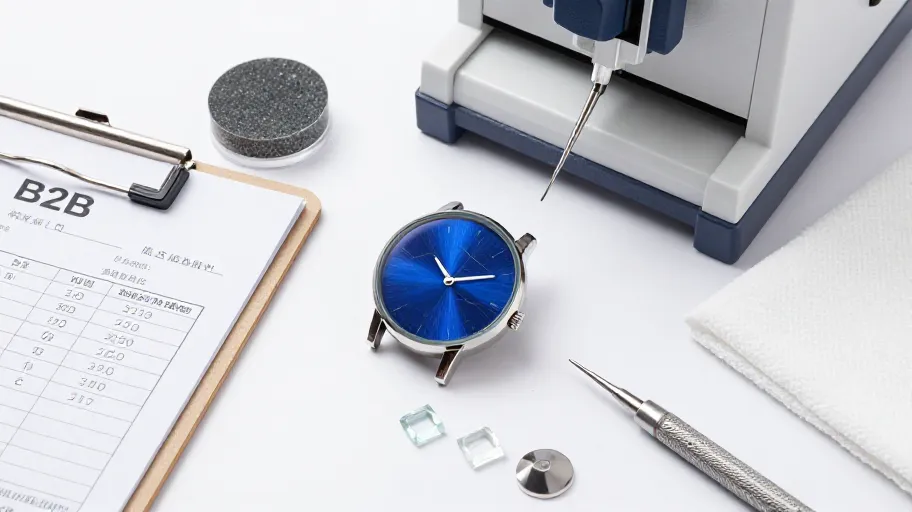
Yes — shallow surface scratches on a sapphire crystal can be polished out by reworking the polished face, but deep scratches, chips at the edge, and cracks go into the material and require remaking the crystal. For buyers, the more important question is contractual: define in writing which marks are polishable, which are rejects, and how both are verified at sample and incoming inspection. That is the SPEC-Verify-Approve approach this guide walks through.
Why the Question Matters More Than the Answer
If you source sapphire crystals for a watch line, you will eventually face a dispute: an incoming batch shows fine marks, and the conversation turns into opinion — your QC team says "scratched," the supplier says "within spec." The cost of that dispute is not just the batch; it is schedule risk, rework logistics and eroded trust.
The question "can you get scratches out of a sapphire crystal?" is therefore best reframed as three buying questions:
- Which marks are reworkable surface defects, and which are structural rejects?
- How do we write acceptance criteria that both parties can measure the same way?
- How do we approve samples and inspect production against those criteria?
The SPEC-Verify-Approve (SVA) Framework
S — Specify. Write the defect criteria into the drawing or spec sheet before tooling. Include the surface finish of each face, any coating, and the inspection conditions under which defects are judged.
V — Verify. Evaluate physical samples under the agreed conditions — defined lighting, magnification and viewing geometry — not under a desk lamp. Record what you see against the written criteria.
A — Approve. Lock a golden sample that both parties sign. Production approval and incoming QC are then measured against that reference, not against verbal descriptions.
SVA works because it converts a subjective word — "scratch" — into three separate, testable things: a defect type, a detection method, and an acceptance threshold you agree in writing.
Which Scratches Can Be Removed — and Which Cannot
Sapphire is an extremely hard material. That hardness is why it resists scratching in wear, and also why rework is limited: polishing removes material from the surface, but only to a shallow depth before geometry, thickness and edge shape are affected.
| Defect type | Can it be polished out? | Buyer action |
|---|---|---|
| Fine hairline marks on the top polished surface | Potentially, if shallow — confirm feasibility case by case | Classify as reworkable-or-reject in the spec; set a maximum rework count |
| Deeper visible scratches | Case-by-case; polishing may distort flatness or thickness | Require supplier assessment before accepting rework |
| Chips or nicks at the crystal edge | No — edge damage is structural | Reject; do not accept polished-over edge chips |
| Cracks or internal fractures | No — the part must be remade | Reject |
| Coating damage or coating-layer marks | Depends on the coating system — stripping and recoating may or may not be possible | Confirm the supplier's current rework policy for coated parts before ordering |
| Marks from handling or packaging | Frequently polishable if superficial | Fix root cause: packaging and handling spec, not just rework |
Treat this table as a starting checklist to adapt with your supplier. Do not assume any specific rework policy, cost or turnaround — confirm it in writing for each project.
Writing Criteria You Can Enforce
Vague language creates disputes. Replace it with measurable, jointly agreed terms.
| Vague wording | Enforceable alternative |
|---|---|
| "No visible scratches" | "No linear surface marks detected under [agreed lighting] at [agreed viewing distance] with [agreed magnification, if any]" |
| "Good polish" | Reference to the approved golden sample, judged side by side |
| "Edge must be clean" | "No chipping detectable under [agreed magnification]" with a defined reject trigger |
| "Coating OK" | Agreed coating inspection method and an approved coating reference sample |
The specific lighting, magnification and viewing conditions are project decisions — agree them with the supplier and record them. What matters is that both parties inspect the same way, every time.
How to Evaluate Samples Before Approving Production
A sample evaluation only protects you if it is repeatable. Use this protocol:
- Prepare the conditions. Agree lighting type and angle, background, viewing distance and whether magnification is used — and write them down.
- Inspect all faces. Top surface, underside and edge, since underside and edge defects matter for assembly and for coatings.
- Compare against the drawing, not memory. Tick each criterion line by line.
- Record every mark. Photograph defects with scale reference, note location by zone (centre, mid-radius, edge) if your spec defines zones.
- Decide per criterion: approve, rework request, or reject. Never approve "with comments."
- Lock the golden sample. Both parties label, sign and date it. Keep a sealed reference on each side if practical.
Approval Questions to Put to Your Supplier
Bring these to your next crystal sourcing conversation — they are deliberately open, because the answers must come from the supplier's current, confirmed policies:
- Which defect types do you classify as reworkable, and what is your current rework process and its limits?
- What inspection conditions — lighting, magnification, viewing distance — do you propose for joint defect judgement?
- What is your current policy on golden samples: retention, labelling, and how production is checked against them?
- For coated crystals, what is your current process when coating damage is found — and can coating be reapplied?
- What documentation accompanies each production lot — inspection records, coating batch records, dimensional reports?
- How do you handle a disputed incoming inspection result, and what is the escalation path?
- What packaging spec protects the polished surfaces and edges in transit, and is it documented?
Ask these before tooling, not after the first disputed batch.
FAQ
Can polishing a sapphire crystal change its thickness or flatness? Polishing removes material, so thickness and geometry can be affected if rework depth is significant. Whether that matters depends on your design margins and the crystal type. Ask the supplier to confirm rework depth limits in writing for your part before approving any reworked units.
Should we ever accept reworked crystals for a watch line? That is a brand decision, not a technical one. Some brands accept shallow-surface rework; others specify remake-only for flagship models. Decide the policy per product line, write it into the spec, and hold both your team and the supplier to it.
What is the best way to inspect crystals at incoming QC? Recreate the agreed inspection conditions from the sample stage — same lighting, same viewing distance, same magnification rules — and compare against the sealed golden sample. Consistency between sample approval and incoming inspection is what prevents disputes.
Do coatings change the scratch-rework question? Yes. A mark in the coating layer is a different defect from a mark in the sapphire itself, and rework options depend on the coating system used. Confirm the supplier's current coating rework policy before ordering coated parts.
Where JadeZone Sapphire Fits
JadeZone Sapphire manufactures custom sapphire watch crystals and precision sapphire components from Shenzhen and Hong Kong. If you are specifying crystals for a new model, the practical first step is a written defect-criteria and inspection conversation — which is exactly what our sourcing brief supports. All sample, pricing, lead-time and policy details are confirmed per project; nothing here should be read as a fixed policy statement.
Get the sourcing brief: 获取采购 Brief — a structured template covering defect criteria, inspection conditions, approval questions and golden-sample language you can put directly into your next RFQ.
Quick-Start Checklist
Before your next crystal RFQ goes out:
- Defect classes written: polishable vs. remake-only
- Inspection conditions agreed and documented
- Golden sample procedure confirmed with the supplier
- Coating rework policy confirmed in writing
- Lot documentation requirements listed
- Dispute-resolution path agreed
- Packaging spec for surface and edge protection defined