
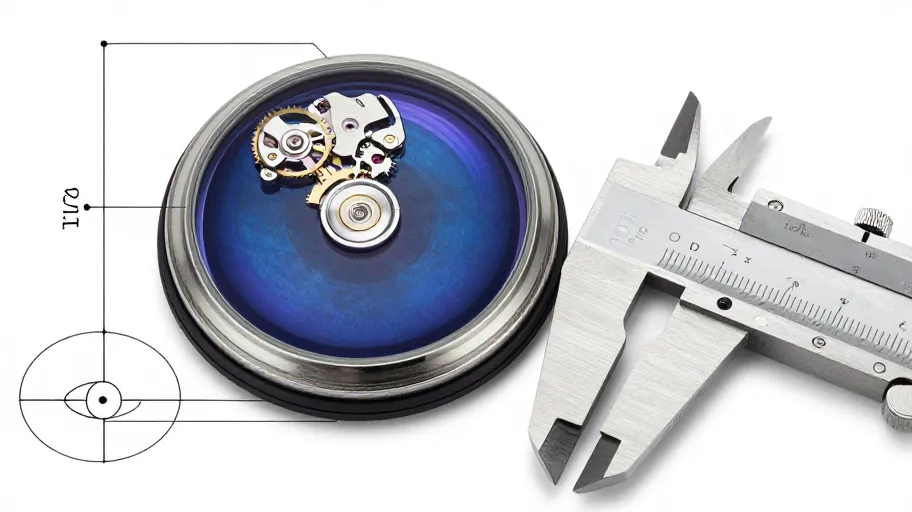
If you are sourcing custom or OEM sapphire watch crystals, the honest answer to "how much does it cost to put a sapphire crystal on a watch?" is that there is no standalone price. The cost of a sapphire crystal is an output of your specification — geometry, coatings, tolerance calls, gasket fit and finishing — multiplied by your sample and approval process. Control the specification and the approval loop, and you control the number.
Why This Question Has No Single Answer
A consumer asking this question wants a repair price. A sourcing manager, product developer or watch brand asking it needs something different: a cost model they can defend internally and a supplier conversation they can control.
The cost of a custom sapphire watch crystal moves with technical decisions that are made before any quote exists. Two buyers ordering visually identical crystals can receive materially different numbers because one specified a double-sided anti-reflective coating and a step edge for a gasket, while the other accepted a plano design with a looser thickness call. Neither is wrong — but they are different products.
This is why any supplier who quotes before the specification is locked is quoting a guess. The professional move is to make your specification quotable, then cost the sample loop, then control the approval gate.
The SPEC–SAMPLE–APPROVE Ladder
Use this three-stage framework to structure your enquiry with any sapphire crystal manufacturer, including JadeZone Sapphire:
Stage 1 — SPEC. Document every technical variable that affects manufacture: crystal geometry (flat, domed, box, stepped), diameter and thickness calls, edge treatment, coating specification, printed or applied elements, gasket interface, and the movement and case it must fit. Anything undocumented becomes a later variation and a later cost.
Stage 2 — SAMPLE. Commission a sample against the written specification. Treat the sample phase as the moment to verify that the manufacturer's process, inspection criteria and your drawing agree — not merely to look at a part. Confirm the current sample policy, any applicable fees, and shipping arrangements directly with the supplier, in writing, before proceeding.
Stage 3 — APPROVE. Define acceptance criteria before the sample arrives: which surface characteristics are acceptable, how they are inspected, and what triggers a re-loop. Approve formally against the documented criteria. An approval made against a drawing is enforceable; an approval made against a feeling is not.
Skipping a stage does not remove its cost — it relocates that cost to production, where it is more expensive.
Decision Table: Specification Choices and What They Cost You
| Decision point | Options to consider | Why it moves cost | What to verify with the supplier |
|---|---|---|---|
| Geometry | Plano, domed, box, stepped, integrated bezel seat | Complex curves and multi-axis features add grinding and polishing operations | Which geometries the manufacturer's process supports for your drawing |
| Coating | Uncoated, single-sided or double-sided AR | Coating adds process steps and inspection criteria | Coating specification, adhesion and durability testing evidence |
| Thickness and tolerance calls | Loose fit-for-purpose calls vs tight dimensional limits | Tighter calls increase yield loss and inspection load | Achievable tolerance for your specific geometry — confirm, do not assume |
| Edge and gasket interface | Straight edge, stepped, chamfered, gasket groove | Precision edge work is a distinct finishing operation | Fit verification against your case and gasket drawings |
| Printing / applied elements | None, logo, index, date window aperture | Each added feature adds tooling and alignment inspection | Registration and durability criteria in writing |
| Inspection level | Visual-only vs documented multi-point inspection | Deeper inspection adds process cost but reduces downstream risk | What the sapphire crystal quality inspection includes and how it is documented |
No row in this table carries a fixed price. Each row is a lever: the buyer's job is to decide which levers matter for the product's market position, and to document those decisions so the quote reflects the product you intend to build.
Sapphire Crystal Quality Inspection: What to Verify
Because the queue signal behind this article came from searches around sapphire crystal quality inspection, treat inspection as a cost lever in its own right. A crystal that passes inspection is not free — inspection is a purchased service embedded in the unit. Define what you are buying:
- Surface criteria. Which characteristics are inspected, by what method, and at what acceptance threshold — documented, not verbal.
- Dimensional verification. Which dimensions are measured on which units, and how results are recorded.
- Coating verification. How coating presence, uniformity and adhesion are confirmed, if you specify a coating.
- Fit confirmation. Whether the supplier verifies fit against your case, gasket and movement references.
- Documentation. Whether inspection results are supplied with the sample or shipment in a form your quality team can review.
Ask the supplier to walk you through their inspection process for a part like yours. A manufacturer that can describe its inspection coherently is easier to approve than one that cannot.
Concrete Approval Questions for Your Supplier
Bring these to your next enquiry with any sapphire crystal manufacturer:
- Can you confirm which crystal geometries and coating options your current process supports for this drawing?
- What is your current sample policy — including any applicable fees, shipping arrangements, and how revisions are handled? Please confirm in writing.
- What dimensional tolerances can you hold for this specific geometry, and how will you evidence them on the sample?
- What does your sapphire crystal quality inspection cover, and in what documented form will I receive results?
- If the first sample does not meet the documented acceptance criteria, what is the agreed path to a revised sample?
- What information do you need from me — case drawings, gasket specification, movement reference — to quote accurately?
- How should I submit a specification change, and how will its cost impact be communicated before work proceeds?
Every answer should be captured in writing and attached to the drawing revision. This is what makes an approval defensible months later, when team members change.
Sourcing Checklist: Before You Ask for a Number
Use this checklist to make your enquiry quotable:
- Written crystal drawing with geometry, dimensions and thickness calls
- Coating specification stated (or explicitly excluded)
- Edge, gasket and case interface defined
- Printing or applied elements specified
- Acceptance criteria for surface and dimensional quality documented
- Inspection and documentation requirements agreed
- Supplier's current sample policy, fees and shipping terms confirmed in writing
- Approval sign-off route named inside your organisation
- Change-control process agreed for specification revisions
FAQ
Is a sapphire crystal more expensive than other watch crystal materials? Sapphire is a engineered material requiring growth, slicing, grinding and polishing operations, so it sits at a different cost position from soft minerals or hardened glass. The precise comparison for your programme depends on geometry, coating and volume — request a like-for-like quote against an identical drawing.
Why did two suppliers quote different numbers for the same drawing? Because the drawing is not the whole product. Differences in assumed coatings, tolerance interpretations, inspection depth and sample handling all change the number. Compare quotes line by line against your written specification, not headline to headline.
How many sample loops should I plan for? You cannot know in advance. You can, however, reduce loops by submitting a complete specification and documented acceptance criteria before the first sample, and by approving formally against them.
Should I approve a sample based on appearance? No. Approve against the documented specification: dimensions, coating, edge fit and inspection results. Appearance approval without dimensional verification transfers risk to production.
What should I confirm about shipping and samples before ordering? Confirm the supplier's current sample policy, any applicable fees, shipping arrangements and revision handling directly, in writing. Do not rely on assumptions or third-party summaries — policies differ and change.
Get the JadeZone Sapphire Procurement Brief
JadeZone Sapphire manufactures custom sapphire watch crystals and precision sapphire components from Shenzhen and Hong Kong, serving watch brands, component buyers and product developers. Before you ask for a price, get the 获取采购 Brief — it walks you through every specification variable, inspection question and approval step covered in this guide, so your enquiry is quotable from the first message.
[获取采购 Brief]
Not ready to enquire? Download the Sourcing Checklist above and use it to audit your current crystal drawing. A specification that passes the checklist will get a sharper answer to "how much does it cost to put a sapphire crystal on a watch?" from any supplier you approach — including us.