
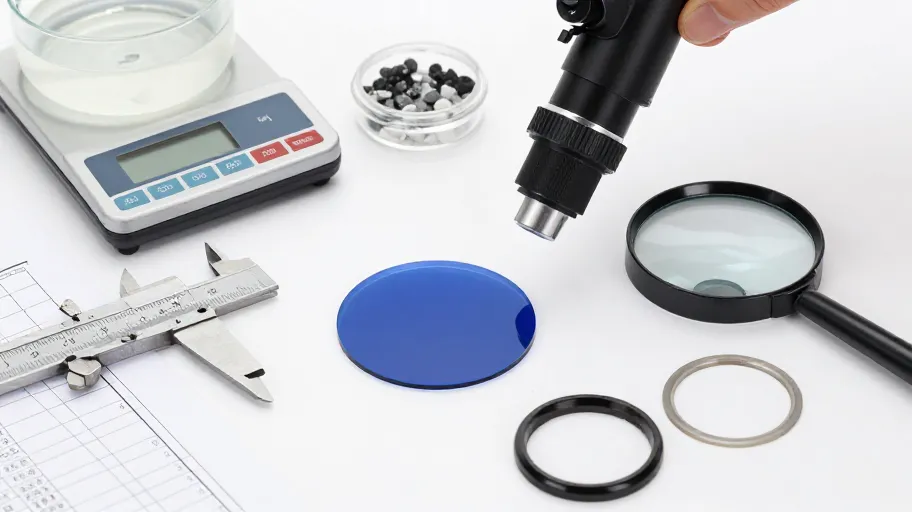
To check a sapphire crystal, verify it against a written specification before anything else: material confirmation via hardness and density behaviour, dimensional measurement against your case and gasket, optical and surface inspection under magnification, and documentary cross-checks such as material certificates. Then run a defined sample round and record a formal approval. Glance-testing tells you little worth approving.
That is the short answer. The working method — the one that protects you when a batch lands and something is wrong — is a repeatable process. The rest of this guide gives you one.
Why checking starts with the specification, not the crystal
A crystal cannot be "good" in the abstract. It can only conform or not conform to a drawing: diameter, thickness, gasket seat geometry, surface finish, coating, and any printing or hole features. If you cannot state the specification in writing, no inspection method will save you, because you have no reference to measure against.
So the first act of checking happens before any sample exists: freeze a specification sheet and a drawing, with tolerances agreed in writing with the supplier. Ask the supplier to confirm manufacturability and to state what tolerance class they can hold for your part — then record their answer. Do not accept verbal assurance as part of an approval file.
The SPEC-SURE framework for verification and approval
Use the six gates below in order. A crystal advances only when the current gate passes; the file closes only when all six do.
- S — Specification lock. Drawing, tolerances, coating, finish and marking requirements issued and acknowledged in writing.
- P — Physical checks. Hardness behaviour, dimensional measurement, edge and seat inspection on the actual sample.
- E — Edge and coating evaluation. Magnified review of edge polish, bevel consistency, coating presence and uniformity.
- C — CoA verification. Material documentation requested, received and compared against the spec; provenance questions asked and answered.
- S — Sampling protocol. A defined sample quantity and inspection method agreed before mass production — confirm the policy and any costs directly with the supplier.
- U — Ultimate approval record. A signed or written approval, with retained reference samples and measured data, kept as your baseline for batch comparison.
This framework turns "how to check sapphire crystal?" from a one-off inspection into an auditable decision.
Physical checks you can run yourself
Hardness behaviour. Sapphire sits at 9 on the Mohs scale; ordinary glass and most mineral glasses scratch far more readily. A careful scratch test with a hardened steel tip on a non-critical area of a sample can differentiate materials — but it destroys the sample and proves little about the batch. Use it only as a rough screen on sacrificial parts, never on approval samples.
Dimensional measurement. Measure diameter, thickness and seat geometry with a micrometer or calibrated calipers at multiple points, rotating the part. Record the numbers. A crystal that is out of round or tapered will leak or seat badly regardless of how good it looks.
Optical and surface inspection. Under a loupe or microscope, inspect for inclusions, bubbles, chips at the edge, polishing marks and coating defects. Check both faces under angled light. Look at the gasket seat with particular care — it is the least visible and most consequential surface.
The water-drop and feel tests. A drop of water beads differently on sapphire than on glass, and sapphire feels notably colder to the touch. These are indicative screens only. They cannot distinguish grades, cannot detect coating substitution and should never be the basis of an approval.
Fit trial. Trial-fit the sample in the actual case with the actual gasket, at assembly torque or pressure. Conformity on paper that fails in the case is still a rejection.
Decision table: what each result means
| Check | Pass looks like | Fail signal | Your move |
|---|---|---|---|
| Hardness screen | No scratching from steel tip on sacrificial sample | Readily scratched surface | Reject material claim; request documentation before proceeding |
| Dimensions | All measured points within agreed drawing and stated tolerance class | Out-of-round, taper, thickness drift | Reject sample; ask supplier to re-measure against the drawing with you |
| Edge and seat | Clean polish, consistent bevel, no chips under magnification | Chips, uneven seat, polish marks | Quarantine; request corrective action and resample |
| Coating | Uniform reflectance behaviour, no visible blotching | Absent or patchy coating vs spec | Confirm what was actually supplied in writing |
| Documentation | CoA received and consistent with spec and order | Missing, vague or mismatched paperwork | Do not approve; escalate in writing |
| Fit trial | Seats correctly with intended gasket, no rock or gap | Rocking, gap or gasket distortion | Reject regardless of other results |
What to request from the supplier — and compare
Ask for, in writing: the material grade and its certificate of analysis for the lot; confirmation of the coating specified (if any) and on which face(s); the dimensional inspection method they use and a measurement report for your sample; and their sample and approval policy, including quantities and any charges. Confirm current policy directly — this article does not state what any supplier includes, charges or how samples are handled, because that varies by supplier and by project, and only a current written confirmation counts.
Cross-check every document against the drawing you issued, not against the supplier's own summary of it. Where a document and your drawing disagree, resolve the disagreement before production, in writing.
Questions to ask before approving any sapphire crystal supplier
- Can you confirm the tolerance class you will hold for this exact part, in writing, per feature?
- What material documentation accompanies each lot, and can we audit it against our spec?
- What is your current sample policy — quantity, cost and handling — and where is it documented?
- What inspection do you perform before shipment, and can we receive the inspection report per batch?
- What is the escalation path if a delivered batch fails our incoming inspection?
None of these require the supplier to be the largest or the fastest. They require the supplier to be specific. Specificity in writing is what you can verify; anything else is marketing.
FAQ
Can I check a sapphire crystal without instruments? You can screen it: hardness behaviour on a sacrificial part, the cold-touch and water-drop indicators, and careful loupe inspection. But approval-level verification needs measurement against a drawing and documentation. Screens reject impostors; they do not confirm conformity.
How do I tell sapphire from mineral glass? Scratch resistance is the most accessible discriminator — steel will not mark sapphire but will mark glass. Density and thermal feel add supporting evidence. For a sourcing decision, pair these screens with a material certificate and confirm what the supplier will document per lot.
How many samples should I inspect before approving? That depends on your risk position and the supplier's current sample policy — confirm both directly. What matters more than the number is that the quantity, the inspection method and the acceptance criteria are agreed in writing before mass production, and that approved reference samples are retained.
What coating checks matter for sapphire crystals? Confirm which coating was specified and on which face, then inspect under angled light for uniformity and adhesion defects. Ask the supplier how coating conformity is verified and documented per batch, and compare their answer to what you observe on the sample.
Should I approve based on the supplier's own inspection report? Treat it as one input, not the decision. Measure the physical sample yourself, run the fit trial, and cross-check the report against your drawing. Approval should rest on your own verified evidence, retained as a record.
Next step
[获取采购 Brief →] Get the sourcing brief with the full supplier-verification question list and specification checklist — built for buyers approving custom sapphire crystals.
Prefer to start smaller? [Download the sapphire crystal inspection checklist] and run it against your next sample round.