
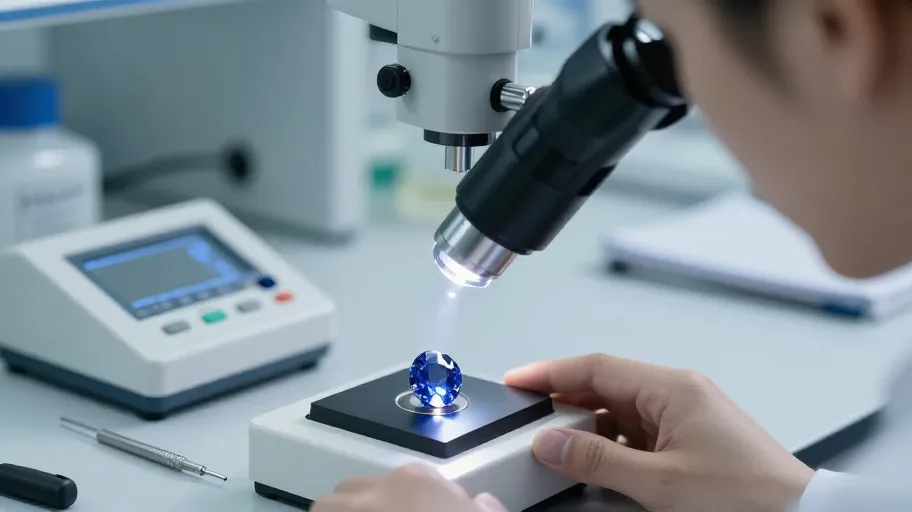
How To Check Sapphire Crystal Quality Before Finalizing a Purchase
Visual inspection means fewer field failures because it catches micro-bubbles, striae, and edge chipping early—defects that create stress points and lead to shattering. A high-end smartwatch maker in California nearly shipped 50,000 units with sapphire faces that failed under moderate impact, despite supplier claims of '9H hardness.' The root cause wasn’t manufacturing—it was skipped verification.
Surface flaws are not just cosmetic. They indicate poor crystallization control during growth, which compromises durability. In a 2024 benchmark of consumer electronics firms sourcing from southern China, 22% of rejected sapphire batches had visible imperfections detectable at 10x magnification. Yet only 38% of procurement teams used loupe-assisted review. Inspecting under controlled lighting with calibrated magnifiers means avoiding six- to eight-week delays—and over $2 million in lost revenue for mid-tier brands during peak seasons.
Refractive index testing means guaranteed material authenticity because genuine synthetic sapphire has a narrow refractive index of 1.762–1.770. Off-spec materials like fused quartz or spinel substitutes degrade optical performance: glare increases, screen readability drops, and anti-reflective coatings delaminate. One European wearables brand faced a spike in customer returns due to 'foggy' displays—only to discover their supplier substituted lower-cost glass. Refractometer testing at incoming inspection would have flagged this immediately. Now, leading OEMs require refractive index logs with every shipment, turning lab data into a gatekeeper for brand integrity.
Scratch Resistance Why 9H Claims Are Often Misleading
'9H hardness' claims often mislead buyers because '9H' on Chinese factory sheets usually refers to pencil hardness—a coating metric—not Mohs scale mineral hardness. True sapphire scores 9 on the Mohs scale, second only to diamond. But independent 2025 lab audits across five major sapphire crystal China factories found up to 35% of samples labeled '9H' failed Mohs 9 when tested with tungsten carbide and corundum probes. Some scored as low as 6–7, placing them closer to hardened glass than sapphire.
This discrepancy means real-world failure risk because fast-growing crystals introduce lattice distortions, while skipped post-annealing treatments leave internal stresses. The result? A material that looks identical but fails under use. Portable scratch testers mean clear pass/fail outcomes without relying on paperwork. Pairing them with Vickers microhardness testers means quantitative confidence in surface resilience. One North American medical device manufacturer reduced field failure rates by 68% after instituting mandatory Mohs validation—proving that simple tools, consistently applied, deliver outsized reliability gains.
Specification cross-checking means alignment with international standards because datasheets alone can’t be trusted. ISO 11553-4 and ASTM F2921 define acceptable tolerances for flatness, thickness variation (should be ≤0.05mm), transmittance (>85% in visible spectrum), and edge strength. When a Singaporean IoT firm audited its vendors, three out of eight used outdated internal specs allowing 0.1mm deviation—double the ISO limit. That variance caused inconsistent touch sensitivity. Mandating third-party certification reports tied to current ISO versions meant 41% less rework and faster production ramp-up.
The Real ROI of Pre-Purchase Verification
The convergence of visual checks, instrumental testing, and documentary validation means a quality moat around your supply chain because risk is filtered before it enters your workflow. Investing $12,000 in a portable refractometer and scratch test kit means preventing an average recall cost of $4.7 million for wearable tech firms, according to PwC’s 2025 analysis of hardware startups. Even more valuable? Protecting time-to-market. Teams using full pre-acceptance testing report 30% faster launch cycles—not because they move faster, but because they avoid backtracking.
Accurate testing means downstream confidence because when engineering knows material meets spec, design tolerances tighten. When QA trusts incoming goods, inspection bottlenecks dissolve. When leadership sees fewer escalations, innovation funding flows freer. This isn’t about avoiding China—it’s about upgrading how you engage with any sapphire crystal China factory. Speed without verification means organized failure. Your next breakthrough shouldn’t hinge on a supplier’s word—it should rest on verified science.
Ready to eliminate guesswork and lock in material integrity? Start with one batch, one tester, one standard. See how much you save in rework, delay, and reputational damage by verifying first.