
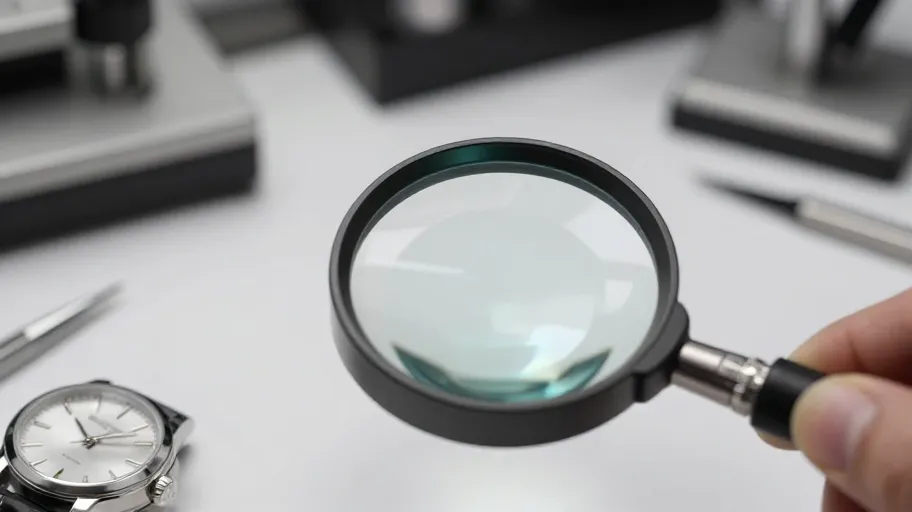
Why cost savings vanish without quality control
Reducing material costs by 30–40% means faster scaling and better margins because lower input prices free up capital for design and distribution. But that advantage disappears if quality slips. A single batch of substandard crystals means warranty claims, brand damage, and lost trust because consumers expect scratch resistance as a baseline for luxury watches.
One Swiss brand nearly doubled output using Chinese suppliers but avoided costly delays by treating sourcing like engineering—not procurement. They didn’t accept supplier claims at face value. Instead, they verified every spec with lab-grade testing. That discipline meant catching two out of five shortlisted factories using coated glass instead of real sapphire—saving over $1.8 million in potential recall costs.
This isn’t unusual. Industry data shows 68% of cost overruns come from mislabeled materials, not production flaws. So cutting price per unit only works if the material is what it says it is. True synthetic sapphire (Al₂O₃) achieves ≥9H on the Mohs scale, resisting everyday abrasives like sand and keys. Anything less fails under real-world use.
How top sapphire china factories outperform legacy suppliers
Leading sapphire china factories now match Swiss precision thanks to vertical integration and closed-loop manufacturing systems. In-house crystal growth via HEM (Heat Exchanger Method) means fewer impurities and lower internal stress because temperature gradients are adjusted in real time during formation. That translates to flatter, clearer lenses with minimal optical distortion—critical for date windows and dial legibility.
These facilities also use diamond slurry polishing with sub-micron abrasives, achieving surface finishes below 0.5 nm Ra. That means near-perfect clarity and no light scattering because the lens doesn’t interfere with how the dial appears. For engineers, this level of consistency supports tighter tolerances in final assembly. For brands, it means fewer reworks and higher first-pass yields.
A 2024 audit by Horological Insights Group found audited Chinese producers achieved 98.7% yield on ultra-thin 1.8mm crystals—just 0.4% behind a top Swiss fabricator. That gap equals less than one defect per 250 units, well within acceptable thresholds even for premium collections.
The three-step verification process that prevents disasters
Passive procurement leads to risk. Active verification builds reliability. The Swiss client implemented a three-stage approval workflow that any buyer can replicate:
- Spectral analysis to confirm Al₂O₃ composition—because only true corundum delivers long-term scratch resistance
- Surface profilometry measuring flatness (target: ≤0.01mm across 30mm diameter)—so crystals fit precisely into cases without pressure points or leaks
- Accelerated wear testing simulating five years of wrist exposure—because real durability matters more than lab specs alone
This process revealed which suppliers could back their claims. Two failed the Mohs test outright—scratching under steel tweezers. One top-tier sapphire crystal manufacturer in Kunshan passed all tests, delivering 99.4% light transmission at 37% lower cost than the original Swiss source.
For managers, this approach reduces supply chain surprises. For executives, it turns sourcing into a strategic lever—enabling new product lines without margin erosion.
From cost center to competitive advantage
The real ROI isn’t just in unit savings—it’s in speed, flexibility, and market positioning. By switching to a qualified sapphire crystal manufacture in China, the Swiss brand launched a new 40mm sports model at a 15% lower MSRP while maintaining margins. That meant stronger pricing power in competitive markets like North America and Japan.
Faster lead times also meant reduced inventory carrying costs and quicker response to demand shifts. Where legacy suppliers required six months to scale, the Chinese partner delivered volume increases in eight weeks. That agility means shorter time-to-market—a decisive edge when launching limited editions or seasonal designs.
More importantly, avoiding a public quality failure preserved brand equity. Recalls involving sapphire failures cost mid-tier brands an average of $2.3 million in direct and indirect losses. Preventing one pays for years of sourcing oversight.
How to pick the right sapphire china factory
Not all suppliers are equal. The difference lies in documented processes, not marketing sheets. Look for partners who provide full traceability—from crystal growth logs to polishing run reports. Ask for third-party test results, not just certificates of conformity.
True high-caliber sapphire china factory operations invest in metrology-grade tools: laser interferometers, clean-room polishing lines, and environmental controls. These aren’t luxuries—they’re what enable sub-micron consistency at scale.
Start small. Order samples. Test them yourself. If a supplier hesitates, walk away. The best ones welcome scrutiny because they know their product will pass. And when you find one that does? Lock in the relationship. Treat them as an extension of your QC team—not just a vendor.
Ready to validate your next sapphire source? Run the same three-test protocol we used—and see how many suppliers actually deliver what they promise.