
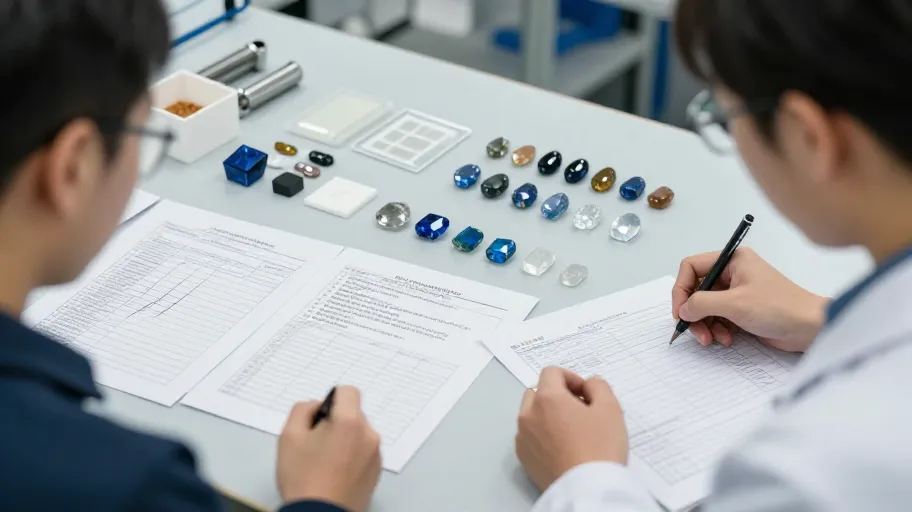
To evaluate a custom sapphire crystal factory online, verify documented manufacturing capability rather than marketing claims: confirm production evidence, request an engineering dialogue about your exact geometry and coating, run a small pilot order, and document acceptance criteria before committing tooling budget. Compare suppliers using a fixed framework so every quote is judged on the same basis.
Why online evaluation decides the outcome of a private-label project
A private-label watch lives or dies on the crystal. It is the surface the customer touches, the component most exposed to damage, and the part where a specification error — the wrong dome profile, an uncoated surface, a mis-sized gasket seat — becomes visible on every unit shipped. Choosing the supplier for that component online, before you can visit a floor or hold a sample, is one of the higher-risk decisions in a watch programme.
The risk is not that suppliers lie. It is that websites compress complex manufacturing into short claims: "custom shapes", "AR coating", "strict QC". None of these statements tells you whether that supplier can hold your geometry, at your volume, with your acceptance criteria. The purpose of online evaluation is to convert vague claims into verifiable commitments — and to do it before tooling money, design files and calendar time are committed.
This article gives you a framework for that work. It is written from the buyer's side: use it to evaluate any supplier, including us.
The VERIFY Framework for evaluating a custom sapphire crystal factory online
Use the five-stage VERIFY Framework to structure your evaluation. Each stage produces documentation, so your final supplier decision is backed by a paper trail rather than impressions.
V — Vet credentials and legal substance
Start with what can be checked from a desk. Confirm the legal entity behind the website: business registration, export history where visible, and whether the entity you are invoicing is the same entity that will manufacture. Ask directly: "Are you the manufacturer, or do you subcontract part of the process?" Both models can work, but you must know which one you are pricing, because it changes who answers quality questions later.
Confirm where production happens and who controls each step — crystal growth or boule sourcing, cutting, grinding, polishing, coating, inspection. A supplier who cannot describe their own process chain in writing is telling you something important.
E — Evidence of process and quality control
Ask for documented evidence, not adjectives. Useful evidence to request includes: the supplier's inspection workflow for crystals (what is measured, with what instruments, at which stages); their method for verifying coating presence and uniformity; and their process for handling dimensional verification of a custom shape. Ask how defects found at inspection are recorded and reported to you.
Be careful with claims about certifications or test results. Do not accept a logo on a website as evidence. Ask which certificates are current, what scope they cover, and request the documents themselves. If a claim cannot be evidenced, treat it as absent.
R — Request an engineering dialogue
This is the single most revealing step. Send your drawing — under a confidentiality agreement you both sign — and ask specific technical questions: how the supplier would achieve your dome profile, how they would fixture an asymmetric shape, what they recommend for gasket-seat geometry, how they would approach anti-reflective coating on both surfaces versus one.
A genuine manufacturer responds with questions of their own: about case dimensions, tolerance priorities, gasket specification, volume bands, assembly method. A reseller responds with a price and a reassurance. The quality of the counter-questions is a stronger signal than any catalogue page.
I — Initiate a small pilot
Before tooling or production commitments, request a pilot: a small batch of samples made to your actual drawing, not catalogue samples. Evaluate the pilot against written acceptance criteria you define in advance — dimensional fit in your case, visual quality under your inspection conditions, coating performance as you measure it.
F — Formalise yields, acceptance terms and change control
Once a pilot is approved, move the commercial specifics into writing before volume production: what constitutes an accepted unit, how disputed units are handled, what documentation accompanies each batch, and what the change-control process is if either side modifies the drawing or process. Agree who signs off first article inspection, and on what basis.
Do not rely on any numerical tolerance, yield figure or lead time implied by the supplier's website. Every number in your agreement should be one you negotiated for your part, in your document.
Decision table: interpreting online signals
| Online signal | What it may suggest | What you must confirm directly |
|---|---|---|
| Detailed process descriptions (cutting, polishing, coating) | Possible in-house manufacturing depth | Which stages the entity itself performs, and where |
| Engineering questions returned on your drawing | Real technical capability | That the questions reflect understanding of your specific geometry and case |
| Named inspection instruments and QC stages | Structured quality process | What is measured, on which dimensions, and what records you receive |
| Certification logos or claims | Intentional quality management | Current certificate documents, scope, and expiry |
| Published client names or logos | Marketing claim | Permission and currency; do not treat as evidence of fit for your project |
| Vague claims ("high precision", "strict QC") with no method | Insufficient information | Everything — treat as unverified until documented |
| Immediate price with no technical questions | Trading-style response | Whether any manufacturing step is subcontracted and who answers quality issues |
Concrete approval questions to send each custom sapphire crystal factory
Use these questions verbatim, in writing, and compare the answers side by side:
- Which production steps for custom sapphire crystals do you perform in your own facility, and which are subcontracted?
- What is your process for first article inspection of a new custom geometry, and what documentation do you provide with it?
- How do you verify dimensional accuracy of a non-round or domed crystal, and what measurement equipment is used?
- How do you apply and verify anti-reflective coating, and how is coating quality checked per batch?
- What is your current MOQ and lead time for this specific part at my intended volume? (Ask for your part; do not accept a general figure.)
- What confidentiality protections apply to my drawings before any order is placed, and will you sign our NDA?
- How are defects found after delivery documented, investigated and resolved?
- Who is my technical contact after production starts, and in what language and time zone?
- What change-control process applies if either of us modifies the drawing, coating spec or process mid-programme?
Score each answer: documented, partially documented, or verbal only. A supplier with fewer claims but fuller documentation is a safer foundation than the reverse.
Red flags worth pausing on
- A supplier who quotes before asking technical questions about your part.
- Refusal to put sample, defect or acceptance policies in writing.
- Certificate claims without documents on request.
- No named engineering contact for post-order support.
- Pressure to pay tooling before a drawing-level technical review.
None of these is proof of a problem, and none of this article asserts what any particular supplier does. They are reasons to slow down and demand documentation.
Frequently asked questions
Can I reliably evaluate a custom sapphire crystal factory online without visiting? You can substantially reduce risk online: verify legal entity and process ownership, demand documented QC methods, run an engineering dialogue on your drawing, and pilot with written acceptance criteria. A factory visit adds confidence for larger programmes, but documented commitments are what protect you contractually.
How do I compare sapphire crystal quotes that are not like-for-like? Normalise each quote against a written specification: material grade, coating on which surfaces, dimensional verification method, acceptance criteria, and documentation delivered per batch. Only then compare prices — a lower quote that omits coating or inspection may not be cheaper for your programme.
Should I ask about IP protection before sending drawings? Yes. Establish confidentiality terms — ideally a signed NDA — before transmitting geometry. Make protection of design data a scored item in your supplier comparison, not an afterthought.
What documentation should accompany every production batch? Agree this before volume orders: inspection records, first article sign-off, coating verification method and results, and traceability back to your approved drawing. What matters is that the documentation is specified in your agreement, not assumed.
Get the working tool for this evaluation
[Download the Supplier Scorecard] and run every custom sapphire crystal candidate through the same scored framework — process ownership, evidence, engineering dialogue, pilot results and formalised terms — so your private-label decision is documented, not guessed.
Prefer to start smaller? Use the ten approval questions above as your first enquiry checklist, and keep a written record of every answer before you release drawings or budget.