
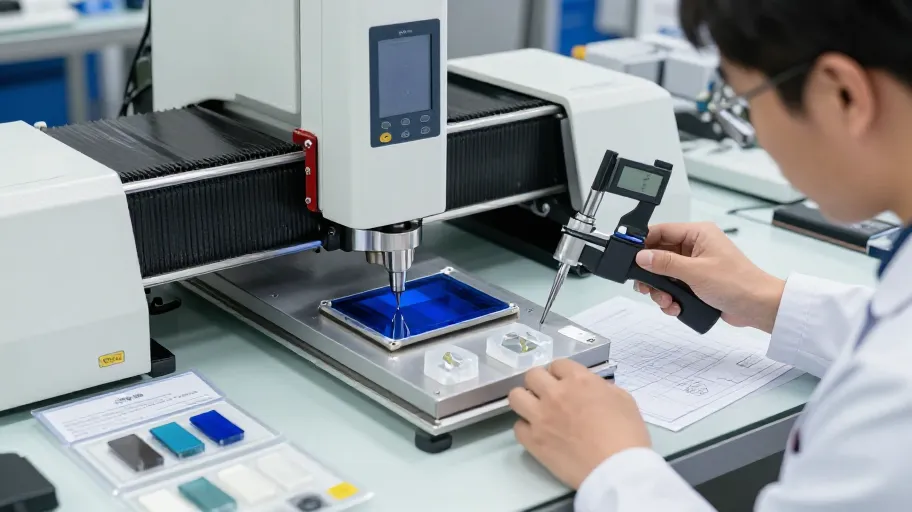
Every private-label watch project eventually reaches the same gate: one supplier will cut, grind, polish and — in many cases — coat the crystal that sits on top of your movement and your brand's reputation. To evaluate a sapphire crystal manufacturer, verify five things in order: real production capability, a documented quality system, engineering collaboration, reliable communication and transparent commercial terms. This article gives you a framework, a comparison table and the approval questions to ask before any tooling money moves.
Why "best" is the wrong question — and what to ask instead
Searches for the best sapphire crystal manufacturer return a long list of factories and trading companies. But "best" is not a property of a supplier. It is a property of the match between a supplier and a specific project: your case geometry, your dome profile, your coating requirements, your volumes, your documentation needs and your revision rhythm.
A manufacturer that suits a high-volume dive-watch program may be a poor fit for a short-run collector's piece with an unusual double-domed profile. The evaluation task is therefore not to rank the market. It is to gather evidence, compare candidates against your project's requirements, and document what each supplier can and cannot confirm in writing.
That is the purpose of the framework below.
The V.A.P.O.R. Framework for supplier evaluation
V — Verify capability. Ask what the supplier actually produces in-house versus subcontracts. For sapphire crystals, the critical processes include crystal growth or sourcing of the boule, orientation and slicing, shaping, grinding, polishing, drilling (for date windows), and coating deposition for anti-reflective treatments. A supplier may be strong in some of these and reliant on partners for others. Neither structure is disqualifying, but you need to know which processes are under the supplier's own control, because that shapes who is accountable when something goes wrong. Ask for process-flow documentation and for photos or videos of the actual lines, and ask which stages have in-process inspection.
A — Assess the quality system. Capability without control produces inconsistency. Ask how the supplier inspects incoming material, controls in-process dimensions, and performs final inspection. Ask what measurement equipment is used for surface quality, flatness and thickness, and what records you receive per batch. If your brand sells into markets with regulatory expectations for materials or substances, ask what documentation the supplier can provide — and require evidence, not assurance, for anything you intend to rely on.
P — Probe engineering collaboration. Custom crystals are an engineering conversation, not a catalogue purchase. Give each candidate the same drawing package — case dimensions, gasket seat, dome geometry, date-window position, coating specification, accepted references — and observe how they respond. A strong partner identifies ambiguities, proposes solutions and asks about tolerances you have not specified. A weak one says yes to everything and delivers surprises. Track how revisions are quoted, documented and version-controlled.
O — Observe communication. In a private-label program, most failures are communication failures wearing a quality costume. Note response time, whether the same engineer stays on your project, whether answers address your actual questions, and how the supplier behaves when you ask something difficult. Ask explicitly how they notify buyers of process changes, delays or nonconformities once production is running.
Decision table: matching supplier evidence to your project
| Evaluation dimension | Evidence to request | What strong evidence looks like | What to document in your scorecard |
|---|---|---|---|
| Capability (V) | Process flow, in-house vs subcontracted steps, equipment list | Specific answers per process; willingness to show lines | Which steps the supplier controls directly |
| Quality system (A) | Inspection plan, measurement methods, batch documentation | Defined inspection stages; named instruments; documented outputs per lot | What certificates/records accompany each batch |
| Engineering (P) | Response to your drawing package | Questions back, ambiguity flagged, tolerance discussion | Quality of first technical exchange |
| Communication (O) | First-contact and follow-up behaviour | Consistent contact, direct answers, change-notification process | Responsiveness and escalation path |
| Commercial terms (R) | Written confirmations on MOQ, samples, tooling, IP, revisions, delivery | Each term confirmed in writing, not verbally | Exact wording of each confirmed term |
Score each dimension 1–5, weight the dimensions by what matters most to your project, and compare candidates on the same sheet. The point is not the absolute score; it is the pattern of gaps.
Approval questions to ask every candidate
Before approving a supplier, get written answers to these. Where an answer is "it depends," record what it depends on.
- Which production stages for our crystal do you perform in-house, and which do you subcontract?
- What inspection points exist between raw material and finished crystal, and with what equipment?
- What documentation ships with each production batch?
- What anti-reflective coating options can you offer, and how do you verify coating performance — and what results can you evidence for our specific part?
- How do you handle a drawing revision after tooling exists, and how is the change priced and documented?
- What is your current minimum order quantity for a custom part, and how does it change across dome profiles and coatings?
- Who owns the tooling and the drawings if we part ways?
- How will you notify us of a process change, delay or nonconformity during production?
- Which named engineer or contact owns our account after the first order?
Every one of these is project-specific. The right answer is not a fixed number; it is a written confirmation you can hold both sides to.
Red flags worth documenting
Treat the following as prompts for deeper questions, not automatic disqualifications: refusal to distinguish in-house from subcontracted processes; yes to every specification without a single clarifying question; quality claims unsupported by any inspection documentation; commercial terms that shift between conversations; and no named owner for your account. Note each in your evaluation sheet, date it, and ask the supplier to resolve it in writing.
FAQ
How many sapphire crystal manufacturers should I shortlist for a private-label project? Three to five is a workable range for most programs: enough to compare meaningfully, few enough to run the same drawing package and question set through each. Applying the identical evaluation to every candidate is what makes the comparison valid.
Should I visit the factory before approving a supplier? A visit is one of the strongest verification tools available, and for many private-label programs it is worth planning around a sourcing trip to manufacturing hubs. If a visit is not feasible, ask for a live video walkthrough of the relevant lines and match what you see against the process flow the supplier documented.
How do I evaluate anti-reflective coating quality without technical equipment? Ask the supplier how they verify coating performance, what evidence they can produce for parts matching your specification, and whether an independent third party can test samples. Then decide what verification you will run on your side before production release — and record who is responsible for what.
What should the sample approval process cover? Define it in writing before ordering samples: which specifications the sample must meet, how conformity will be measured and by whom, how many rounds of revision are in scope, and what happens — commercially and technically — when a sample does not conform. Confirm the supplier's current sample policy directly rather than assuming it.
How do I protect my design when sharing drawings with candidate suppliers? Use a confidentiality agreement before sending any proprietary drawing package, and keep records of what was sent to whom and when. Ask each supplier to confirm in writing how your files are stored and who can access them.
Download the Supplier Scorecard
Turn this framework into a side-by-side comparison document. The Supplier Scorecard gives you weighted columns for capability, quality system, engineering, communication and commercial terms, plus a written-confirmation log for every term you approve.
[Download Supplier Scorecard →]
Not ready to score suppliers yet? Start lighter: take the ten approval questions above as your pre-qualification checklist, send the same drawing package and question set to each candidate, and record the answers. The scorecard will be waiting when you're ready to compare.