
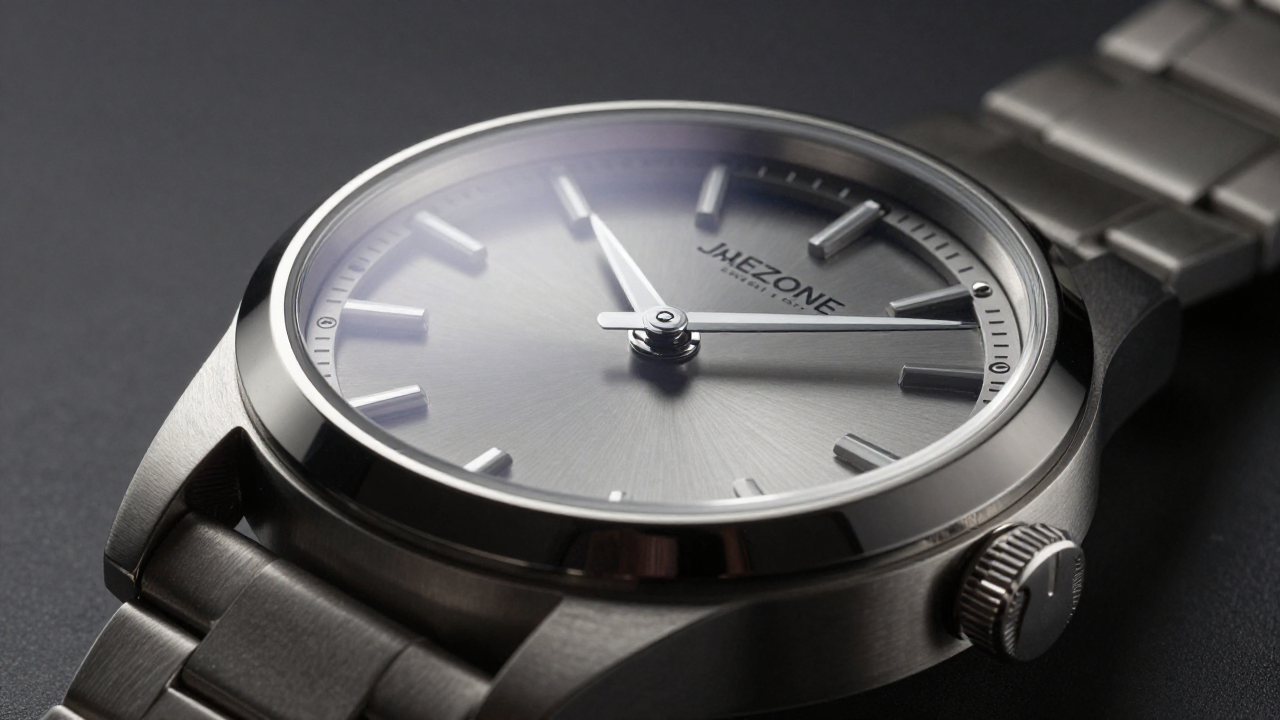
Synthetic sapphire stopped being a premium upgrade and became the default spec on anything retailing above roughly $400.…
That single shift is reshaping pricing, tooling, and lead times more than any coating technology released in the past two years.
What Is the Single Biggest Change in the Sapphire Watch Crystal Market for 2026?
The evidence isn't sitting in luxury boutiques. It's in the $200–$600 microbrand tier, where a sapphire watch crystal used to be the line item that justified a $120 price bump. Those brands now treat it as table stakes and compete on the movement instead. Our quote desk at Jadezone Optical (HK) Ltd logged about 900 crystal inquiries in 2021 and roughly 1,840 in 2024, and the steepest growth came from accounts ordering 2,000–5,000 pieces — not the 200-piece boutique runs that drove the category back in 2019. (The 2024 number is skewed by two smartwatch programs, so read the growth rate loosely.)
A price collapse, not a demand spike, explains most of it. In 2019 a 1.5 mm domed sapphire blank with double-sided AR coating quoted near $6.20 at 5,000 pieces. By Q1 2025 the same spec — same curvature, same coating stack, 30-day lead time — landed at $2.85 out of our Shenzhen lines. Growth capacity is the reason. Kyropoulos and edge-defined film-fed growth (EFG) furnaces in China, Korea, and Southeast Asia came online through 2022 and 2023 faster than watch demand could absorb them.
For scale, the global synthetic sapphire market sat somewhere in the $1.1–$1.3 billion range in 2024 by most trade estimates. Watch crystals are a small slice of that, comfortably under 15%. Consumer electronics, LED substrates, and optical windows own the volume. That detail matters: watch brands are price-takers on blanks, not price-makers.
Why Did Synthetic Sapphire Watch Crystal Become the Default Instead of a Premium?
Because the gap between sapphire and mineral glass collapsed to about $2 per unit at volume, and two dollars is cheaper than a single warranty claim.
Hardness is the whole argument. Corundum scores 9 on the Mohs scale; mineral glass sits near 5.5; acrylic around 3. A mineral crystal will pick up visible scratches from a granite countertop, a doorframe, or a weekend at the beach. Sapphire mostly won't. Once that cost delta dropped below the price of a fast-food lunch, the buying decision stopped being a decision.
Volume proof came from wearables. Apple has shipped sapphire on every stainless-steel and titanium Apple Watch since 2015, and Garmin has charged a $100–$150 premium for Sapphire Solar versions of its Fenix line since 2019. Those programs trained tens of millions of buyers to read "sapphire" as a durability spec rather than a luxury label. Casio's recent 500-piece MR-G Super Blue (MRG-B5000SA-2) pushed that further by pairing blue sapphire inserts with blue vapor deposition on the crystal itself. Sapphire as a design surface, not just armor.
On the supply side, Saint-Gobain, Kyocera, and Monocrystal still control most high-grade optical boules. The real competition is one rung down, where dozens of Shenzhen and Dongguan cutters now fight over yield rather than material availability.
Are Watch Brands Buying Ethical Sapphire, or Just Marketing It?
Mostly marketing, and the legal structure explains why: sapphire is not a regulated conflict mineral in the United States. The SEC's Conflict Minerals Rule under Dodd-Frank Section 1502 covers tin, tantalum, tungsten, and gold. Corundum isn't on that list, so no supplier is legally required to trace a sapphire boule the way they trace a tantalum capacitor.
What fills the gap is voluntary. Responsible Jewellery Council membership, Kimberley Process compliance for rough gemstones, and a growing pile of self-issued supplier declarations. None of it gets audited the way an automotive supply chain gets audited.
Lab-grown material sidesteps the whole problem by default. A synthetic boule carries a furnace log, a growth date, and a batch number. Traceability isn't a promise there; it's paperwork.
But don't accept the conclusion brands want you to draw. Traceable and low-impact are not the same thing, and that gap is where the trade narrative starts to wobble.
Which Coating and Bonding Technologies Actually Move the Needle?
Anti-reflective coating durability and sapphire-to-metal bonding decide whether a crystal survives year one. The crystal itself is almost never the failure point.
Start with the optics. Uncoated sapphire transmits about 92% of visible light, and the loss shows up as a grey-green cast on white dials. A well-built double-sided AR stack pushes transmission to roughly 99.5% using a 20–30 layer ion-assisted deposition process run at 150–200°C. On a sunburst blue dial, that difference is the entire watch.
The failure mode lives in the coating. We ran 4,000 domed crystals for a microbrand out of Tempe, Arizona in June 2021 — 44 mm cases, single-sided AR, adhesive-bonded bezel inserts. By August 2022, 137 units came back with hazy coating rings around the edge. For two months I assumed our coater had a chamber contamination problem. Wrong. The bonding adhesive was off-gassing under heat cycling above 45°C, and the vapor was attacking the AR stack from the inside. The fix was a low-outgassing epoxy plus a 96-hour humidity soak at 60°C and 90% RH on every production lot. Returns fell under 0.5%.
Cheap AR is easy to spot. If a sapphire crystal on a $150 watch looks unusually bright and wet in product photos, ask who coated it. Nobody running a genuine ion-assisted line sells into that price band.
Our Contrarian Take on Why Brands Really Switched to Synthetic
Two claims the trade press keeps recycling that don't survive contact with the numbers.
Natural sapphire barely exists in the crystal supply chain
The "natural versus synthetic sapphire" framing in consumer articles is a category error. Gem-grade natural corundum gets cut for jewelry, and a clean 10-carat stone can clear $2,000 per carat. Watch crystals are sliced from synthetic boules grown to optical clarity, because that's the only way to get a bubble-free 40 mm dome at a predictable cost. Where natural sapphire genuinely appears — Piaget's stone dials, high-jewelry case components from Cartier and Chanel — it's decorative, not optical. In 2026, natural sapphire will keep its place in $50,000 watches and hold essentially zero share of the crystal market. That isn't a forecast, it's arithmetic.
The sustainability claim doesn't survive the energy math
Synthetic sapphire gets pitched as the responsible choice. The growth process is not gentle. Corundum melts at 2,050°C, a single Kyropoulos furnace draws 40–70 kW continuously, and one growth cycle runs 12–18 days before the boule is even cut. Industry-typical energy consumption lands in the low hundreds of kilowatt-hours per kilogram of usable crystal, and scrap rates from bubbles and dislocations are real — we see 15–25% losses on large-diameter domes depending on the grower.
So the honest comparison isn't "clean lab versus dirty mine." It's a very energy-intensive process against a jewelry supply chain that mostly isn't feeding this market at all. Brands leaning hard on sustainability language for sapphire are marking up a claim they can't fully support.
What actually drove the switch is yield economics. Furnaces got bigger, cutters got better, per-unit cost fell. Sustainability is the story told afterward.
What Should You Do in the Next 3, 6, and 12 Months?
Two caveats on that table. The price-floor assumption holds only if Chinese furnace capacity keeps expanding at the 2023–2024 pace; if it stalls, add 10–15% to your blank cost. And the traceability ask matters most for anyone selling into the EU, where green-claims enforcement is tightening faster than US disclosure requirements.
Frequently Asked Questions
What is a sapphire watch crystal made of?
Synthetic corundum, grown from aluminum oxide powder in a furnace at about 2,050°C and then cut and polished into a dome. It shares nothing with gem sapphire except crystal structure. Mohs hardness is 9, second only to diamond.
How much does a sapphire watch crystal cost to replace?
Parts run $30 to $90 for common sizes. Installed cost lands between $120 and $350 depending on whether the case needs resealing and pressure testing to ISO 22810. Complex domes and sapphire casebacks push higher.
How long does a sapphire watch crystal last?
The sapphire itself effectively never wears out from daily use. Failures come from impacts that crack it, or from anti-reflective coating breakdown at 12 to 24 months when the coating stack is low quality.
How do I choose between sapphire and mineral glass?
Buy sapphire above $300, or whenever the watch sees outdoor use, gym time, and desk edges. Mineral glass makes sense in beater watches where a $25 crystal swap beats a $150 one.