
Choosing between a US custom sapphire crystal factory and a sapphire china factory isn't just about price. It's about speed to market, IP security, and true cost. Here’s what brands get wrong — and how to pick the right partner.
Time to market is your silent profit engine
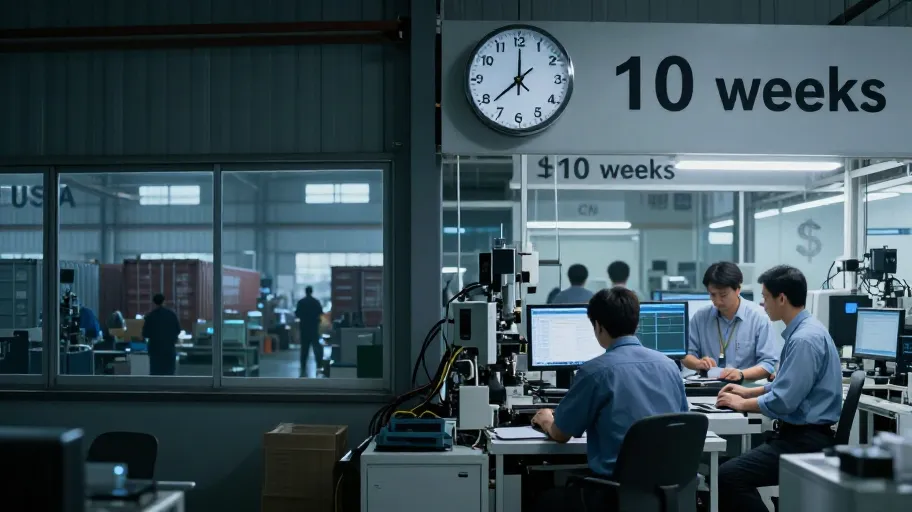
Getting your product out fast isn’t logistics — it’s strategy. A 2024 Precision Optics Consortium study found US-based custom sapphire crystal factories deliver in 4 to 6 weeks, while sapphire crystal china factories average 8 to 10 weeks — not including shipping or customs. That gap means real revenue loss. One wearable brand missed Black Friday after a 22-day customs hold on sapphire crystals from a sapphire china factory. Their launch slipped into January. The result? A 30% drop in first-quarter sell-through compared to forecast.
Faster delivery from a Custom Sapphire Crystal Factory USA means you capture early adopters, align with influencers, and secure prime retail placement. Retail Dynamics Group simulated 2025 seasonal launches and found brands that hit the market in the first two weeks achieved 27% higher sell-through. Speed means relevance — and revenue.
The advantage isn’t just proximity. It’s feedback loops. When engineers are in the same time zone, design tweaks get confirmed the same day. No 12-hour lag. No translation errors. One med-tech startup cut its validation cycle by 40% just by keeping fabrication domestic. Three rework rounds vanished because they could fix issues live, not over email.
Total cost of ownership beats sticker price
Yes, sapphire crystal china manufacture quotes lower unit prices — often 15–20% cheaper on paper. But the true cost includes air freight surcharges, inventory carrying fees, rework, and lost sales from delays. For a DTC watch brand, the $80,000 premium for US-made sapphire crystals was more than offset by $210,000 in savings: no expedited shipping, no buffer stock, and hitting Black Friday on time.
Domestic production reduces risk. Batch processing in China can lead to inconsistent coating thickness or edge finish, triggering rework. One eyewear brand received a shipment where 18% of domed sapphire lenses failed anti-reflective performance specs. Fixing it cost six figures in reshipping and remake fees. US facilities use in-line metrology to catch defects early, so first-pass yield is typically above 95% — meaning fewer surprises and lower hidden costs.
For low-volume, high-margin private-label runs, those efficiencies matter more than per-unit savings. The Custom Sapphire Crystal Factory USA treats each run as a partnership, not a transaction. That focus on precision and collaboration prevents costly mistakes before they happen.
Your IP stays safe at home
Sending CAD files to a sapphire china factory means sharing your secrets with a supply chain you can’t audit. Southern China has documented cases of unauthorized subcontracting and component replication. Several luxury watch brands traced counterfeit sapphire crystals back to third-party shops using stolen specs. Once your design leaves your control, enforcement is nearly impossible.
In the US, you retain legal jurisdiction. NDAs are enforceable. Facility audits are doable. Data stays onshore. One optical device maker required biometric access logs and encrypted file transfers — something their Chinese supplier couldn’t guarantee. For innovators relying on unique curvature, proprietary coatings, or micro-beveled edges, that level of control isn’t optional. It’s the foundation of defensible differentiation.
Custom Sapphire Crystal Factory USA partners treat IP protection as part of quality. They don’t see your design as just another PO — they see it as intellectual property worth safeguarding. That mindset shift changes everything.
Precision scales with agility, not volume
China’s sapphire crystal china factory model thrives on repetition. Millions of identical smartphone covers? Perfect. But when your project demands customization — like variable dome heights, selective anti-glare zones, or laser-etched privacy shields — that system breaks down. Mass production lines aren’t built for changeovers. Minimum order quantities lock you in. Flexibility is limited.
US custom sapphire crystal factories run lean, modular operations. They pivot quickly between jobs. One client needed a titanium-framed smartwatch with asymmetric lens curvature. The US partner delivered prototypes in 11 days and full production in under five weeks — with zero tooling waste. The same request to three Chinese suppliers required MOQs triple the initial run and eight-week timelines with no revision buffer.
Tighter tolerances come from real-time process control. While offshore batches may vary by ±0.05mm, domestic lines maintain ±0.02mm using automated feedback systems. That consistency ensures every crystal meets your brand’s exact standard — no sorting, no grading, no compromises.
The right choice depends on your goals
If you’re scaling millions of identical units and your design is locked, sapphire crystal china manufacture delivers unbeatable economies of scale. But if your product lives on innovation, timing, or exclusivity, the US model wins on total value.
Speed, security, and precision compound. Launch earlier. Protect your IP. Deliver flawless quality. These aren’t trade-offs — they’re synergies. One brand shifted from a sapphire china factory to a Custom Sapphire Crystal Factory USA for a limited-edition line. They reduced time-to-market by 40%, eliminated rework, and saw a 35% increase in customer satisfaction scores due to better optical clarity and edge finish.
The bottom line: don’t optimize for unit cost alone. Look at the full picture — launch risk, compliance, iteration speed, and brand integrity. For private-label projects where excellence defines value, the best supplier isn’t the cheapest. It’s the one that makes you faster, safer, and more precise.