
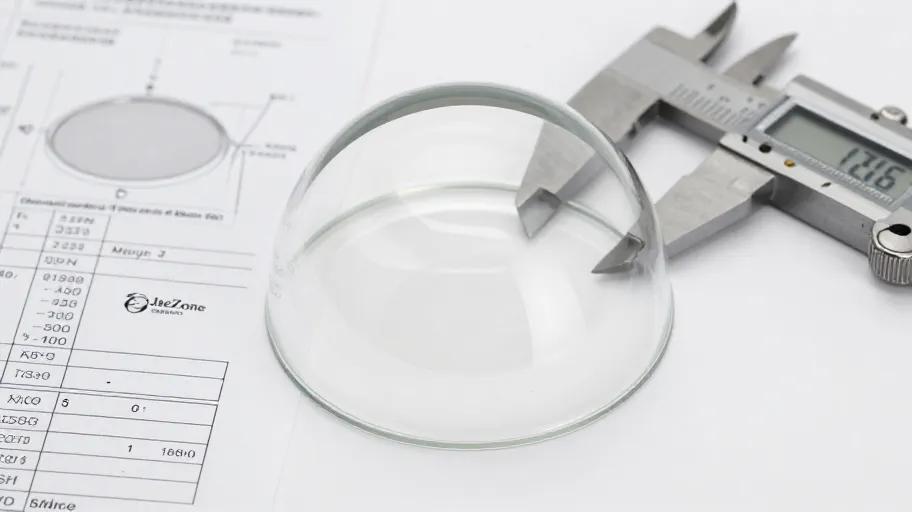
A domed watch crystal is a curved, transparent sapphire cover glass for a watch case, grown as synthetic sapphire and ground into a raised profile rather than a flat disc. For a sourcing manager, the purchasing risk sits in three places: the geometry specification, the sample evaluation, and the written approval gate. This guide walks through all three so your RFQ to JadeZone Sapphire — or any sapphire manufacturer — is precise, testable and defensible.
Why dome geometry drives the sourcing conversation
A flat crystal is defined by diameter and thickness. A domed crystal adds at least two more variables that determine fit, optics and cost of the project: the dome height above the edge and the curvature profile — whether the rise is spherical, a continuous arc, or a shaped profile specific to your case design. The edge treatment matters just as much: a boxed dome, a stepped flange, or a tension-fit edge each interact differently with the case bezel and gasket.
Because these variables are case-specific, a domed crystal cannot be sourced responsibly from a catalogue mindset. The buyer's job is to convert a design intent into a dimensional and finish specification, then verify that the supplier can measure and hold it before any volume commitment.
The SPEC–SAMPLE–SIGN framework
A practical way to run a domed crystal project is a three-gate framework:
- SPEC — Write a complete drawing and finish specification before contacting suppliers. Every dimension that affects fit, every surface that affects appearance, and every test that defines acceptance.
- SAMPLE — Request production-representative samples and evaluate them against written pass/fail criteria, not visual impressions. Document what you measure and how.
- SIGN — Approve formally against the documented criteria, record the approved revision, and lock the drawing revision referenced on the purchase order.
Each gate produces a document. If any gate produces only a verbal assurance or an unmeasured opinion, the project has skipped a gate.
Decision table: choosing the crystal form for your project
| Criterion | Flat crystal | Domed crystal | Double-domed / high-profile crystal |
|---|---|---|---|
| Fit complexity | Lowest — diameter and thickness | Moderate — dome height and profile added | Highest — bilateral curvature, case-specific tooling discussion |
| Optical behaviour | Predictable reflections | Raised profile changes reflection geometry; AR options to discuss | Highest risk of distortion if profile is mis-specified; prototype strongly advised |
| Vintage / design signal | Neutral | Strong retro character | Strongest vintage signal |
| Dimensional definition burden | Drawing with basic callouts | Drawing plus dome profile and edge treatment | Full profile definition, reference datum strategy |
| Approval evidence to request | Measurement report on key dimensions | Report including profile/height measurement method | Profile measurement method plus first-article inspection scope — confirm with supplier |
None of these columns implies a performance outcome. They describe what you, the buyer, must specify and verify — not what any supplier will deliver.
What to put in your domed crystal RFQ
- A dimensioned drawing with the dome profile explicitly defined, plus the datum the profile is measured from.
- Edge treatment: tension edge, boxed edge, stepped flange or custom — with the case interface dimensions.
- Finish requirements for both surfaces, and any anti-reflective coating intent.
- The movement-side clearance requirement, so dome sag into the dial area can be checked against the movement height.
- How dimensions will be verified: which measurement methods the supplier uses, and what evidence accompanies shipments.
- Your acceptance criteria, so the supplier can price and plan to a defined standard rather than an implied one.
Tolerances, coating specifications and measurement methods are project-specific. Do not assume values; ask the supplier what they can hold and verify, then record the agreed values in the approved drawing.
Sample evaluation: what to actually check
When samples arrive, evaluate them against criteria written before the samples existed. A usable domed crystal sample checklist:
- Dome profile matches the approved drawing at the agreed measurement points — method documented.
- Dome height verified against the specified reference datum.
- Diameter and edge geometry fit the target case — test assembly performed and recorded.
- Surface finish inspected under defined lighting and magnification on both faces.
- Optical distortion checked by viewing a reference pattern through the dome at set viewing angles.
- Coating presence and visual effect checked against the agreed reference, if coating was specified.
- Any deviation logged in writing, with disposition: accept, rework or reject.
Pass or fail, keep the sample and the record. It is your baseline for the first production lot.
Approval questions to confirm with the supplier
These questions deliberately avoid assuming any policy. Confirm each one in writing with JadeZone Sapphire or your chosen manufacturer:
- What are your current MOQ, pricing structure and lead time for this drawing?
- What dimensional tolerances can you hold and verify for this dome profile, and with which measurement methods?
- What inspection documentation accompanies samples and production shipments?
- What happens if a delivered lot deviates from the approved drawing — what is the disposition process?
- Which drawing revision will the purchase order reference, and how are revisions controlled?
FAQ
Is a domed sapphire crystal harder to specify than a flat one? Yes, in a documentation sense. The dome profile and its measurement datum must be defined explicitly, and the edge treatment must match the case interface. The manufacturing difficulty is a question for the supplier to answer against your specific drawing.
How do I verify a dome profile without laboratory equipment? Ask the supplier which method they use and what report they provide. On your side, a test assembly in the actual case plus a documented visual check against a reference pattern will catch fit and distortion issues; formal dimensional verification should come from the supplier's measurement evidence, which you should compare to the drawing.
Should I request samples before finalising the drawing? Request samples against a defined draft revision, and treat them as inputs to drawing finalisation. Approve the final revision only after samples pass your written criteria — that is the SIGN gate.
What documentation should travel with production orders? At minimum: the approved drawing revision number, the agreed measurement methods, and whatever inspection report scope the supplier confirms it provides. Confirm the exact documentation package before the first order.
Can a domed crystal be changed after approval? Any change should trigger a new revision and, where geometry changes, a re-sample. Confirm the supplier's revision-control process in writing so both sides reference the same drawing.
Next step
If you are preparing a domed watch crystal project, 获取采购 Brief — a structured specification and approval document you can send to any sapphire manufacturer, including JadeZone Sapphire.
Not ready for that? Download the free sample-evaluation checklist above and run it against your next incoming crystal sample first.