
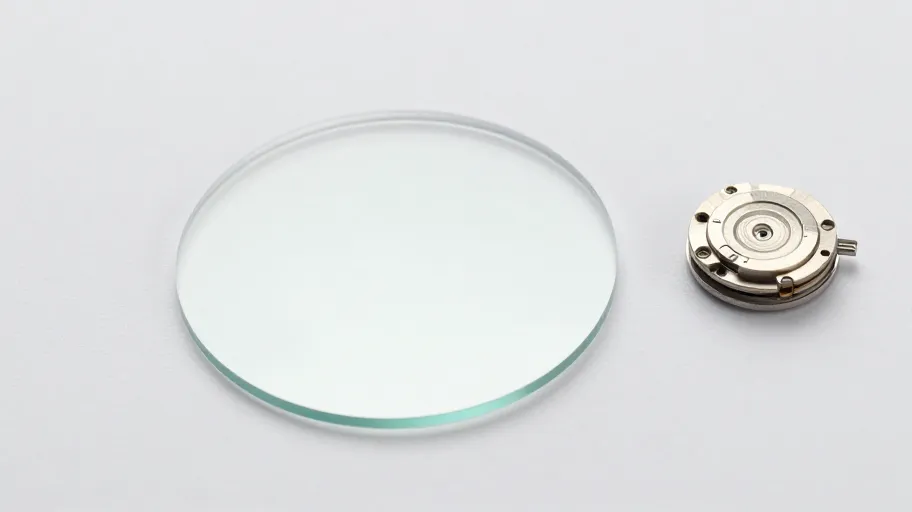
The cheapest sapphire crystal watch, from a sourcing perspective, is the one built around a simplified crystal specification: a flat or minimally curved profile, standard thickness, plain edges, and no optional coatings or applied features — produced by a supplier whose sample you have inspected and approved in writing before tooling. Cost in custom sapphire is driven less by "sapphire" itself and far more by geometry, finish, coating and feature choices. This guide gives you a framework to control those levers deliberately.
The Spec-Cost-Lever Framework
When a buyer asks "what is the cheapest sapphire crystal watch?", the useful question becomes: which specification choices in my design are adding cost, and which of them does my market actually notice? We call the answer the Spec-Cost-Lever Framework. It has three levers and one gate:
- Lever 1 — Geometry. Dome height, box-section profiles, step flanges, unusual plan shapes and tight curvature all increase grinding and polishing complexity. A flat crystal with a straightforward outline is the least demanding to produce and inspect.
- Lever 2 — Finish and coatings. Each additional finished surface — bevelled edge, polished flank, anti-reflective coating on one or both sides — adds a process step, a yield risk and an inspection requirement.
- Lever 3 — Feature set. Date windows, cyclops magnifiers, tension rings, gasket grooves and printed or applied indices each add an operation. Some are market-necessary; some are design habit.
- The Gate — Documented sample approval. Whatever specification you choose, the cheapest outcome is the one you approve against written criteria before mass production, because rework and disputes cost more than any lever.
The framework's value is not that it tells you to delete features. It tells you to decide which features carry their cost. A flat crystal with no coating may be entirely correct for a value line; a double-domed coated crystal may be correct for a flagship. The mistake is specifying by default rather than by intent.
Decision table: specification choices and cost behaviour
Use this table in your design review. "Cost behaviour" describes the direction and reason a choice affects cost — not a price, which depends entirely on your project and supplier and must be quoted per enquiry.
| Specification choice | Lower-cost direction | Higher-cost direction | Question to ask before deciding | Cost behaviour rationale |
|---|---|---|---|---|
| Crystal profile | Flat, single gentle curve | Double dome, box section, steep curvature | Does the design reference need this curvature, or is it inherited? | More complex curves need more grinding and polishing stages |
| Plan shape | Round, standard outline | Tonneau, cushion, asymmetric | Can the case design accept a round crystal with a shaped bezel? | Non-round outlines complicate both processing and inspection |
| Thickness strategy | One standard wall | Varying thickness, stepped sections | Is the step structural or cosmetic? | Stepped sections multiply controlled surfaces |
| Edge treatment | Plain ground edge | Polished or bevelled flank | Will the edge be visible in the finished watch? | Invisible edges invite unnecessary finishing cost |
| AR coating | None or single-side | Double-sided, colour-tuned | What lighting conditions does the market use the watch in? | Each coating layer adds process and yield considerations |
| Features | Plain crystal | Date window, cyclops, groove, tension ring | Which features are market-facing vs. engineering habit? | Every feature is an added operation with its own inspection |
| Tolerance callout | Functional tolerances | Uniform tight tolerances everywhere | Which surfaces actually mate or seal? | Over-tightened tolerances where not needed add no value — ask which dimensions are functional and confirm what your supplier can hold per drawing |
This last row matters more than buyers expect. Over-tolerancing a drawing "to be safe" is one of the quiet ways a project becomes expensive. Ask your supplier which dimensions are functional, which they recommend relaxing, and what they can consistently hold for your part — then document the answer.
Reading a "cheap" quote without being fooled or over-specifying
A low number on its own tells you nothing, because quotes differ in scope. Two suppliers can quote the same drawing with different inclusions: tooling, first samples, coating, inspection documentation, packaging, or rework terms. The honest way to compare is to force the comparison to the same scope.
Ask every supplier the same scope questions, in writing:
- Does the quote include tooling, and who owns the tooling if we move production later?
- Which inspection criteria and documentation come with delivery, and against which drawing revision?
- Which surface finishes and coatings are included in the quoted specification?
- What is not included that we should budget separately?
- How are deviations from drawing handled at sample stage versus at production stage?
Regarding samples, fees and shipping: confirm the current policy directly with the supplier, and record it in your project file. Do not rely on assumptions or on what another supplier does — treat sample and fee policy as a per-supplier, per-project question, answered in writing.
The "cheapest sapphire crystal watch" at the project level is the one where the quote scope is transparent enough that no cost surprises appear after approval. A marginally lower unit price with an opaque scope is not a saving; it is an unpriced risk.
Sample approval: what to inspect and what to document
Sample approval is where a low-cost specification either proves itself or fails. Approve against written criteria, never a verbal "looks fine". At minimum, document:
Sample approval checklist
- Drawing revision number matches the sample being inspected
- Profile and outline match the approved 3D model, checked against stated functional dimensions
- Edge treatment matches the specification (ground, polished, bevelled as ordered)
- Coating, if specified, present on the correct side(s) and visually assessed under agreed lighting
- Date window, cyclops or other features positioned and sized per drawing
- Fit trial with the actual case and gasket completed and photographed
- Any deviation recorded in writing, with supplier response and agreed disposition
- Approval (or rejection) signed and dated, with retained reference samples identified
- Sample and fee policy for this project confirmed in writing — confirm the current policy directly
- Production inspection criteria agreed to be identical to the approved sample criteria
A supplier who engages willingly with this checklist is telling you something about how production will be controlled. A supplier who resists documenting acceptance criteria is telling you the same thing, in the opposite direction.
FAQ
1. Is a sapphire crystal the right choice for a value-oriented watch line? That depends on your market positioning and target price, which is a commercial decision. Technically, sapphire's scratch resistance is a recognised selling point for watch crystals, and simplified specifications can keep custom sapphire within reach of mid-market programmes. Compare the cost of the simplified sapphire specification against your alternatives on the same scope before deciding — and confirm pricing per project.
2. Which single specification change most reduces cost in a custom sapphire crystal? Geometry is the most influential lever for most designs. Moving from a complex curved profile to a flat or gently curved one removes grinding and polishing stages. But the answer for your part depends on the drawing — review your design against the decision table above and ask your supplier which features they would recommend simplifying.
3. Should we skip AR coating to save cost? Only if your market accepts the reflection characteristics. Coating is market-facing: buyers see it every time they read the dial. Removing an invisible cost is smart; removing a visible quality cue to hit a price can damage the line. Decide it deliberately, then confirm the coating options and their process details with your supplier.
4. How do we compare two suppliers quoting the same sapphire crystal drawing? Force both quotes to identical scope using the scope questions above, then compare sample quality against the same written approval checklist. Whichever supplier documents their answers more precisely gives you the more comparable — and more predictable — number.
5. What documentation should we keep after approving a sample? Retain the approved drawing revision, the signed checklist, reference samples, the supplier's written responses to any deviations, and the written confirmation of sample, fee and delivery arrangements for the project. Confirm the current policy directly for each of these items rather than carrying assumptions between projects.
Next step
获取采购 Brief — request the JadeZone Sapphire sourcing brief for custom sapphire watch crystals. It walks your team through the specification levers, scope questions and approval documentation covered in this guide, so your RFQ goes out comparable and complete. (CTA destination link to confirm before publishing.)
If you are not ready to request the brief, start smaller: download or copy the sample approval checklist above and run it against your next crystal sample. It costs nothing to use and will sharpen your next supplier conversation.