
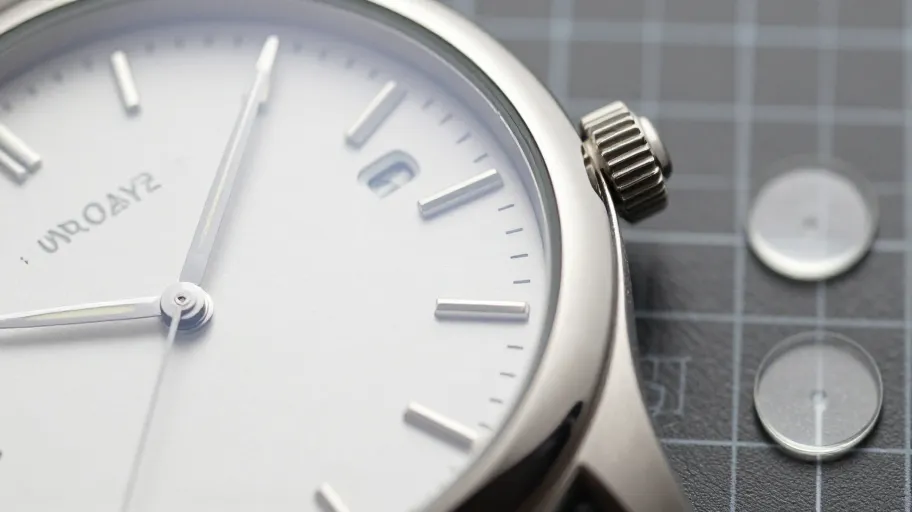
Yes — sapphire crystal is a strong choice for watches when the goal is scratch resistance and long-term optical clarity, and the specification, coating and fit are documented and approved against samples. Whether it is the right choice for your watch depends on product positioning, case design and your approval process, not on the material alone.
Why This Is a Sourcing Question, Not a Consumer One
A consumer asks whether sapphire scratches less. A sourcing manager asks a harder question: will this specific crystal, made to this specific drawing, pass this specific approval process, at a quality level we can document across production?
The material question and the procurement question are related but not identical. Sapphire as a material is well understood. Sapphire as a delivered component depends entirely on how it is grown, cut, ground, polished, coated, inspected and packed — and on how clearly you specified all of that. This guide focuses on the procurement question.
What Sapphire Offers — and What You Must Verify
Sapphire (single-crystal aluminium oxide) is valued in watchmaking for hardness and optical clarity. But as a buyer, treat every material advantage as a hypothesis to verify in your samples, not a fact to assume. AR coating adhesion, surface quality, dimensional fit to your case gasket, and consistency between sample and production lots are all supplier- and project-specific.
No supplier claim about defect rates, coating performance, tolerances or certifications should enter your decision file unless it is backed by current documentation you have reviewed. Confirm the current policy directly.
The SPEC-APPROVE Framework
Use this five-stage framework to turn "is sapphire good?" into a documented decision:
- S — Specify. Define geometry, thickness profile, coating, finishing, marking and fit requirements on a controlled drawing.
- P — Prototype. Request samples against that drawing and agree in writing how they will be evaluated.
- E — Evaluate. Test samples against your written criteria — fit, optics, coating, edge quality — using your own inspection, not the supplier's summary alone.
- C — Confirm. Reconcile every deviation with the supplier in writing; revise the drawing or the process until both sides sign the same document.
- A — Approve. Issue a formal approval referencing the drawing revision and retained golden samples before production is released.
Skipping the "Confirm" step is where sourcing problems begin: verbal agreements about "it'll be the same as the sample" are not approval criteria.
Decision Table: Choosing Sapphire by Product Context
| Product context | Sapphire suitability | Key evaluation focus | Watch-outs |
|---|---|---|---|
| Premium/flagship watch line | Strong candidate | Coating quality, optical consistency across lots | Verify coating inspection method, not just hardness claims |
| Mid-range mechanical watch | Candidate, cost/positioning dependent | Thickness vs. case design, gasket fit | Fit failures trace to drawings, not material |
| Sports/dive watch | Candidate; pressure and sealing are project-specific | Crystal retention design, thickness, edge finishing | Do not assume sealing performance; test in your assembly |
| Vintage-inspired or curved-dome design | Candidate; geometry drives difficulty | Dome profile tolerance and polish uniformity | Complex geometry raises approval complexity |
| Entry-level line | Evaluate against positioning | Whether approval effort matches product strategy | Consider whether full sapphire serves this tier |
This table is a planning aid, not a rule. Your positioning, case engineering and target quality level decide the answer.
Specification Inputs to Prepare Before Contacting a Supplier
- Controlled 2D drawing with tolerances you actually need (not copied defaults).
- Thickness profile, including any dome or box geometry.
- Coating definition: which faces, which type, acceptance criteria.
- Edge and finishing requirements: polish, chamfer, bevel.
- Fit interface: gasket, bezel or clamp — with the mating case dimensions.
- Marking/printing requirements, if any.
- Inspection and packing expectations, stated as measurable criteria.
- Quantity planning and program timeline as internal context for discussion.
Approval Questions to Ask Every Candidate Supplier
- Can you produce to our controlled drawing, and what documentation will accompany each lot?
- How do you inspect dimensional conformity and surface quality, and what evidence will we receive?
- What coating options do you offer, and how is coating quality checked?
- How are deviations from drawing communicated and resolved?
- Can we retain golden samples as the reference for production approval?
- What is your process for handling a lot that fails our incoming inspection?
These are project-specific questions. Any answer about minimum order quantity, price, sampling arrangements or timelines must come from the supplier in writing against your project. Confirm the current policy directly.
Supplier Verification Checklist
Before approving any sapphire crystal supplier, document:
- Drawing revision agreed and signed by both parties
- Samples received and evaluated against written criteria
- Fit verified in your actual case, gasket and assembly
- Coating inspected under your defined lighting and method
- Golden samples retained and labelled
- Deviations logged and resolved in writing
- Lot documentation requirements agreed
- Incoming-inspection and dispute process defined in writing
- All policy questions (quantity, price, sampling, timing) answered in writing
Frequently Asked Questions
Is a sapphire crystal good for watches compared to mineral glass?
For scratch resistance and long-term clarity, sapphire is the stronger material on paper — but the comparison that matters is between delivered components from specific suppliers. Evaluate samples of each option against your written criteria before deciding.
How do I evaluate a sapphire crystal sample fairly?
Define acceptance criteria before the sample arrives: fit in the real case, optical clarity, coating behaviour under your lighting, edge finishing. Inspect it yourself, log deviations, and only then negotiate corrections. Never approve from photos or a supplier's summary.
What specifications matter most for custom sapphire crystals?
Fit interface dimensions, thickness profile, coating definition and finishing. The most frequent failure mode in crystal sourcing is not material quality but an under-specified drawing that leaves interpretation to the supplier.
Should we demand certifications or test reports?
Ask what documentation the supplier can provide, verify it is current, and match it to your market and product requirements. Do not accept generic claims; request project-specific evidence and review it as part of your SPEC-APPROVE process.
How many approval rounds should we plan for?
That depends entirely on drawing maturity and geometry complexity. Agree the evaluation loop with the supplier in advance rather than assuming a fixed number of iterations.
Next Steps
[获取采购 Brief] — Get the JadeZone Sapphire sourcing brief and structure your next crystal RFQ around a documented specification and approval process.
Prefer to start smaller? Download the Sample Approval Checklist above and use it to structure your first evaluation round — no registration required.