
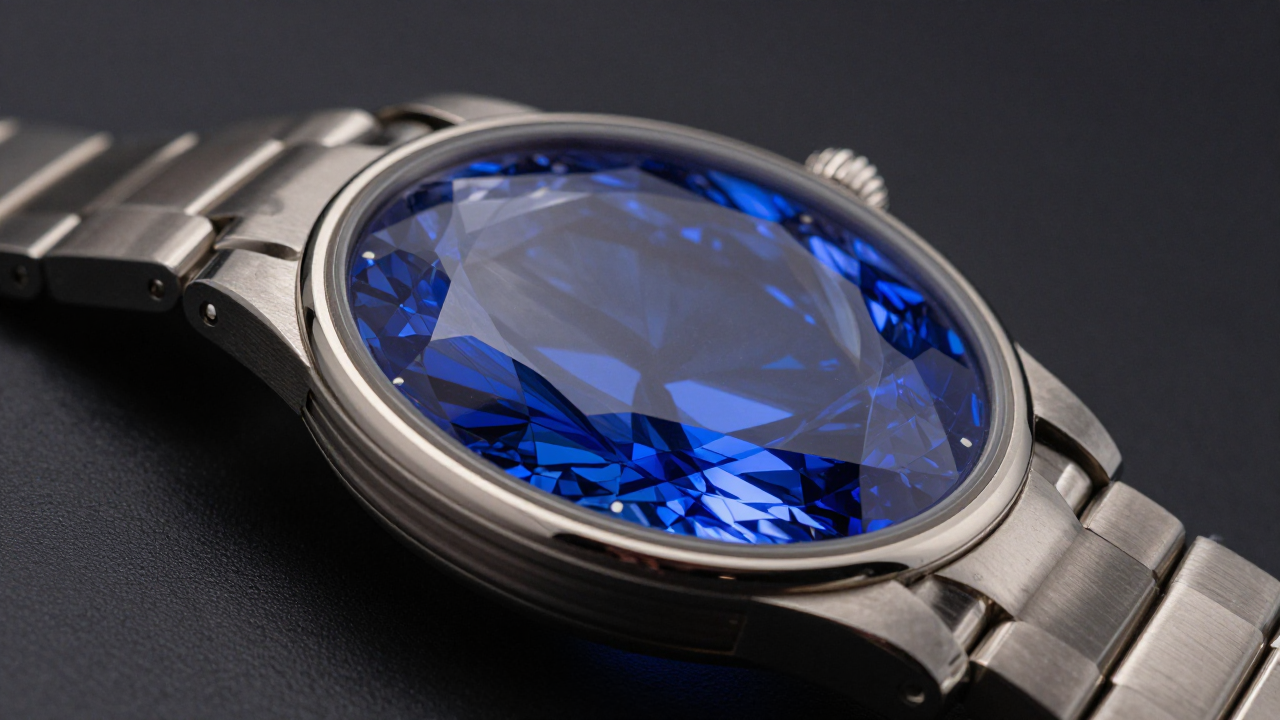
A sapphire watch crystal, made from synthetic single-crystal corundum, is highly resistant to scratches due to its 9 on the Mohs hardness scale. Only diamond, at Mohs 10, is harder.
Why Do Collectors Pay More for a Sapphire Watch Crystal in 2026?
The high hardness of sapphire justifies the price. In January 2026, a microbrand listed two otherwise identical 38 mm field watches: $189 with hardened mineral glass and $319 with a double-domed sapphire crystal. The sapphire crystal itself accounted for roughly $95 of the difference. The rest went to a thicker case gasket, a taller bezel to clear the dome, and a caseback engraved with the crystal specification.
The method of growing sapphire matters more than most buyers realize. Flame fusion (the Verneuil process) grows boules fast and cheap, and it supplies nearly every sapphire watch under $500. Kyropoulos and heat-exchanger methods produce larger, more optically uniform blanks at five to eight times the cost per boule. The gap shows up as faint striae visible under polarized light. No wearer will ever see striae on a wrist, which is why flame-fusion sapphire remains the right call for the overwhelming majority of builds.
One clarification keeps tripping up collectors this year. The Casio GMW-B5000SB 1A2, a full-metal G-Shock, does contain four blue sapphires. These are decorative stones mounted on the bezel, not the watch's crystal, so searches for a "blue sapphire G-Shock crystal" lead people to the wrong product entirely.
How Scratch Resistant Is a Sapphire Watch Crystal in Daily Wear?
Sapphire watch crystals measure roughly 1,800 to 2,200 on the Vickers hardness scale, compared to 500 to 650 for hardened mineral glass. A sapphire crystal can withstand desk edges, doorframes, and car keys for a decade. However, the anti-reflective coating on top of the sapphire is the part that actually fails.
In June 2019, Jadezone Optical shipped 8,000 double-domed sapphire crystals with an external AR coating to a microbrand in Denver. By March 2020, the brand had processed warranty claims on 241 units due to hairline scratches in the coating, not the sapphire beneath it. The solution was to move the AR stack to the inside surface only. Reflectance at 550 nm went from about 30% reduction to 15% reduction. The brand accepted the trade, and so do almost everyone else who has been through this once.
Hardness is a surface property, and this catches people off guard. Sapphire chips where mineral glass would merely scratch. In November 2021, a service center in Chicago returned a crystal to us with a half-moon chip at the 12 o'clock position. The owner had dropped the watch onto a ceramic tile floor from waist height. Mineral glass in the same drop would have gouged, not fractured. ISO 1413, the shock-resistance standard, tests a drop onto a hardwood surface from one meter but does not cover ceramic, granite, or concrete.
For you, this means buying sapphire for scratch resistance. Do not expect it to survive a hard impact better than acrylic.
How Much Does a Sapphire Watch Crystal Replacement Cost in the US?
Replacing a sapphire watch crystal in the US costs $65 to $150 for a generic flat lens fitted by an independent watchmaker, $250 to $450 for a brand-specific domed crystal through an authorized service center, and $600 or more when the crystal is bundled into a full factory service.
The raw material is not what drives these numbers. A 32 mm sapphire blank costs a few dollars at volume. What costs money is everything after: diamond-slurry polishing that takes 45 to 90 minutes per lens depending on dome height, the AR coating run, and yield loss. On deep double-domed crystals, we scrap 30% to 40% of blanks due to edge chipping and polishing defects. This scrap rate is the real reason sapphire carries a premium over mineral glass, which is press-formed in seconds.
An anti-pattern that shows up in our inbox every few months is the installation of an aftermarket crystal that is 0.15 mm thinner than the OEM part. In August 2022, a service center in Tampa saved a client $60 by installing such a crystal. The watch passed a visual inspection but failed its 100-meter pressure test at the gasket seat. Water resistance on a dive watch depends on the crystal compressing the case gasket to a specific load, and 0.15 mm of missing thickness is enough to break that seal.
Ask any supplier for three numbers before you commit: total thickness, dome height, and edge chamfer angle. If they cannot provide them, they are selling you a lens, not a watch part.
How Do You Choose the Right Sapphire Watch Crystal for a Build or a Replacement?
Choosing a sapphire watch crystal comes down to four specifications: lens profile (flat, single-dome, or double-dome), thickness tolerance, AR coating placement, and gasket groove geometry. Get any one of these wrong, and the watch will not seal, or the hands will not clear the dial.
Lens profile. Flat crystals are the cheapest and easiest to seal. Single-dome adds distortion at the edges; double-dome looks better and costs 20% to 35% more because of the polishing scrap rate. A vintage-inspired dress watch wants a double-dome. A tool watch does not need it. Thickness tolerance. The watch industry standard for a fitted sapphire lens is ±0.05 mm on total thickness. Tolerance of ±0.15 mm is a red flag for any watch rated over 50 meters. AR coating placement. Inside-only coating eliminates the scratch failure mode described above. Double-sided AR looks noticeably better on a black dial under showroom lighting and degrades faster in the field. Pick based on whether the watch will live in a display case or on a wrist. Gasket geometry. The crystal groove must match the case's gasket durometer and cross-section. This is where most aftermarket parts fail, and it is not visible until the watch is pressurized.Two more factors, briefly. A cyclops magnifier must be aligned to the date window before UV bonding, since re-bonding a misaligned cyclops means scrapping the crystal. And edge chamfers matter on domed lenses—an unchamfered edge concentrates stress and chips at the case lip.
Frequently Asked Questions
How do you clean and maintain a sapphire watch crystal?
Wipe a sapphire watch crystal with a microfiber cloth and lukewarm water with a drop of dish soap. Avoid ammonia-based cleaners and ultrasonic tanks on coated lenses. Internal AR coatings are safe, but external coatings can delaminate after repeated alcohol exposure, so keep solvents away from the crystal surface.
When should you replace a sapphire watch crystal?
Replace a sapphire watch crystal when it chips, cracks, or loses water resistance, not when it scratches. Chips at the edge compromise the gasket seal immediately. A scratched sapphire crystal with an intact seal can stay in service indefinitely, as sapphire does not degrade with UV exposure or age.
How do you identify an authentic sapphire watch crystal?
Measure the refractive index with a refractometer: synthetic sapphire reads 1.76 to 1.78, and mineral glass reads 1.52. A water droplet also beads higher and rounder on sapphire. Under a 10x loupe, a genuine sapphire lens shows a polished chamfer and sharper edge definition than a press-formed glass lens.