
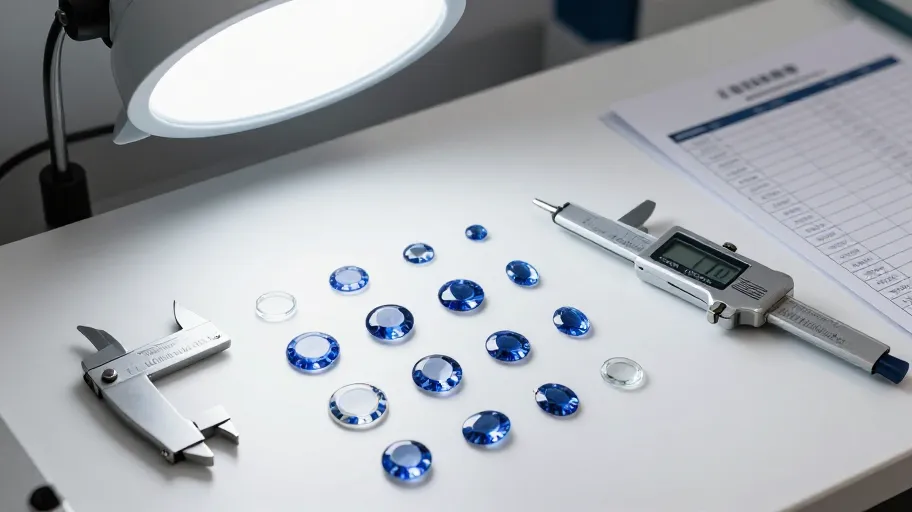
Photographs cannot tell you how a sapphire watch glass will behave in production, inspection or after assembly. To compare a sapphire watch glass supplier properly, request physical samples from every candidate, inspect them under controlled conditions using the same checklist, document every observation, and ask each supplier to confirm attributes and policies in writing before you approve a quotation.
Why photos are not evidence
A photograph is a marketing artefact. Lighting, lens choice and post-processing can flatter a crystal in ways that physical inspection immediately exposes: edge chipping, uneven anti-reflective behaviour, glue-line visibility, dome distortion, or a crown that sits off-axis. None of these are reliably visible in a supplied image, and none can be measured from one.
That does not mean suppliers who send polished photos are untrustworthy. It means photos belong at the top of the funnel — for shortlisting — and nowhere near your approval decision. The approval decision needs samples, structure and documentation.
The SEE Framework: a repeatable way to compare samples
When evaluating a sapphire watch glass supplier, use the SEE Framework:
- Structure the comparison. Define, before any sample arrives, exactly what you will inspect and how. Write it down. If you inspect samples ad hoc, your judgement will drift toward whichever piece arrived in the nicest box.
- Examine the evidence. Inspect every supplier's samples against the same checklist, under the same lighting, with the same instruments and by the same person or panel where possible. Rotate the order so no supplier benefits from being assessed while attention is fresh.
- Escalate the questions. Anything you cannot verify yourself — coating process, material origin, measurement methods, policy terms — becomes a written question to the supplier. Their response speed, precision and honesty are themselves evaluation data.
The framework works because it separates what you can observe (surface quality, edge finish, fit against your case) from what you must confirm (process, policy, documentation). Suppliers who answer the second category precisely tend to be easier to work with in the first.
Sample comparison decision table
Score each supplier's sample on a simple scale as you inspect. The point is not the score itself; it is that every supplier is scored on the same rows.
| Attribute to inspect | How to inspect | What strong evidence looks like | Red flag |
|---|---|---|---|
| Edge finish and chamfer | Visual under magnification; run a gloved fingertip along the edge | Clean, consistent edge across all supplied pieces | Chipping, uneven chamfer, sharp spots on some pieces only |
| Surface clarity and inclusions | Hold against a bright, diffuse light source; tilt slowly | No visible inclusions or haze at your agreed inspection standard | "Showpiece" is clean; additional pieces differ |
| Coating behaviour (if specified) | Tilt under controlled light; compare reflection pattern across pieces | Consistent reflective behaviour piece to piece | Patches, rings or differences between samples |
| Fit to your case or drawing | Trial-fit against your actual case or gauge | Consistent fit on every supplied piece | Some pieces seat, others rock or gap |
| Dome or curve profile (if curved) | Compare against profile gauge or reference part | Curve reads the same on every piece | Visible asymmetry or variation between pieces |
| Marking and identification | Check engraving, printing or packaging labels | Clear, matching identification on each piece | Unmarked, mixed or ambiguous pieces |
| Documentation with the sample | Read what accompanies the samples | Dimensions, material description and inspection notes supplied in writing | Nothing written; "trust the sample" |
Anything in this table you cannot verify with your own instruments becomes an escalation question — not an assumption.
Batch consistency matters more than the showcase piece
A single excellent sample proves very little. What protects your project is consistency: whether the fifth piece in a batch matches the first. When you request samples, ask for more than one piece of the same specification where the supplier's policy allows, and inspect them side by side. Variation between pieces of the same part number is the single most useful signal in the whole evaluation — and it is invisible in any photograph.
What to measure — without inventing tolerances
You should absolutely measure the samples: diameter, thickness, dome height, chamfer geometry, and the position of any date window or aperture. But the specific tolerance limits belong to your project specification, not to this article. Define your own acceptance criteria with your engineering team before samples arrive, write them into your request for quotation, and ask each supplier to confirm in writing that they can hold them and how they verify them.
Useful escalation questions on measurement:
- Which instruments do you use to verify the dimensions you ship against?
- Will you supply a dimensional report with production lots if we specify it?
- How do you handle a piece that falls outside our stated acceptance criteria?
Concrete approval questions to send each supplier
Paste these into your supplier communication before approving any quotation:
- Can you confirm in writing that the supplied samples were produced by the same process intended for production, or were they prepared differently?
- What inspection steps does each crystal pass through before packing, and can we receive the inspection criteria?
- If a production lot fails our incoming inspection, what is your documented resolution process?
- What information do you need from us — case drawing, gasket profile, assembly method — to quote accurately?
- Can you supply reference documentation for the sapphire material and any coating you propose?
- What are your current terms for samples, revisions and pre-production approval? Confirm the current policy directly.
- Who is our named technical contact after quotation, and in what language will technical communication be conducted?
A supplier's willingness to answer question 7 precisely is, in practice, as informative as any measurement.
Document, then decide
Keep a single evaluation file per supplier: your scored comparison table, photographs you took yourself under your controlled conditions, written supplier answers, and the escalation trail. When the decision goes to management or engineering review, this file is the difference between a defensible sourcing decision and a preference. It also becomes your baseline: if the first production lot differs from the approved sample file, you have documented grounds for discussion.
Frequently asked questions
How many sample pieces should I request from a sapphire watch glass supplier? Request more than one piece of the same specification where the supplier's policy allows, so you can check piece-to-piece consistency rather than a single showcase item. Confirm the current policy directly.
What lighting should I use to inspect sapphire crystals? A bright, diffuse light source that you tilt the crystal under lets you see inclusions, haze and coating behaviour far better than a fixed desk lamp. Use the same setup for every supplier so your comparisons are like-for-like.
Should I test hardness myself to confirm it is sapphire? Field hardness tests on finished crystals risk damaging a sample you may need for fit trials. Prefer requesting material documentation from the supplier, and reserve destructive tests for pieces you designate for that purpose.
Can I compare suppliers fairly if my volumes are small? Yes. The SEE Framework works at any volume: structure, examine, escalate. Smaller programmes simply weight documentation and communication quality more heavily, since you have less leverage to correct problems after the fact.
What if two suppliers' samples look identical? Then decide on the written record: quality of answers, measurement methods, documentation, and the clarity of their resolution process. Identical samples with unequal paperwork point to unequal risk.
Prepare a quote-ready brief
Before you contact any sapphire watch glass supplier, gather: your case drawing or crystal specification, your stated acceptance criteria, your gasket and assembly details, target piece specification, your sample-evaluation checklist, and your list of written approval questions. A quote-ready brief shortens the quotation cycle, filters out suppliers who cannot answer precisely, and gives you a documented baseline for approval. JadeZone Sapphire, a Shenzhen and Hong Kong B2B manufacturer of custom sapphire watch crystals and precision sapphire components, works from buyer-supplied specifications — prepare your brief and confirm the current policy directly.
Low-friction checklist CTA
Download-ready sample evaluation checklist — take the decision table above, add your own acceptance criteria, and turn it into your standing supplier-evaluation sheet before your next sample package arrives.