
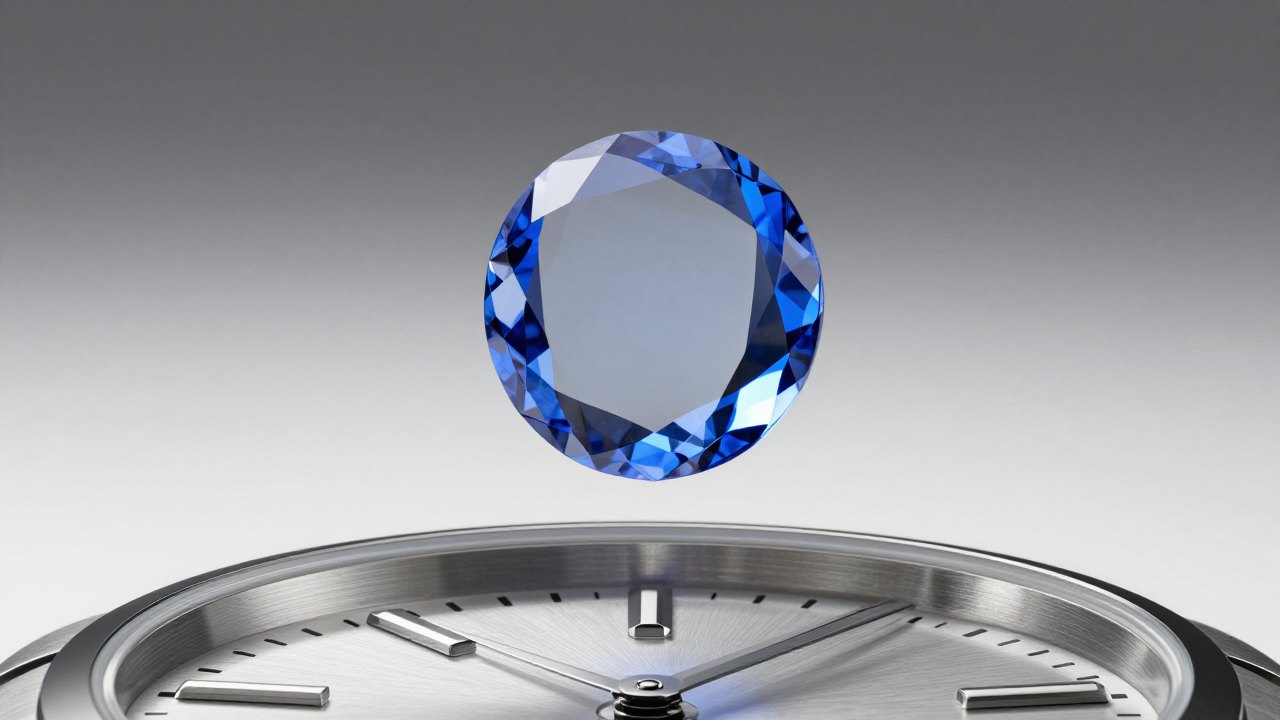
The most common mistake is treating "sapphire" as one commodity. Buyers spec hardness at Mohs 9, pick a diameter, and then shop on price per piece — ignoring growth method, internal strain, coating…
stack, and thickness-to-case matching. Two crystals that look identical on a purchase order can behave nothing alike after 18 months on a wrist.
What Is the Most Common Mistake With Sapphire Watch Crystal?
That gap is where the money goes. Not in the material cost. In the rework, the freight, the returns, and the customer who never places the second PO.
Why Do Two Sapphire Watch Crystals at the Same Price Behave So Differently?
Because synthetic corundum is grown at least four different ways, and each method leaves a different fingerprint. Verneuil flame fusion is fast and cheap, and it traps strain and bubbles. Czochralski pulling and Kyropoulos growth cost more and produce far cleaner boules. EFG (edge-defined film-fed growth) sits in between. The growth method sets the ceiling on optical quality before anyone touches a polishing wheel.
What hardness numbers tell you — and what they don't
Mohs 9 is a scratch-resistance number. It says almost nothing about whether a crystal will survive a doorframe at 2 a.m.
Sapphire runs around 2,200 HV on the Vickers scale, against roughly 500–600 HV for mineral glass. Diamond sits near 10,000. So sapphire resists keys, grit, and sandpaper far better than mineral glass does.
Fracture toughness is the other half of the story, and it's much less flattering. Sapphire's fracture toughness lands near 2 MPa·m^1/2 — brittle. A crystal that will not scratch can still chip at the edge from a glancing impact.
The strain you can't see in a photo
Cheap Verneuil material shows birefringence — internal strain that reads as a faint milky haze under cross-polarized light. Unpolarized inspection misses it completely. So does every product photo your supplier sends you.
Kitchen-table test: hold the crystal between two polarizing filters (camera polarizer and sunglasses work). Rotate one 90 degrees. A clean crystal goes dark. A strained one lights up like a stress map in a materials lab.
Mistake #1: Buying Blanks on Price Per Piece
This is the most expensive error on the list, and it is the one that hurts months after the invoice is paid. Sourcing blanks from the lowest-cost furnace moves the defect discovery point downstream, to after coating and after assembly — when you already own thousands of finished watches and no longer have leverage.
Here's ours.
In February 2021, a wearables client outside Carlsbad, California needed 8,000 double-domed crystals, 30.5 mm diameter, 1.2 mm thick, for an April 15 launch. Our primary blank supplier was booked through March. We bought from a broker instead, at 38 cents under our normal landed cost, and told ourselves the incoming visual check would catch anything bad.
Visual check passed. Coating ran. Then the client's QA pulled samples under polarized light and found strain haze across roughly 34% of the lot — 2,700 pieces that were optically fine to the eye and obviously defective on a tester. Rework, replacement blanks, and a rush air freight bill ran us $46,000 plus $11,400 in freight. We ate all of it. The client stayed, which was luck more than anything.
What changed the following month: 100% cross-polarized inspection on incoming blanks, no exceptions, plus a retained sample per lot held for 24 months so we can trace a complaint back to a specific furnace run.
How to spot inferior sapphire before it gets coated
Mistake #2: Specifying Thickness by Habit
Crystal thickness should be driven by water-resistance rating, case geometry, dial clearance, and gasket compression — not by whatever the last project used. A 1.0 mm crystal in a case rated to 10 ATM will flex under pressure. If it touches the seconds hand or the dial, you'll hear about it from a customer, not from a test bench.
Typical specs that hold up in the field:
ISO 22810 (2010) governs water-resistance claims generally; ISO 6425 (2018) covers actual dive watches and requires testing at 125% of the rated depth. Neither standard specifies crystal thickness — that's your engineering call, and it's the one most often made by copying a competitor's teardown.
Mistake #3: Assuming the Press Fits Itself
Installation fails more often than manufacturing does. Uneven press force cracks the edge. A pinched or over-compressed gasket leaks. A case that wasn't thermally stabilized before pressing can seat a crystal at a slight angle — which passes a water test at the bench and fails on a customer's wrist three weeks later.
Two things we now require from every assembly partner: monitored press force within ±10% of a validated setting, and gasket compression between 15% and 25% of cord diameter. Above 25%, the gasket takes a set and stops sealing. Craft shops that "press by feel" are the single most common source of edge fractures we see in failure analysis.
Mistake #4: Cleaning Sapphire Like It's Glass
Ammonia-based cleaners, ultrasonic baths above 40°C, and abrasive polishing cloths strip anti-reflective coatings long before they touch the sapphire underneath. Most "scratched crystal" complaints we investigate turn out to be coating damage. The crystal is intact. The coating is gone.In 2022, a US service partner ran 900 units through an ultrasonic bath at 60°C with a mildly alkaline detergent. Every one came back with a cloudy AR surface. Coating adhesion on those parts had passed the tape test in our own QC — the chemistry did the damage in the field.
Safe cleaning: pH 6–8, lukewarm water, a microfiber cloth, no ammonia, no ultrasonic on coated parts.
Mistake #5: Believing Sapphire Means Unbreakable
It doesn't. Sapphire is hard and brittle. Edge impacts fracture it, and ISO 1413 (2016) shock testing is the benchmark that catches weak case-and-crystal combinations before a customer does. Bezel protection matters more than crystal thickness for impact survival. A domed crystal sitting flush with the case will chip. A domed crystal recessed 0.3 mm behind a raised bezel usually won't.
How Do You Vet a Supplier Without Getting Burned Again?
Ask for three things before the first PO: cross-polarized inspection data per lot, coating adhesion test results, and a retained sample from the last six months. A supplier who can't produce all three is a trader, not a manufacturer. We've been on both sides of that conversation.
Jadezone Optical has run crystal production in Shenzhen since 2010, which mostly means we've made most of the mistakes above at least once. Here's the checklist we use internally before any lot ships.
Frequently Asked Questions
What is the difference between sapphire watch crystal and mineral glass?
Sapphire crystal is synthetic corundum at Mohs 9 and roughly 2,200 Vickers hardness, about four times mineral glass. Its refractive index near 1.76 also produces sharper edge reflections. Mineral glass costs far less but scuffs within months on a daily-worn watch.
How much should a sapphire watch crystal cost?
For a 30 to 32 mm double-domed blank at 1.2 mm thick, expect roughly $6 to $14 per piece at 5,000-unit volumes in 2026, with AR coating adding $2 to $5. Quotes under $4 usually signal uncontrolled-strain Verneuil blanks.
How long does a sapphire watch crystal last?
The sapphire substrate typically outlasts the movement, often 20 years or more. The coating stack is the limiting factor, showing wear in 3 to 7 years on a daily-worn watch. Coating life depends more on cleaning habits than on the crystal itself.
Can a scratched sapphire watch crystal be polished out?
Rarely. Because the material sits at Mohs 9, removing a scratch requires diamond media and hours of bench work, and it alters the dome geometry. Coating scratches cannot be repaired at all — replacement is the only option.
How do I choose a sapphire crystal supplier?
Ask for cross-polarized inspection data per lot, coating adhesion results, and a retained sample from the past six months. Confirm thickness tolerance and dome radius capability in writing. A supplier who cannot produce those three items is reselling, not manufacturing.