
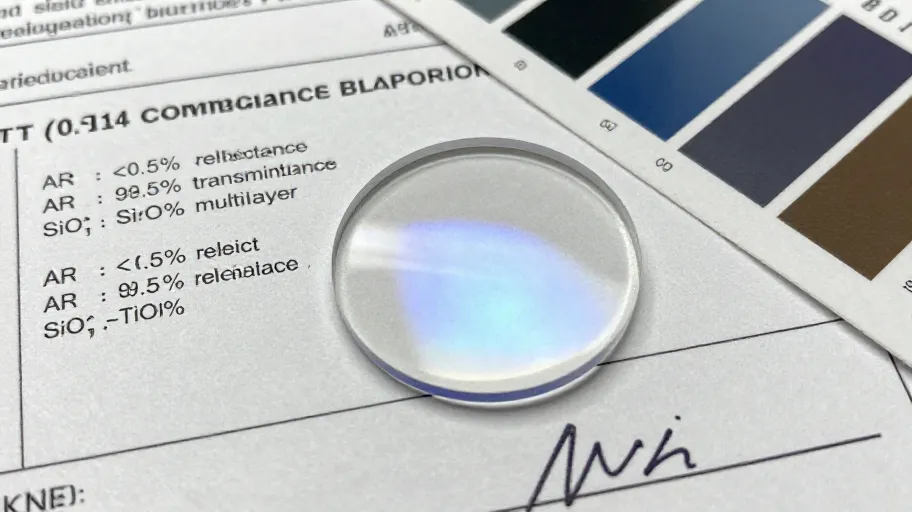
The best watch crystal AR coating decision is the one you can specify, verify and sign off. Write the coating requirement into your drawing, qualify it on physical samples under controlled lighting, and document written approval before mass production. Every unspecified detail becomes a supplier-specific assumption you inherit.
That is the whole game in miniature. The rest of this guide expands it into a working process you can run on your next custom sapphire crystal project.
The SPEC–SAMPLE–SIGN-OFF framework
When buyers run into trouble with AR coatings, the root cause is rarely the coating itself. It is the gap between what the buyer imagined and what the supplier was asked to produce. The framework closes that gap in three stages:
- SPEC — translate intent into a written, drawable requirement.
- SAMPLE — verify the requirement against physical parts, not renderings.
- SIGN-OFF — approve in writing, with acceptance criteria attached, before production begins.
Each stage feeds the next. A vague spec produces an unjudgeable sample; an unjudgeable sample produces a meaningless sign-off.
Stage 1 — SPEC: writing the coating requirement
An AR coating requirement is not one line reading "AR coated". At minimum, decide and document the following with your supplier:
- Which surfaces are coated. Coating applied to the inner face only, the outer face only, or both faces. Each choice changes reflectance behaviour, scratch exposure of the coated surface, and visual signature.
- Residual reflection colour. Some coatings leave a deliberate tint (a blue or violet residual reflection is a design choice on many dials). Specify whether the reflection colour must be neutral, matched to the dial, or matched across a product family.
- Intended environment. A crystal destined for a dive watch, a dress watch and a smartwatch face may face different chemical and abrasion exposures. State the intended use so the supplier can comment on coating suitability for that use — and confirm what testing, if any, they perform against it.
- Substrate and geometry. Domed crystals, double-domed crystals and flat crystals present different coating challenges at curvature extremes. Provide the drawing, not just the diameter.
- Acceptance criteria. How will you judge reflectance, tint uniformity and adhesion on incoming parts? If you cannot describe it, you cannot enforce it.
Two cautions on this last point. First, do not accept a numerical reflectance percentage, adhesion rating or test method as credible unless the supplier states the method used and can evidence it — ask, and confirm directly. Second, anything the supplier does not put in writing belongs to the category of "verify before you rely on it": certifications, test results, environmental compliance. Confirm current status directly rather than assuming continuity.
Decision table: choosing an AR coating configuration
| Your priority | Configuration to discuss | Trade-off to weigh | Question to put to the supplier |
|---|---|---|---|
| Maximum glare reduction on a highly reflective dial | Coating on both surfaces | More coated surface exposed to handling on the outer face | How do you qualify outer-face coating durability, and with what test? |
| Balanced performance with lower exposure risk | Inner-face coating only | Outer surface reflectance remains uncoated sapphire | What reflectance difference should we expect between configurations? |
| Distinctive visual signature (e.g. blue reflection) | Tinted residual reflection | Tint must stay consistent across a product family and across production batches | How do you control reflection-colour consistency between batches? |
| Vintage or heritage design | Minimal or no AR coating | Higher reflectance is accepted as part of the design language | Can you supply uncoated and coated samples from the same blank for comparison? |
| Harsh-environment product | Coating system qualified for the stated exposure | Not every coating system suits every chemical or abrasion environment | Which environments is this coating system qualified for, and on what evidence? |
The right-hand column matters more than the middle columns. The answers — or the absence of clear answers — are your real supplier evaluation.
Stage 2 — SAMPLE: what to inspect on physical parts
A coating sample approval should be a controlled exercise, not a glance under office lighting. Run these checks and record the result for each sample:
Coating sample inspection checklist
- Inspect under at least two controlled light sources (e.g. warm and cool) plus daylight — does the residual reflection colour stay consistent?
- Compare against a reference crystal or previous approved batch, side by side on the intended dial.
- Rotate the crystal through multiple angles; check for tint banding or uneven reflection at the curve edges.
- Check the coating edge definition at the gasket contact zone — is the transition clean and repeatable across all samples?
- Inspect for coating defects visible at magnification: spots, streaks, de-wetting marks, scratches from handling.
- Verify marking or logo placement on the crystal does not interact with the coated zone.
- Photograph every sample under identical conditions and file the images with the approval record.
- Ask the supplier which of these checks they perform internally, and request their outgoing inspection criteria in writing.
That last item deserves emphasis. A supplier's own inspection regime tells you as much about them as your inspection tells you about the parts. Confirm directly what inspection documentation accompanies each shipment, and how nonconforming parts are handled — all of this is supplier-specific policy that must be confirmed, not assumed.
One more boundary worth stating plainly: this article does not describe sample fees, shipping responsibility, sample quantities or turnaround, because no such policy was supplied. Put these questions to the supplier in writing at the sample-request stage and keep the answers with your project file.
Stage 3 — SIGN-OFF: approval questions that protect both sides
A sign-off is not "the samples look fine" in an email thread. Before authorising production, close these questions with written answers:
- Which exact sample (by serial or photo ID) is approved, and against which drawing revision?
- What are the acceptance criteria for production parts — reflection appearance, edge definition, defect allowance — and are they attached to the purchase documents?
- What happens if a production lot deviates from the approved sample? What is the containment and resolution path?
- How is batch-to-batch coating consistency maintained, and what reference does the supplier hold on their side?
- What documentation accompanies deliveries — inspection records, coating lot identification, or certificates — and in what form?
- What is the current policy on re-qualification if the coating process, line or material changes mid-programme?
None of these questions presumes any particular answer. They simply convert assumptions into documented commitments, which is what makes the approval meaningful.
Common buyer questions
Should we coat one side or both sides of the crystal? It depends on the product's design intent and exposure profile. Both-surface coating maximises glare reduction but puts a coated surface on the outside; inner-only coating reduces exposure. Use the decision table above, then confirm with your supplier how each configuration behaves on your specific geometry.
How do we judge AR coating quality without lab equipment? Controlled lighting, side-by-side comparison against a reference, angle rotation, and magnified inspection of edges and defects will surface most appearance issues. For durability and adhesion, ask the supplier which tests they run and request the results — confirm directly what evidence exists rather than inferring it.
Should reflection colour match exactly across every model in a family? If your family shares dials or side-by-side retail display, yes — specify the residual reflection colour in the drawing and ask how batch consistency is controlled. If models are sold separately, you may have more freedom. This is a design decision to document, not a supplier default to inherit.
What should we do when two suppliers describe their coatings differently? Normalise the descriptions into the same requirement sheet: coated surfaces, residual colour, environment, acceptance criteria, and documentation. Ask both suppliers the same written questions and compare answers. Uneven clarity in the answers is itself decision-relevant information.
When should we re-approve a coating? Trigger re-qualification whenever the coating process, equipment, material source or crystal geometry changes, and whenever a new production phase begins. Agree the trigger conditions at sign-off so the path is defined before you need it.
Get your AR coating purchase right, in writing
Ready to run this process on your next project? 获取采购 Brief — a structured brief that turns everything in this guide into a written requirement you can send to any supplier, including JadeZone Sapphire.
Not ready to talk yet? Start smaller: work through the coating sample inspection checklist above on your next incoming sample batch, and see what it surfaces. It is a low-effort step that upgrades every future coating conversation.