
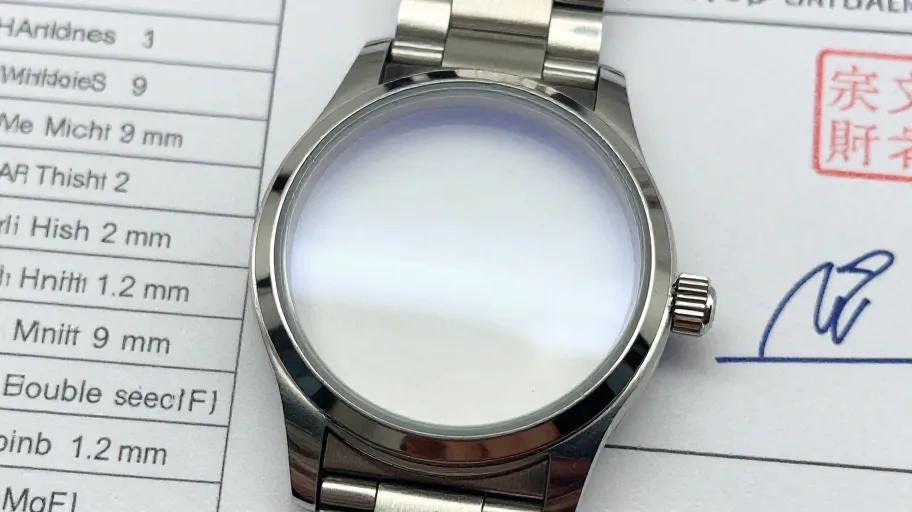
An AR sapphire crystal is a synthetic sapphire watch crystal with an anti-reflective coating that reduces surface reflections and improves dial legibility. For B2B buyers, the purchasing risk sits not in the sapphire itself but in under-specified coating requirements, inconsistent sample evaluation and missing approval records. This guide gives you a repeatable SPEC–SAMPLE–SIGN-OFF framework so you can specify, verify and approve with documented confidence.
What AR coating changes — and what it does not
Anti-reflective coating is a thin optical layer applied to sapphire to cut reflection. As a buyer, three decisions belong to you, not the supplier:
- Coating faces. Coating can be applied to the inner face, or to both faces. Each option changes appearance, reflection behaviour and cost structure. Your drawing must state which faces are coated — do not leave this to interpretation.
- Coating colour and residual reflection. Some AR coatings leave a faint residual tint when viewed at an angle. Define whether any tint is acceptable, and document what you approved so production matches the sample.
- Acceptance criteria. "Looks good" is not a specification. Agree in writing how coating quality will be judged — visual inspection under defined lighting, and any functional or environmental tests you require — before production is released.
AR coating does not change the sapphire substrate's hardness or geometry. If your project also depends on dimensions, edge finish, or gasket fit, those must be specified separately and verified on the same samples.
Stage 1 — SPEC: define the crystal before you request a quote
A clear specification is the cheapest quality control you will ever buy. Before contacting any supplier, including JadeZone Sapphire, prepare a document that covers:
- Substrate: synthetic sapphire; diameter or shape; thickness; whether the crystal is flat, domed, or has other geometry.
- Coating: which face or faces receive AR coating; the visual standard you will accept; how you will inspect it.
- Finish and features: polish quality, anti-fingerprint or other surface treatments if required, date-window cut-outs, printed logos or indexes, bevel details.
- Fit data: case opening dimensions, gasket seat, retention method (friction, adhesive, screw-down ring).
- Quantity intent and programme timeline: your target volumes and project milestones, so the supplier can confirm what is feasible rather than guess.
Where you do not yet know a value — tolerance, inspection standard, test method — write "to be agreed" and resolve it in writing during quotation. What you must not do is assume defaults: numerical tolerances, lead times and MOQ are project-specific and must be confirmed directly with the supplier in every case.
Stage 2 — SAMPLE: evaluate with a record, not an opinion
Once samples arrive, evaluate them the same way every time. A one-page evaluation record prevents the classic failure mode where engineering, design and sourcing each remember a different sample.
Sample evaluation record (score each item pass / conditional / fail, with notes and photos):
| Item | What to check | Recorded how |
|---|---|---|
| Dimensional fit | Fits case opening and gasket seat per your drawing | Measurement vs specified values; measuring method noted |
| Coating face(s) | Coating present on the agreed face or faces | Visual check plus supplier inspection report if provided |
| Reflection performance | Legibility under your defined lighting conditions | Photo under standard lighting |
| Surface quality | Scratches, pinholes, coating blemishes, edge chips | Macro photos; agreed reject criteria |
| Print / markings | Position, colour, adhesion of any print | Photos; adhesion check per agreed method |
| Edge and bevel | Finish consistent across the sample set | Photos of every sample, not one |
| Documentation | Inspection report, drawing revision, material traceability where agreed | Filed with the sample |
Keep every sample labelled and stored. When you later compare a second or third iteration — or a second supplier — you are comparing records, not memories.
Stage 3 — SIGN-OFF: the approval gate before production release
Approval should be a gate, not a feeling. Before authorising production, the following questions should each have a written answer:
- Which drawing revision was sampled, and is it the same revision quoted for production?
- What coating configuration was approved — which faces, what visual standard?
- What inspection method and criteria apply to production parts, and who performs them?
- What happens if a production part does not conform — what is the agreed corrective and communication process?
- Who in your organisation has authority to sign off, and has that person seen and approved the physical sample?
- What are the confirmed commercial terms for this project — MOQ, pricing, lead time, sample policy, and shipping arrangements for samples — confirmed directly with the supplier in writing?
- Is there a first-article or pilot-batch step before full production, and what triggers release to full volume?
None of these terms can be assumed from this article. Confirm each one directly with JadeZone Sapphire for your specific project, and record the answers in your approval pack.
Decision table: acting on sample results
| Sample result | Recommended action | Documentation to keep |
|---|---|---|
| All items pass, terms confirmed | Approve; release production with signed approval pack | Approval record, drawing revision, confirmed terms |
| Minor, correctable deviations | Request revised samples against the same criteria; do not verbally waive issues | Deviation notes; revised sample records |
| Coating or fit fails defined criteria | Re-sample with corrected specification; restate acceptance criteria in writing | Failure photos; corrected drawing |
| Supplier cannot confirm critical terms or criteria | Pause and compare alternative suppliers before committing | Correspondence; comparison matrix |
The value of the table is symmetry: the same criteria that justified approval are the criteria that justify rejection or a re-sample.
Pre-approval checklist
Run this gate before any production commitment:
- Drawing revision stated and matches the quoted item
- Coating faces and visual standard specified in writing
- Inspection method and acceptance criteria agreed
- Samples evaluated using a documented record with photos
- All commercial terms (MOQ, price, lead time, sample and shipping policy) confirmed directly in writing
- Deviations resolved and re-sampled, or formally waived by the approver
- Named approver has physically inspected the sample
- Corrective process for non-conforming parts agreed
- Approval pack filed and dated
Frequently asked questions
Should AR coating be on one side or both sides of the crystal? This is a design and cost decision for your brand, not a fixed rule. Single-face (inner) coating reduces reflections while protecting the outer coating surface from wear; two-face coating maximises transmission and legibility. Specify your choice on the drawing and confirm with your supplier how each option affects appearance, durability expectations and cost for your project.
How do I evaluate AR coating quality on samples consistently? Use a fixed evaluation record: defined lighting, defined viewing angles, macro photography of every sample, and written pass/conditional/fail criteria agreed before samples arrive. Consistency comes from the record, not from individual judgement.
What information does a supplier need to quote a custom AR sapphire crystal? At minimum: crystal geometry and dimensions, thickness, coating faces and visual standard, any print or markings, case and gasket fit data, target quantities, and your project timeline. Anything undefined becomes a question back to you — so defining it first shortens the loop.
Can I request samples before committing to production? Ask the supplier directly about the current sample policy, including any fees, shipping arrangements and how samples relate to your production order. This article does not state any sample policy because terms are project-specific and must be confirmed with the supplier in writing.
How do I handle differences between the approved sample and production parts? Resolve this before release, not after. Agree the inspection criteria for production parts, define what counts as a deviation, and document the corrective process for non-conforming output. Your approval pack — drawing, sample record, criteria and terms — is your reference in any discrepancy discussion.
Get the purchasing brief
The fastest way to run this process is with the paperwork already structured. 获取采购 Brief — the JadeZone Sapphire purchasing brief with the spec sheet, sample evaluation record and sign-off template in one document.
Not ready to download? Copy the pre-approval checklist above into your next RFQ and use it as your internal gate — it works with any supplier conversation you are having this week.