
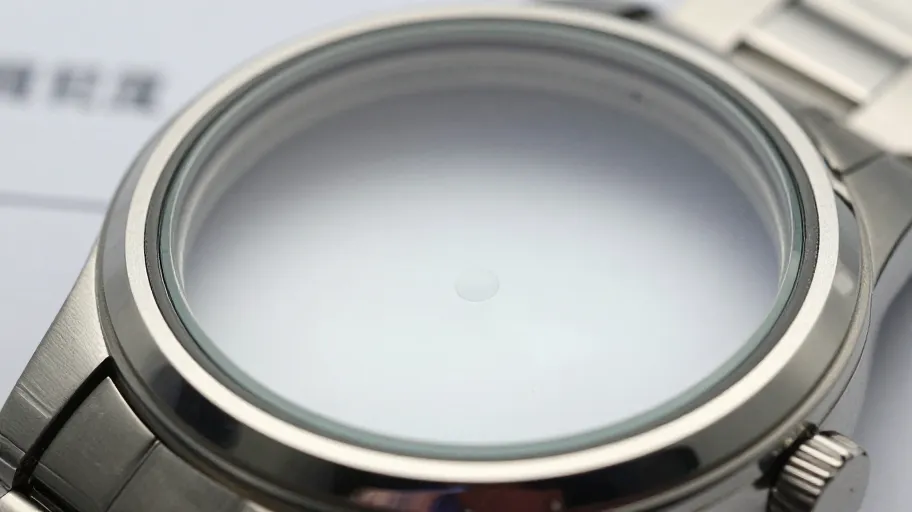
An AR coated sapphire crystal is a synthetic sapphire watch crystal with an anti-reflective coating applied to reduce surface reflection and improve dial legibility. For buyers, the procurement job is not judging the coating itself but specifying it precisely, sampling it against documented criteria, and signing off with written evidence. This guide gives you the structure to do all three before committing a production order.
What AR coating changes — and why it is a sourcing decision, not a styling afterthought
Anti-reflective coating is a thin optical layer, or stack of layers, applied to a sapphire surface. In a watch, it determines how the dial reads under light, how the crystal photographs for marketing, and — critically for B2B buyers — how consistent your finished watches look across a production run.
That makes AR coating a sourcing decision with three commercial consequences:
- Legibility and brand perception. The coating affects how the dial is seen and photographed. Two crystals of identical geometry can present differently depending on coating configuration and quality.
- Approval risk. Coating appearance and durability are difficult to judge from a drawing. They must be evaluated on physical samples under agreed conditions.
- Specification dependency. Unlike crystal diameter or thickness, coating variables — placement, tint, hardness — must be named explicitly in your spec package or they remain open to interpretation.
The framework below keeps those risks contained.
The SPEC–SAMPLE–SIGN framework
Use SPEC–SAMPLE–SIGN as your procurement spine:
- SPEC — define every crystal and coating variable in a written specification and drawing.
- SAMPLE — evaluate physical samples against documented, observable criteria under agreed lighting.
- SIGN — approve in writing, with a retained golden sample and a plan for verifying production consistency.
Each stage has a gate. Do not sample before the spec is written; do not sign before the sample criteria are met and documented.
Stage 1 — SPEC: what to specify in writing
Your specification package should name each of the following. Where you do not yet have an internal standard, mark the item as "to be confirmed with supplier" rather than leaving it silent.
- Coating placement. Internal-side only, external-side only, or both sides. Each choice trades reflection reduction against exposure of the coated surface to wear and cleaning.
- Target appearance. Residual reflection colour, if any, and whether a visible tint is acceptable to your brand. Describe it in words and, where possible, with a reference sample.
- Crystal geometry. Flat, domed, double-domed, with or without cyclops or other features — geometry affects how coating behaves visually and how it is applied.
- Markings and treatments. Any printing, gasket grooves, or edge treatments that interact with the coating process.
- Dimensional and functional requirements. State the tolerances and fit requirements your project requires — these are project-specific and must be confirmed against the supplier's confirmed capabilities, not assumed.
- Marking and traceability. How samples and production parts are identified so a golden sample can be referenced later.
A question worth asking yourself at this stage: could two different suppliers read your package and produce the same crystal? If not, the spec is not finished.
Stage 2 — SAMPLE: how to evaluate AR coating samples objectively
Coating evaluation fails when it relies on impression. Replace impression with documented observation:
- Evaluate under agreed lighting. Define the light sources and angles used for evaluation — daylight, studio light, oblique angles — and use the same conditions for every round.
- Compare against references, not memory. Place samples next to your approved references or golden parts at every review.
- Assess both sides separately. If coating is applied to both surfaces, evaluate internal and external reflections independently.
- Document durability expectations as questions, not assumptions. Ask the supplier what adhesion, abrasion and environmental tests they perform, what evidence they can provide for your specific part, and what they can confirm in writing. Do not accept a general capability statement as an approval basis — request the current, part-specific evidence.
- Confirm sampling terms directly. Sample quantities, costs, lead arrangements and replacement terms vary by supplier and project. Confirm the current policy with JadeZone Sapphire or any candidate supplier in writing before relying on it.
At the end of sampling, you should hold: a retained approved sample, a written record of the conditions it was approved under, and a list of any accepted deviations.
Stage 3 — SIGN: approval questions and the production gate
Before signing off, put these questions to the supplier and record the answers:
- What coating configuration was applied to the approved sample, and how is it identified in your records?
- What inspection criteria will be applied to production parts, and how do they relate to the approved sample?
- What evidence can you provide that production parts will match the approved sample — and what happens if they do not?
- Which tests, if any, are performed on production lots, and what documentation accompanies them?
- What is the agreed escalation path if a coating issue is found after delivery?
- Who is the named contact responsible for coating quality during production?
If any answer is vague, treat it as an open risk rather than a closed one.
Decision table: choosing your coating configuration
| Project priority | Coating configuration to consider | Key approval focus | Questions to confirm with supplier |
|---|---|---|---|
| Maximum dial legibility, moderate wear exposure | Coating on both surfaces | Residual tint consistency; wear behaviour of external layer | What durability evidence applies to this exact part? |
| Conservative durability, protected internal coating | Internal-side coating only | Reflection from external surface acceptable to brand | What reflection appearance is confirmed for uncoated exterior? |
| Marketing-critical photography | Coating configuration optimised for studio and product shots | Evaluate samples under the same lighting your marketing team uses | Can supplier provide samples for photography trials? |
| High-volume programme | Any configuration, with lot-level verification | Consistency between golden sample and production lots | What lot inspection and documentation is confirmed? |
| Vintage-styled or discreet designs | Minimal or partial coating | Whether any visible tint conflicts with the design intent | Can tint targets be matched to a reference sample? |
Approval checklist
Use this checklist before releasing any production order:
- Written specification names coating placement, appearance target and geometry
- Drawing identifies all features that interact with the coating process
- Tolerances and fit requirements stated and confirmed against supplier capability
- Sample evaluation conditions (lighting, angles) documented and repeated each round
- Samples compared against references at every review
- Approved sample retained and traceable
- Deviations, if any, listed and accepted in writing
- Production inspection criteria agreed and tied to the golden sample
- Durability and adhesion evidence requested and confirmed as part-specific
- Sample terms (quantity, cost, lead, replacement) confirmed directly with supplier
- Named quality contact and escalation path recorded
FAQ
Does AR coating go on the inside or outside of a sapphire crystal? Either, or both, depending on project priorities. Internal coating is protected from wear; external coating can further reduce reflection but is exposed to abrasion and cleaning. Specify placement explicitly rather than leaving it to the supplier's interpretation.
How do I judge AR coating quality on a sample? Judge it against documented criteria under agreed lighting, not impression: reflection reduction, tint consistency across the surface, comparison with reference parts, and — for durability — written part-specific evidence from the supplier. Confirm what testing applies to your part directly.
Can AR coating scratch or wear off? Coated surfaces can behave differently from bare sapphire under abrasion. The relevant sourcing question is not a general one but a specific one: what durability evidence can the supplier confirm for this exact coating on this part, and in writing.
How do I keep production crystals consistent with the approved sample? Retain a traceable golden sample, agree inspection criteria that reference it, and confirm with the supplier how production lots are checked against it and what documentation you receive. This consistency question belongs at the SIGN stage, before release.
What should a spec package for an AR coated sapphire crystal contain? Coating placement, appearance target, crystal geometry, markings, dimensional and fit requirements, traceability markings, and every open item explicitly flagged as "to be confirmed with supplier" rather than left implicit.
Take the next step
获取采购 Brief — download the JadeZone Sapphire sourcing brief and structure your specification, sampling and approval requirements before your next crystal enquiry.
Or start lighter: copy the approval checklist above into your next sample review, and confirm each item directly with your supplier as you go.