
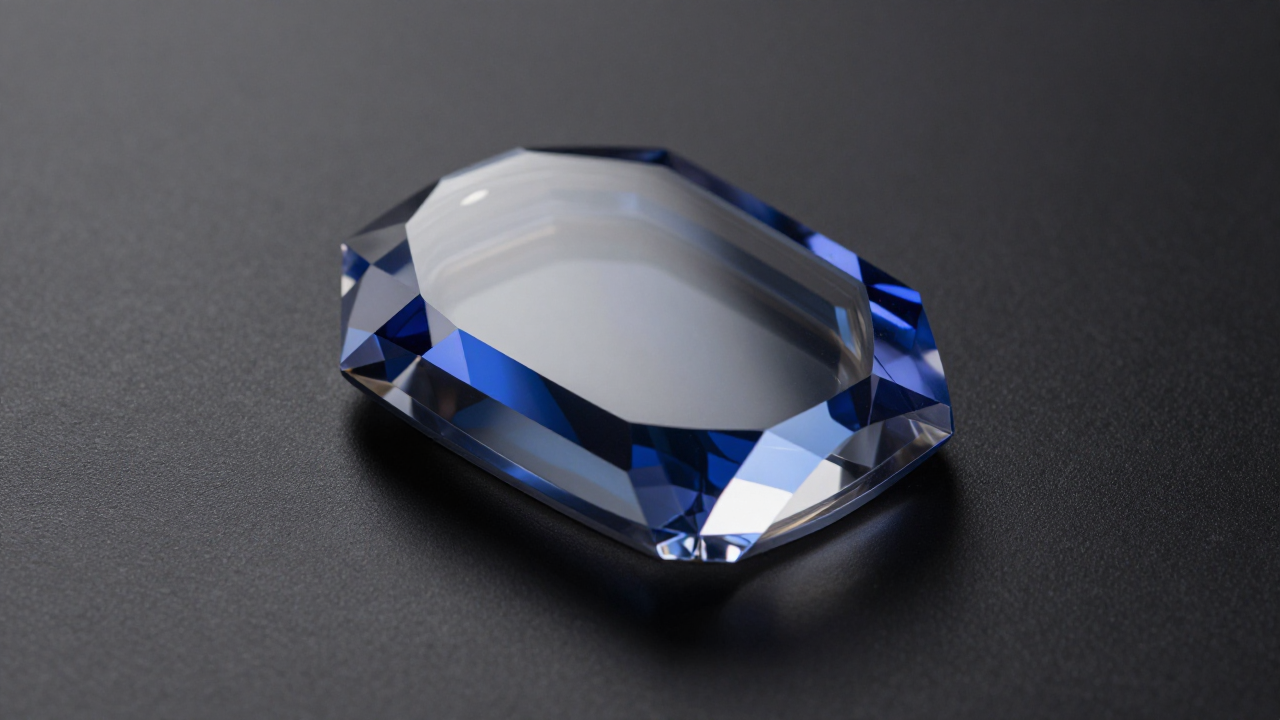
Lab-grown sapphire watch crystal wins for everyday wear, and roughly 95% of production builds should stop there. Natural sapphire justifies a 30x premium only when origin is the product being sold.…
Sapphire-coated mineral glass is the honest budget answer, as long as you say so on the box.
What Actually Separates One Sapphire Watch Crystal From Another
Hardness is not the dividing line. Every sapphire watch crystal sold in the United States today, lab-grown or natural, measures 9 on the Mohs scale — about 1,800 to 2,200 HV on the Vickers scale, and four times the scratch resistance of the mineral glass it replaced. Origin, optical grade, and geometry are what separate them.
Lab-grown corundum is pulled as a single crystal boule using Verneuil flame fusion, Kyropoulos, or heat exchanger method (HEM) growth. Producers including Rubicon Technology, Saint-Gobain, and Monocrystal supply the raw boule stock that most Asian cutting shops, ours included, slice into blanks. The chemistry is aluminum oxide, Al2O3, with a refractive index around 1.76. That single number explains why sapphire disappears against a dial when it's coated properly, and why it doesn't when the coating is skipped.
Natural sapphire comes out of Sri Lanka, Madagascar, Australia, and Montana's Yogo Gulch. Here's the detail that trips up marketing teams: a natural sapphire crystal is not blue. You cut the near-colorless rough, which is the rarest and most expensive corner of the corundum market. The Gemological Institute of America grades clarity on a scale built for gemstones, not optics, and any natural stone that survives that grading cleanly enough for a watch crystal is a genuine anomaly. Rutile silk, zircon halos, and color zoning are the norm.
Synthetic vs. Natural vs. Coated, Side by Side
At 1,000 pieces, a 32 mm domed lab-grown sapphire crystal lands between $9 and $28 depending on coating and tolerance. The same part in natural sapphire starts near $310 and runs past $1,100. Every other difference in the table below follows from that gap.
Where each option quietly breaks down
Lab-grown sapphire is not a scratch problem. It's an edge problem, and the anti-reflective coating is the weak link rather than the crystal. A 2–5 µm AR stack applied by physical vapor deposition will fail a 480-hour salt spray test per ASTM B117 if the adhesion layer is rushed to hit a ship date.
Natural sapphire fails differently. Inclusions behave as stress risers. A 0.3 mm rutile needle sitting 0.4 mm below the surface becomes the crack origin the first time the watch takes a hit on a doorframe. We quote a 25–35% rejection rate on natural rough before cutting even starts.
Coated mineral glass fails predictably. The coating is measured in microns, and after 18 to 30 months of daily pocket and desk contact, it wears through in a visible patch. Buyers rarely notice until they photograph the watch under flash.
The Dimension Nobody Tests Until the Case Leaks
The spec that sends sapphire watch crystals back is almost never hardness or clarity. It's center-to-edge thickness tolerance, and it decides whether a 300 m dive watch still passes its pressure test.
Most factories hold ±0.05 mm on a domed crystal. A quote that comes in at ±0.15 mm is where the cost savings hide, and the difference is invisible on a spec sheet and on a caliper check at the rim. What matters is the thickness at the point where the gasket seats. Push that dimension 0.2 mm over spec and gasket squeeze jumps from roughly 25% to 40%. The gasket rolls instead of sealing.
In September 2024, a dive-watch brand out of Long Island City shipped 4,300 units through its own QC. A retail partner pulled 60 pieces for a hydrostatic retest. Eleven failed at 375 psi, which is about 250 meters of rated depth. The case machine shop blamed the gasket vendor. The gasket vendor blamed the case. Crystal thickness had drifted +0.18 mm across the last three production lots, and nobody had measured at the seat radius.
Edge geometry belongs in the same conversation. A 12° bevel on the underside of a domed crystal resists chipping measurably better than a 45° chamfer, and it costs the cutting shop about 40 seconds more per piece. We run a 1.2 m drop test onto ceramic tile across 50-piece lots from each production run. Lab-grown sapphire at a 12° bevel averages 8 to 9 survivors out of 10. The same crystal at 45° averages 5. (Those are our internal numbers from 2023 onward, not a trade association benchmark, so treat them as directional.)
I expected coating wear to dominate our return logs. It didn't. Edge chips did, by roughly four to one.
What US Brands Are Actually Specifying Right Now
On our order desk, the US mix flipped between 2021 and 2024. In 2021, about 60% of the 32 mm to 38 mm domed crystals we shipped to American brands were mineral glass with sapphire sold as an upgrade. By Q2 2024, mineral had become the downgrade option, and brands were asking for double-domed sapphire with inner-surface AR as the default.
The buying logic changed with it. A US microbrand selling at $350 to $600 retail now treats the crystal as a warranty line item rather than a design flourish. The question we get is no longer "how hard is it." It's "what's your thickness tolerance and can you hold it on reorders." That shift is why we started documenting center and seat-radius measurements on every lot at Jadezone Optical (HK) Ltd back in 2019, after a Boulder, Colorado brand returned 900 domed crystals that were dimensionally fine at the rim and out of spec at the gasket seat.
For brands that market heavily on Amazon and DTC, the crystal is also the hero bullet. "Sapphire crystal" outperforms "scratch-resistant glass" in click-through, but the phrase buyers respond to in returns-prevention terms is "double-domed sapphire with inner AR coating." Warranty departments read that phrase as a coating durability claim.
So Which Sapphire Watch Crystal Should You Buy?
If you're building a volume sport, dive, or field watch in the $200 to $900 range, choose lab-grown sapphire with a 12° bevel and inner-surface AR, and bake ±0.05 mm thickness tolerance into the purchase order. That covers most of you.
If you're producing a $3,000-plus collector piece where the stone's origin is part of the story, natural sapphire is defensible, but budget for a rejection rate above 25% and add eight weeks to your calendar.
If you're shipping under $150 retail and your customer never opens a spec sheet, sapphire-coated mineral glass keeps the price honest. Disclose it. The COGS savings evaporate the moment a YouTube teardown calls it out.
And if you're an OEM with a 300 m rating on the dial, the crystal is no longer a cosmetic part. It's a pressure vessel component. Ask your supplier for seat-radius data, not just rim thickness.
The uncomfortable question for 2026: as lab-grown boule capacity keeps expanding and AR coating adhesion becomes the real failure point, will buyers start specifying coating durability the way they once specified hardness?
Frequently Asked Questions
What is the difference between synthetic and natural sapphire watch crystals?
Both are corundum at 9 Mohs and behave identically in daily wear. Synthetic, or lab-grown, sapphire is produced from aluminum oxide boules with controlled purity and near-zero inclusions. Natural sapphire is mined, contains rutile silk and color zoning, costs 30 times more, and carries a higher fracture risk at inclusions.
How much does a sapphire watch crystal cost?
At 1,000-piece volume, a 32 mm domed lab-grown sapphire crystal runs $9 to $28 depending on coating and thickness tolerance. Natural sapphire for the same part runs $310 to $1,150. Sapphire-coated mineral glass runs $3.50 to $7.00. Coating type and tolerance, not size, drive most of the spread.
How long does the anti-reflective coating on a sapphire crystal last?
A properly deposited PVD anti-reflective stack on sapphire typically holds for five years or more with normal wear. Poorly adhered coatings show wear-through in 18 to 30 months. Salt spray testing per ASTM B117 for 480 hours is the useful benchmark when you are comparing suppliers.
Why does a sapphire crystal chip if it is scratch resistant?
Scratch resistance and impact resistance are different properties. Sapphire resists abrasion because of surface hardness, but it is brittle. A strike to the crystal edge concentrates stress at the bevel, which is why edge geometry matters more than thickness for chip survival. Mineral glass scratches; sapphire chips.
Do you need sapphire, or is mineral glass good enough?
For watches above $200 retail, sapphire is expected and mineral glass reads as a cost cut. Below $150 retail, sapphire-coated mineral glass is a reasonable compromise if you disclose it. For dive watches rated past 200 meters, neither matters as much as thickness tolerance and gasket fit.