
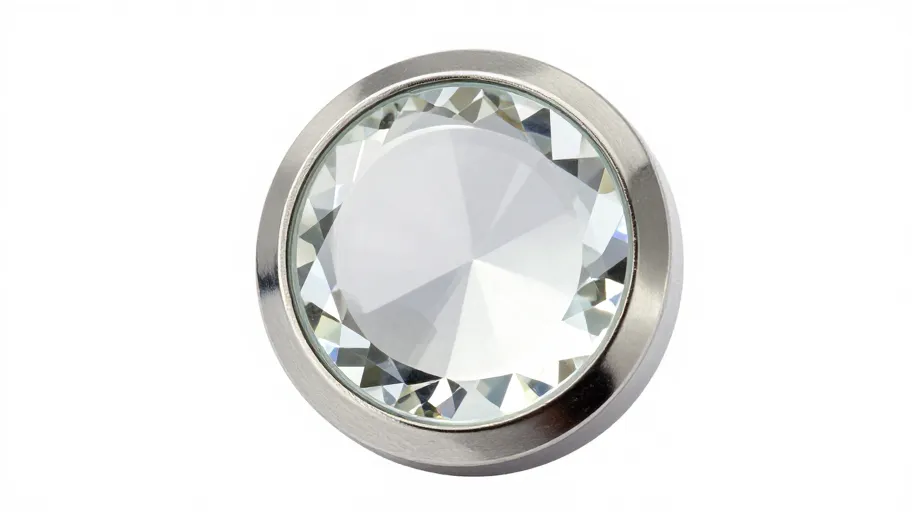
A sapphire watch crystal is made of synthetic sapphire — a single crystal of aluminium oxide (Al₂O₃), known as corundum, grown in a laboratory and sliced, ground and polished into a transparent watch lens. It is not natural gemstone and not ordinary glass; it is an engineered crystalline material chosen for hardness and optical clarity.
That is the short answer. As a component buyer, the material answer is only the first third of your job. The remaining two-thirds are specifying what you need and proving you got it. This guide walks through all three using a simple framework we will call SPEC–SAMPLE–SIGN-OFF:
- SPEC — define the material, geometry, coating and fit requirements in a drawing.
- SAMPLE — qualify a physical sample against written acceptance criteria.
- SIGN-OFF — approve drawings and samples in writing before production begins.
What the material actually is
The "sapphire" in a sapphire watch crystal is synthetic corundum — the same crystalline compound as the blue gemstone, but grown industrially as a pure, colourless single crystal. Because it is monocrystalline aluminium oxide rather than an amorphous glass, it has an ordered lattice structure, which is the source of its scratch resistance: corundum sits near the top of the Mohs scale, below diamond.
Three material points matter to a sourcing manager:
- It is synthetic by design. Laboratory growth is not a cost-cutting shortcut; it is how optical-grade clarity and purity are achieved at all. Natural sapphire with inclusions would be unusable for a watch crystal.
- "Sapphire glass" is loose language. Some suppliers and listings say "sapphire glass" out of habit. In your RFQ and on your drawing, write synthetic sapphire (single-crystal Al₂O₃) so nothing can be substituted with hardened mineral glass.
- Orientation exists. Crystallographic orientation of the cut can affect mechanical and optical behaviour. Whether a specific orientation matters for your application is a question to raise with the supplier's engineering team and record in the drawing notes.
From boule to finished crystal: why the process affects your RFQ
Understanding the production route helps you ask sharper questions and read quotations more accurately.
- Crystal growth. A boule — a large single crystal — is grown from melted high-purity aluminium oxide. Growth methods and parameters influence inclusion levels and optical uniformity; these are legitimate technical questions for your supplier.
- Orientation and slicing. The boule is oriented and sliced into wafers or blanks. Cut strategy affects yield, and yield is one reason quotes for complex shapes differ from quotes for simple flats.
- Grinding and shaping. Blanks are ground to the required form — flat, domed, double-domed, box-shaped, stepped, or a custom geometry matching your case design. Tighter geometry demands more processing steps, which is why your drawing drives cost more than the material itself.
- Polishing. Optical clarity depends on the polish stage. Surface-quality criteria on your drawing are what make this verifiable rather than a matter of opinion.
- Coating. Anti-reflective (AR) coatings may be applied to one or both faces, and some programmes combine AR with anti-fingerprint or oleophobic treatments. Coating stack, face count and any colour tint must be specified, and any performance claims you require should be documented as measurable acceptance criteria — not assumed.
- Edge and gasket features. The crystal's edge profile, chamfer, notch or step must match your gasket or bezel system. This is where fit problems originate, and where your drawing earns its keep.
None of the above implies any particular capability, capacity or policy on JadeZone Sapphire's part. Each point is a technical conversation to have and document with your supplier.
The SPEC half: vocabulary for a drawing you can hold
A specification is only as strong as its wording. At minimum, a sapphire crystal drawing or spec sheet should call out:
- Material: synthetic sapphire, single-crystal Al₂O₃.
- Crystal form and geometry: diameter or length/width, thickness, dome height, edge profile.
- Fit system: gasket seat dimensions, compression style, or bezel interaction.
- Coating: none, single-side AR, double-side AR, additional functional layers.
- Surface and cosmetic criteria: how polish quality and allowable marks will be judged.
- Marking, date window or other cut features, if any.
- Any dimensional tolerances and how they will be measured — numbers to be agreed with the supplier per project, never assumed.
Decision table: matching your requirement to what you must specify
| If your requirement is… | Then your drawing must define… | And you must confirm with the supplier… |
|---|---|---|
| A flat crystal on a gasket | Diameter, thickness, gasket seat profile | Recommended seat geometry for their process |
| A domed or double-domed crystal | Dome height, base thickness, curvature | Achievable curvature range and measurement method |
| A box crystal with visible sides | Side height, wall angle, polish on visible faces | Cosmetic acceptance criteria for side walls |
| AR coating for readability | Coating faces (inner/outer/both), tint | Measurable reflectance criteria and how it is verified |
| A date window or aperture | Cutout position and dimensions relative to datum | Machining capability for the feature and inspection method |
| Custom OEM geometry | Full 2D drawing with datums and critical dimensions | Tolerances they will commit to in writing |
The SAMPLE half: qualify before you commit
Once a drawing exists, samples turn the drawing into evidence. A disciplined sample review compares the physical part against the documented spec — not against memory or a photo.
A workable sample review covers:
- Dimensional check against the drawing, with agreed measurement methods and equipment named on the report.
- Fit check in your actual case and gasket system, on your production parts where possible.
- Optical check for clarity, polish, coating appearance and any tint — under lighting conditions you define in advance.
- Functional checks specific to your product, such as water-seal behaviour, defined as pass/fail criteria before the sample arrives.
- Written disposition: approve, approve with deviations, or reject with reasons — recorded and circulated.
The SIGN-OFF half: the approval gate
Production should start against a frozen document set. Before you authorise production, confirm these questions in writing:
- Is the drawing revision level referenced on the purchase order the one we approved?
- Which sample (by identifier) is the approved reference, and where is it retained?
- What inspection documentation accompanies each production lot, and against which criteria?
- How are deviations or changes handled — who approves, and how is the change recorded?
- What are the current MOQ, pricing, lead time and delivery terms for this part — confirmed for this order, not inferred from past projects?
- If a coating is specified, what measurable criteria define acceptance, and how are they verified?
This gate is where buyers either create leverage for themselves or give it away. A signed drawing, an approved retained sample and documented acceptance criteria convert every future quality conversation from negotiation into reference.
Frequently asked questions
Is a sapphire watch crystal real sapphire? It is real corundum — the same compound as gem sapphire — but grown synthetically as a pure single crystal. "Synthetic" here refers to controlled laboratory growth, which is the correct industrial route and the reason optical clarity is achievable.
How is it different from mineral glass? Mineral glass is an amorphous silicate; sapphire is a single crystal of aluminium oxide with a far harder lattice. The practical consequence is scratch resistance. Trade-offs such as brittleness behaviour and cost belong in your project evaluation, not in general assumptions — raise them with your supplier for your specific geometry.
Does AR coating change what the crystal is made of? No. The substrate remains single-crystal Al₂O₃. AR coating is a thin deposited layer added to reduce reflection; specify which faces are coated and how coating quality will be measured.
What should I send a supplier to start a custom crystal project? A dimensional drawing with datums, your case and gasket details, target quantities, and any coating or cosmetic requirements. Anything you cannot yet specify — ask the supplier's engineering team to propose options, then document the agreed choice.
Can I judge sample quality without lab equipment? You can judge fit, optics and cosmetics against pre-agreed criteria with modest equipment. Dimensional verification against tight tolerances needs agreed measurement methods — define those with the supplier before the sample is made.
Next steps
If you are preparing a custom or OEM sapphire crystal project, 获取采购 Brief — a structured procurement brief that walks your team through specification, sample review and sign-off in the order suppliers need it.
Before that, if you just want to sanity-check your readiness, run this quick self-audit:
Pre-RFQ checklist (low friction, no download required)
- I can state the material as synthetic sapphire (single-crystal Al₂O₃) on my documents.
- I have a drawing with datums, geometry and critical dimensions.
- Fit system (gasket seat or bezel interaction) is defined.
- Coating requirement and faces are specified.
- Cosmetic/surface acceptance criteria are written, not verbal.
- I have a list of policy questions (samples, MOQ, pricing, lead time) to confirm directly with the supplier.
- I know who signs the approval gate on my side.
Every unconfirmed assumption above is a question for your supplier, not a fact to rely on — including all commercial and production policies, which JadeZone Sapphire must confirm for your specific project.