
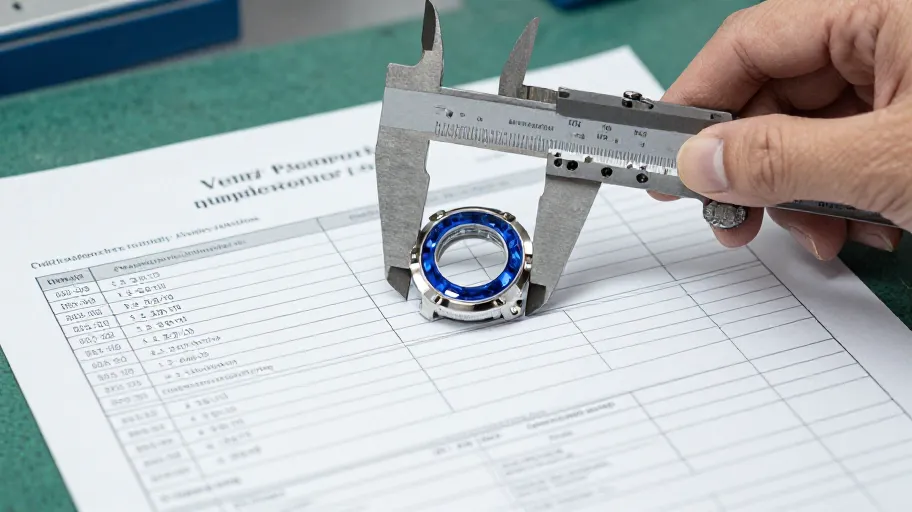
Evaluating a sapphire watch case manufacturer comes down to five things: verified production capability for your specific geometry, a documented quality and inspection system, clear engineering communication, written acceptance criteria, and terms for samples, tooling and escalation that you have confirmed in writing. Use the VERIFY Framework below to score every shortlisted supplier on the same evidence.
Why evaluation discipline matters more than price
A private-label sapphire project locks you into one supplier's tooling, process and quality system. Once tooling is committed, switching manufacturers means restarting engineering — so the cheapest quote at the start can become the most expensive decision at first-article inspection. The purpose of this guide is not to tell you which supplier to choose; it is to give you a repeatable method so that your choice rests on evidence you requested, documented and compared, rather than on claims.
One boundary note before we start: nothing in this article asserts what any specific manufacturer offers on samples, pricing, tolerances, minimums or lead times. Those change over time and vary by project. Treat every one of them as a question you confirm directly, in writing, with each supplier under evaluation.
The VERIFY Framework
V — Verify capability for your exact part. Sapphire watch crystals and sapphire components are not generic purchases. Ask each manufacturer to confirm, in writing, that they can produce your specific geometry, coating, engraving, colour treatment and finishing requirements — and to state where any requirement falls outside their current scope. A supplier who flags a limitation early is more useful than one who agrees to everything.
E — Examine quality systems. Request the inspection process for each shipment: what is measured, with what equipment, how results are recorded, and how dimensional and cosmetic deviations are reported to you. Ask how the supplier defines and documents acceptance criteria before production starts.
R — Review engineering communication. Before sending an RFQ, run a small engineering exchange: send your drawing with one deliberate ambiguity and see whether the supplier's engineers ask the right clarifying question. In a private-label project, your technical dialogue with the manufacturer matters as much as the quote.
I — Inspect documentation. Ask what documentation accompanies each batch — dimensional reports, material documentation, coating notes where relevant — and confirm what is available before you commit. If a supplier cannot describe their documentation package in advance, that itself is a data point for your scorecard.
F — Finish with escalation terms. Confirm, in writing, the process when a part or batch does not meet agreed criteria: how issues are raised, how responsibility is determined, and what the corrective path is. Agree this before tooling, not after a problem.
Decision table: shortlisting gate
Score each supplier on the five gates. Any supplier failing a gate you consider non-negotiable should not advance to RFQ.
| Gate | What to request | What acceptable evidence looks like | Score (0–2) |
|---|---|---|---|
| Capability match | Written confirmation they can produce your geometry, finish and any coating or engraving | Specific, itemised confirmation — including explicit statement of any out-of-scope requirement | ☐ |
| Quality system | Inspection process description and how acceptance criteria are documented | Named measurement methods and a documented acceptance workflow | ☐ |
| Engineering dialogue | Response to your test drawing question | Engineers ask precise clarifying questions; answers reference your drawing, not generic capabilities | ☐ |
| Documentation package | List of what accompanies each batch | Clear, written list you can align with your own incoming inspection | ☐ |
| Terms and escalation | Current sample, tooling and issue-resolution terms | Written policy statements you have confirmed directly — not verbal summaries | ☐ |
Capability questions to send before an RFQ
Send these to every shortlisted sapphire watch case manufacturer and compare the answers side by side.
- Can you confirm in writing that you can produce this exact geometry, thickness profile and finish? Please note any requirement outside your current scope.
- How are dimensional inspections performed, with what equipment, and how are results reported per batch?
- How do you document and agree acceptance criteria — dimensional and cosmetic — before production?
- What documentation is provided with each shipment?
- What is your process when a delivered part does not meet the agreed criteria?
- What information do you need from us (drawings, tolerances, volumes, target timeline) to give a complete quotation?
- Who is the engineering contact for technical questions during the project, and in what language and channel do they work?
Note that none of these presume a policy. Each one forces the supplier to state a current, verifiable position — which is exactly what your scorecard needs.
Sample, tolerance and documentation verification
Three areas deserve special caution because they are where undocumented assumptions cause the most damage.
Tolerances. Do not accept a general tolerance claim. Ask the supplier to confirm, against your drawing, which tolerances they will commit to and how each is measured. Whatever the specific numbers, they belong in the agreed acceptance criteria in writing.
Documentation. A documentation package you can inspect at incoming goods is what protects you if a dispute arises later. Agree the document list before the first production order, not after delivery.
Red flags to watch for
- Unqualified yeses: a supplier who confirms every capability without asking a single technical question about your drawing.
- Verbal-only terms: any sample, tolerance or escalation commitment that exists only in a call.
- Quality answers that describe attitude instead of process ("we are very strict") rather than measurement methods.
- Reluctance to put acceptance criteria in writing before production.
- No named engineering contact for the project.
None of these prove a bad supplier — but each one is a verification gap, and gaps are what the scorecard exists to surface.
FAQ
Should I evaluate one sapphire watch case manufacturer or several? Score at least two or three against the same VERIFY gates. A single-candidate evaluation has no baseline, so you cannot tell whether a strong answer is strong or merely the only answer you have.
What should I send in the first approach? A short project brief — geometry description or drawing, finish requirements, indicative volumes and your evaluation questions — plus a request for written confirmation of current sample and production terms. Withholding full drawings until an NDA is in place is reasonable; ask the supplier how they handle confidential documentation.
How do I compare suppliers who answer questions differently? Score answers on evidence, not tone. A supplier who says "we cannot do that finish" or "we measure this way" has given you verifiable information; a supplier who agrees to everything has not.
Is factory location relevant to the evaluation? Location affects logistics, communication windows and travel for audits — but it does not substitute for the VERIFY gates. A supplier in any location either documents capability and quality systems or does not.
What if the supplier is a trading company rather than a factory? Neither role is inherently better; what matters is who controls the process. Ask directly who performs production, who handles inspection, and who you escalate engineering issues to — and document those answers.
Compare every supplier on the same evidence
The Supplier Scorecard turns the VERIFY Framework into a working document: capability gates, quality-system evidence, engineering-communication results, documentation requirements and confirmed terms, all scored side by side.
[Download the Supplier Scorecard]
If you are not ready for that step, start smaller — run the pre-RFQ checklist below with your current shortlist and see which suppliers give evidence, not assurances.
Pre-RFQ verification checklist
- Written capability confirmation against our exact drawing, including out-of-scope items
- Current sample policy confirmed directly and dated
- Inspection methods and measurement equipment named
- Acceptance criteria process documented before production
- Batch documentation list agreed in writing
- Escalation and issue-resolution path confirmed before tooling
- Named engineering contact established
- Test engineering question answered with drawing-specific precision
JadeZone Sapphire, a Shenzhen and Hong Kong B2B manufacturer of custom sapphire watch crystals and precision sapphire components, welcomes these questions from watch brands, buyers and sourcing teams — verify, compare and document before you approve any supplier, including us.