
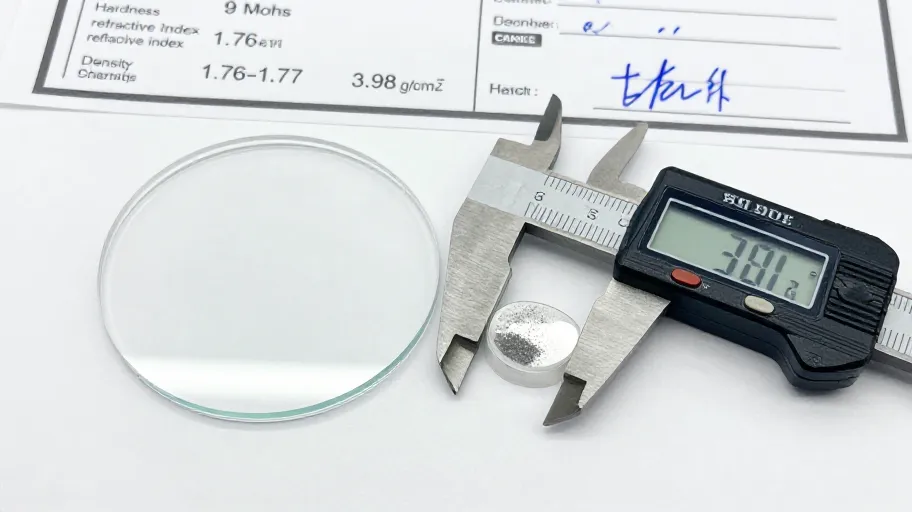
Buying sapphire crystal glass for a watch programme comes down to three controllable steps: define specifications in writing, validate them against physical samples, and lock a documented sign-off before production release. Buyers who separate spec language, sample evidence and approval authority resolve disputes faster and avoid rework.
This guide walks through each step using a practical framework, with the questions you should put to any supplier — including JadeZone Sapphire, a Shenzhen and Hong Kong B2B manufacturer of custom sapphire watch crystals and precision sapphire components — before you commit tooling or volume.
The 3S framework: Spec → Sample → Sign-off
Most sourcing friction around sapphire crystal glass is not about material quality. It is about ambiguity: a drawing that omits a bevel detail, a sample approved verbally, a coating expectation never written down. The 3S framework keeps three phases separate and forces each to produce its own artefact:
- Spec — a written technical definition the supplier confirms they can meet.
- Sample — physical parts checked against that written definition, not against memory.
- Sign-off — a named person approving a golden sample, with every subsequent change documented.
Skipping the artefact in any phase is where programmes drift.
Step 1: Spec — what to define before requesting a quote
A sapphire crystal glass RFQ should read like a contract annex, not a request for "a 36mm dome." At minimum, document the following with your supplier, using their engineering input to challenge and refine each line:
| Spec element | What to document | Why it matters at approval |
|---|---|---|
| Shape and profile | Flat, domed, double-domed, or bespoke curvature — with drawing revision number | Profile is the first thing checked against the golden sample |
| Diameter, thickness, dome height | Nominal values on a controlled drawing; tolerances agreed per feature | Prevents "close enough" disputes at inspection |
| Bezel seating and bevel | Cross-section detail, chamfer geometry, seating method (press, gasket, adhesive) | Fit failures surface late and are expensive |
| Surface finish | Polish quality on both faces, edge treatment | Visible quality defines perceived product grade |
| Coating | Whether anti-reflective coating is applied, inside face, both faces, or none — and how it will be verified | Coating expectations must be testable, not assumed |
| Features | Date window, integrated cyclops, printed or applied indices, drilling | Each feature adds inspection points |
| Material confirmation | Confirmation that parts are synthetic sapphire and how identity is evidenced | Distinguishes sapphire from glass alternatives in disputes |
Tolerances, coatings and finishes vary by project and supplier process. Do not assume a number — agree it on the drawing and ask the supplier to confirm capability in writing for each feature. Where a supplier hesitates on a specific tolerance, that is useful information early, not a problem discovered at inspection.
Step 2: Sample — questions that make the round productive
Samples are evidence, not gifts. Before any sample round with any supplier, ask these approval questions in writing:
- "Which drawing revision are these samples made to, and what deviations exist from that revision?"
- "What dimensional and cosmetic inspection will you perform before shipping samples, and will the inspection report accompany them?"
- "How will you evidence material identity as synthetic sapphire?"
- "If the coating option is selected, how is coating presence and quality verified, and how should we inspect it on arrival?"
- "What is your current policy on sample charges, shipping responsibility, and whether charges are adjusted against production orders?" — You must confirm the current policy directly; do not rely on prior arrangements or assumptions.
- "What is your revision process if the first samples fail our inspection, and who signs revisions on your side?"
- "Can you produce a small pilot batch consistent with the final process before volume release?"
Log every answer. A sample approved without a written inspection baseline is an opinion, not an approval.
Decision table: comparing suppliers and samples
| Evaluation criterion | Strong signal | Warning signal |
|---|---|---|
| Spec response | Line-by-line confirmation or engineering queries on the drawing | Generic "yes we can do all" without referencing features |
| Sample documentation | Inspection report, drawing revision, identified deviations | Parts arrive with no paperwork or traceability |
| Deviation handling | Proactive disclosure and proposed corrective path | Deviations discovered only by your QC |
| Revision control | Named engineer or contact owning changes | Changes handled informally across channels |
| Policy clarity | Written answers on samples, charges and terms | Terms stated verbally and inconsistently |
| Pilot-batch consistency | Pilot parts match approved golden sample | Drift between sample and pilot without explanation |
Use this table to score competing quotes. The cheapest quote that fails three rows here will cost more than the higher quote that passes all six.
Step 3: Sign-off — the approval checklist
Before releasing production, complete and archive this checklist:
- Final drawing revision agreed and version-numbered by both parties
- Golden sample physically held and labelled by both parties
- Dimensional inspection report reviewed against agreed tolerances
- Cosmetic criteria (finish, edge quality) documented with boundary samples or photos
- Coating specification and verification method written into the approval record, if applicable
- Material identity evidence filed
- Sample charges, terms and any adjustments confirmed in writing
- Named approver on both buyer and supplier sides
- Change-control process agreed: no change without a new revision number
- Incoming-inspection plan defined for production lots
This checklist costs an hour. Its absence costs a production run.
Frequently asked questions
What is the difference between sapphire crystal glass and mineral glass for watches? Synthetic sapphire is a single-crystal material valued for hardness and scratch resistance; mineral glass is a hardened glass. For a B2B buyer the practical difference extends beyond material: sapphire requires different machining, polishing and inspection processes, so spec documentation and sample approval matter even more. Confirm material identity evidence with your supplier regardless of type.
How do I specify a custom sapphire crystal for an OEM watch? Start from a controlled drawing: profile, diameter, thickness, dome height, seating geometry, finish, coating and any features such as date windows. Have the supplier confirm each line in writing, then validate against samples. The SPEC–SAMPLE–SIGN-OFF sequence above is the workflow.
What should I check when sapphire crystal samples arrive? Three things: conformity to the drawing revision (dimensional), conformity to agreed cosmetic criteria (visual), and conformity of documentation (inspection report, material evidence, declared deviations). Anything not documented at this stage becomes unresolvable later.
How are sample charges and terms handled? Policies differ by supplier, project and order context. Do not assume — ask for the current written policy covering charges, shipping responsibility, and whether any charge is adjusted against future orders, and file the answer with your approval records.
Should I request a pilot batch before full production? A pilot run consistent with the final process lets you confirm the golden sample transfers to production conditions. Whether a supplier offers this, and on what terms, is a question to confirm directly — but the logic of verifying before committing volume applies to every programme.
Turn this into your sourcing document
The fastest way to apply the 3S framework is to start from a structured brief rather than a blank drawing.
获取采购 Brief — download the JadeZone Sapphire procurement brief and send your sapphire crystal glass requirements in a format engineers can quote against.
Prefer to start smaller? Take the Step 3 sign-off checklist above into your next supplier call — it works with any manufacturer and costs nothing to apply.