
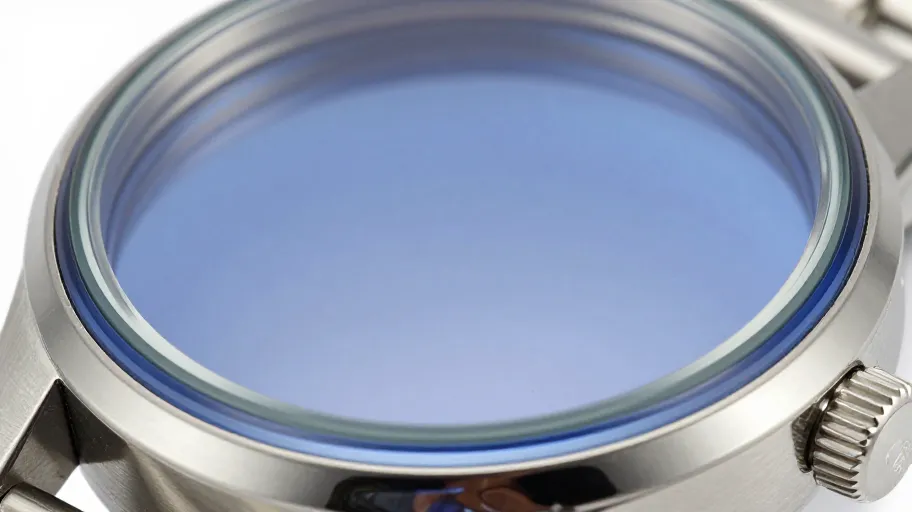
Yes — many watches use sapphire crystal, meaning synthetic sapphire (single-crystal aluminium oxide) grown, cut and polished for watch applications. For a buyer, the real question is not whether it exists but how to specify it, sample it and approve it so that what arrives matches what was quoted. This guide gives you that process.
What "sapphire crystal" means when you are the buyer
In watchmaking, a sapphire crystal is a transparent window made from synthetic sapphire — a hard, crystalline form of aluminium oxide produced deliberately for optical and mechanical parts, then sliced, shaped and polished to a case design. It is not mined gemstone and it is not ordinary glass; it is an engineered component with definable parameters.
That distinction matters commercially. When two suppliers both quote "sapphire crystal," the quotes are only comparable if the underlying specification is identical: the raw material form, the surface treatments, the geometry, and the interface with the case and gasket. A spec-level conversation protects you far better than the word "sapphire" on a quotation.
The SPEC–SAMPLE–SIGN-OFF framework
Use this three-gate framework to move from enquiry to approved production:
- SPEC — define the crystal in writing: material, geometry, coating, interface, marking and packaging.
- SAMPLE — evaluate physical parts against documented acceptance criteria, not impressions.
- SIGN-OFF — record written approval of a specific revision before production, and freeze changes.
Decision table: what to lock down at each gate
| Gate | Parameter to define | Why it matters | What to confirm with the supplier |
|---|---|---|---|
| SPEC | Material form and origin of the sapphire boule or wafer | Material consistency underpins optical and mechanical behaviour | What material documentation is provided per lot |
| SPEC | Crystal geometry (dome, flat, box, step, bevel) and case fit | Drives machining method, gasket seating and visual profile | Which geometries they can hold for your design |
| SPEC | Coating (anti-reflective, single- or double-side) | Affects reflectance, colour and appearance under retail lighting | Coating options and how coating conformity is verified |
| SPEC | Gasket interface and dimensional callouts | Seating tolerances determine water-resistance assembly outcomes | How dimensions are inspected and reported |
| SPEC | Marking, printing or logo treatment | Brand identity on the crystal | Methods available and durability testing approach |
| SAMPLE | Appearance under defined lighting | Visual defects are the most disputed category | Agreed inspection lighting and viewing distance |
| SAMPLE | Fit trial in your actual case | Paper dimensions and real assembly can diverge | Whether sample parts are from production-equivalent tooling |
| SIGN-OFF | Revision control | Prevents silent changes between sample and bulk | How revisions are documented and communicated |
| SIGN-OFF | Acceptance criteria in writing | Makes disputes resolvable | Defect classification and acceptance thresholds per agreement |
Treat any parameter the supplier cannot document as an open risk to resolve before approval, not after delivery.
Approval questions to put to any sapphire crystal supplier
Bring these to your next supplier conversation — for JadeZone Sapphire or any manufacturer you are evaluating:
- What material documentation accompanies each production lot, and can you share the approach with us before we commit?
- Which crystal geometries and coatings can you produce for our specific case design, and where are the limits?
- How do you inspect dimensional conformance, and in what format do we receive inspection data?
- Are sample parts produced with the same process and tooling intended for bulk production?
- How are revisions between sample rounds recorded, and who approves a change?
- What is your current policy on samples, fees and shipping — including whether any fees are credited toward production? (Confirm the current policy directly; do not rely on this article.)
- What is your current lead-time, MOQ and capacity picture for a programme of our shape and volume? (Project-specific; confirm directly.)
- How do you handle a nonconforming batch after sign-off, and what does your process commit to in writing?
None of these questions assumes a policy exists in a particular form. Their purpose is to make the supplier state, in writing, what is true today for your specific project.
Sample-evaluation checklist
Use this checklist when physical samples arrive, and record the result against each line:
- Sample revision number and date recorded, matching the approved drawing
- Material documentation received and filed for the lot
- Visual inspection completed under the agreed lighting condition; findings classified
- Coating presence and placement verified on the specified surfaces
- Fit trial completed in the actual case with the intended gasket
- Marking or logo checked against artwork, position and legibility
- Dimensional report received and compared against your callouts
- Deviations logged, with disposition: accept, rework or re-sample
- Written approval (or rejection with reasons) issued to the supplier
- Approved revision frozen; subsequent changes routed through revision control
A sample round without recorded outcomes is a round you cannot defend later — or repeat.
Frequently asked questions
Do any watches have a sapphire crystal, or is it reserved for luxury brands? Sapphire crystals are used across a wide range of watch segments, not only high-end pieces. For a buyer, the relevant question is the specification behind the label: material form, coating, geometry and inspection. Ask any supplier to define these in writing so you can compare quotations on equal terms.
How is a sapphire crystal specified in an OEM enquiry? At minimum: material documentation approach, crystal geometry and case-fit interface, coating configuration, dimensional callouts for the gasket seating, marking requirements, and the inspection reporting you expect. Every one of these should appear in your request for quotation.
What should we check before approving a sapphire crystal sample? Verify revision control, appearance under agreed lighting, coating placement, dimensional report versus callouts, fit in the real case with the real gasket, and marking accuracy — then issue approval in writing. The checklist above is a starting point you can adapt to your programme.
Can we request changes after sample approval? Ask your supplier how revisions are handled and documented before you approve. The safest structure is one where any change after sign-off is logged, re-sampled if material, and re-approved — for both sides. Confirm the specific process with the supplier rather than assuming it.
What should we confirm about sample fees, shipping and production terms? Only what the supplier states in writing for your project. Sample policy, fee treatment, shipping responsibility, lead time, MOQ and capacity are all project-specific and subject to change — confirm them directly with JadeZone Sapphire or your chosen manufacturer at enquiry stage.
Next step
获取采购 Brief — download the sourcing brief and turn the questions in this guide into a documented enquiry you can send to any supplier, including us.
Prefer to start smaller? Reply with your case drawing and we will return a spec-confirmation checklist tailored to your crystal design — no commitment required.