
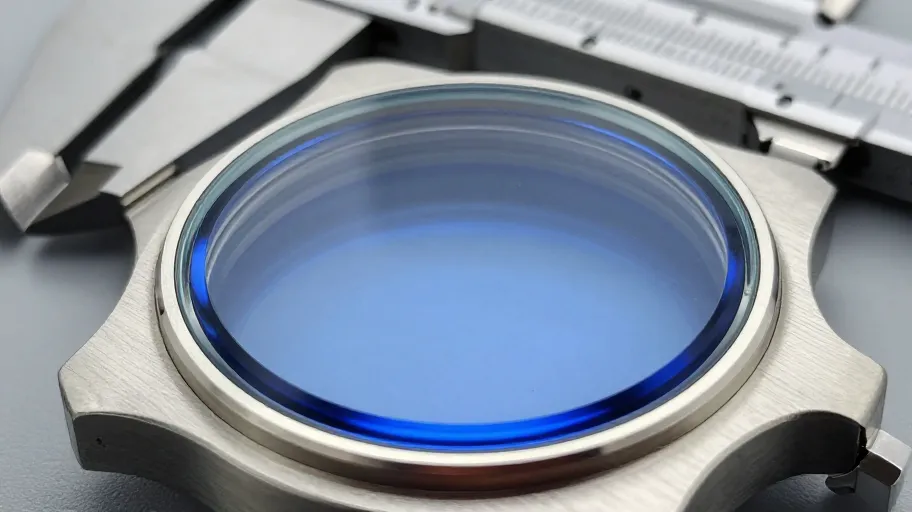
How much does a sapphire crystal cost for a watch? For a B2B buyer, there is no single answer: the price of a custom sapphire watch crystal is determined by the specification you fix — geometry, thickness profile, coatings, edge finish, tolerances, printing and order quantity — and by the supplier's sample and tooling terms. The right first step is not to chase a number; it is to lock a complete specification so every supplier quotes against the same drawing.
This guide sets out a practical framework — Spec–Quote–Sample–Gate — that sourcing managers and watch brands can use to turn an open-ended cost question into a controlled, documentable procurement process.
Why "how much" has no stable answer until the spec is fixed
When a watch brand asks a sapphire crystal manufacturer for a price, the quality of the answer depends on the quality of the enquiry. Two suppliers quoting the same nominal "36 mm domed sapphire crystal" may be quoting materially different parts: one with an anti-reflective coating on both sides, one uncoated; one with a stepped edge, one flat; one ground to a tighter fit tolerance, one to a looser one. The quotes will differ, and neither is "wrong" — they describe different products.
Cost, in other words, is a function of decisions you make before the RFQ goes out. Those decisions include:
- Geometry: flat, domed, boxed, stepped, or a compound curve; doming adds processing stages.
- Thickness profile: uniform wall versus variable profile.
- Diameter and case-fit geometry: how the crystal seats in or on the case.
- Coatings: anti-reflective treatment, and whether applied to one or both faces.
- Surface finishes: polish quality standards and inspection criteria.
- Markings: date-window cut-outs, printed indices, logos, or applied elements.
- Tolerances: the dimensional bands you specify for fit and interchangeability.
- Quantity and cadence: pilot run versus serial production, and how the ramp is scheduled.
- Tooling and fixtures: whether new tooling is required for your geometry.
- Sample and approval terms: how samples are produced, approved and charged — confirm the current policy directly with each supplier.
None of these numbers can be stated here, because none were supplied. That is precisely the point: each one is a supplier-confirmation question, and each one moves the quote.
The Spec–Quote–Sample–Gate (SSG) framework
The SSG framework keeps a sapphire crystal purchase auditable at every stage:
- Spec — Fix the drawing. Every dimension, finish, coating and tolerance is written down, with the acceptance criteria for each.
- Quote — Issue the RFQ against that spec to multiple suppliers. Quotes are only comparable when they reference the identical document.
- Sample — Request production-representative samples and inspect them against the written spec, not against memory or a photograph.
- Gate — Approve in writing, retain a signed-off golden sample, and reference it in the purchase order so production is measured against the approved reference.
Skipping the gate is where most cost overruns actually happen: rework, disputes and line delays cost more than any per-unit price difference between suppliers.
Decision table: how spec choices affect cost and risk
| Specification choice | Effect on unit cost | Effect on risk | Approval consideration |
|---|---|---|---|
| Flat vs domed geometry | Doming involves additional grinding/polishing stages — confirm cost impact per supplier | Dome height affects hand clearance and dial visibility | Approve sample on the wrist, not just on paper |
| AR coating (none / one side / both sides) | Coating adds process steps — confirm pricing structure | Coating durability and appearance need defined acceptance criteria | Specify which side(s) and how coating quality is inspected |
| Tighter fit tolerance | Tighter bands demand more processing and inspection — confirm | Tighter fit aids waterproofing and assembly | Confirm what tolerance the supplier can hold and how it is measured |
| Printed or applied markings | Additional decoration steps — confirm | Print registration and durability vary | Approve a physical printed sample, not a render |
| Date window / cut-outs | Machining complexity increases — confirm | Edge quality of cut-outs is a common inspection point | Inspect cut-out edges under magnification at sample stage |
| New tooling for custom geometry | Tooling may be quoted separately — confirm | Tooling ownership should be documented | Clarify in writing who owns and stores tooling |
| Pilot quantity vs serial production | Unit economics change with volume — confirm | Pilot approval must gate serial release | Reference the approved golden sample in the serial PO |
Building a quote request suppliers can answer precisely
Before contacting any sapphire crystal manufacturer — including JadeZone Sapphire — assemble a one-page spec package:
- A dimensioned drawing with material call-out and thickness profile.
- The case interface: how and where the crystal seats.
- Required coatings and which surfaces they cover.
- Surface finish and inspection criteria.
- All tolerances, stated as bands you can defend to your assembly team.
- Markings, windows and decoration, with artwork if applicable.
- Target quantities for both pilot and serial phases.
- Your questions on sample terms, tooling terms and inspection/reporting — to be answered in writing by the supplier.
With that package, "how much does a sapphire crystal cost for a watch?" becomes a question each supplier can answer with a firm, comparable number, and you can see exactly where one quote differs from another.
The sample stage: inspect and document
At sample stage, inspect against the written spec item by item: dimensions, dome profile, coating presence and quality, edge finish, print registration, cut-out quality, and overall optical clarity. Record what you find. If the sample deviates, decide deliberately whether the deviation is acceptable — and if so, revise the drawing so the spec and the approved part agree.
Then approve formally: a signed approval (email is fine) referencing the drawing revision, plus a retained golden sample held by both parties. Confirm with the supplier, in writing, how production parts will be checked against the approved reference.
Approval questions to put to any supplier in writing
- What dimensional tolerances can you hold for this geometry, and how are they measured and reported?
- What are your current sample terms — how are samples produced, charged and shipped? (Confirm the current policy directly.)
- What tooling, if any, is required for this part, and what are the ownership and storage arrangements?
- What coatings do you offer, and what inspection criteria apply to coating quality?
- What is your process if a production batch deviates from the approved golden sample?
- What documentation accompanies a production delivery?
- What are your current terms for pilot quantities and for serial ramp-up?
These questions apply to any supplier you evaluate, including us.
FAQs
Is a sapphire crystal always more expensive than mineral glass? For a like-for-like spec, sapphire involves different raw material and processing routes, and a custom sapphire part should be quoted on its own specification. Ask for quotes on both materials against the same drawing and compare directly rather than assuming.
Should I request samples before comparing quotes? Quote first against a fixed spec, then sample the shortlisted suppliers. Sampling every candidate is slower and can obscure the spec differences that drive price; sampling the best two or three quotes keeps the process tight.
What is a golden sample and why does it matter?
Do I need to specify coatings before asking for a price? Yes. Coating choice changes both the process and the inspection requirements, so a quote without a defined coating specification is not comparable to one that includes it.
How do I compare two quotes that differ significantly? Compare them line by line against your spec: geometry, coating, tolerance, tooling, sample terms and quantity assumptions. Ask each supplier to state what is and is not included, in writing.
Next step: 获取采购 Brief
Ready to turn these questions into a controlled sourcing process? 获取采购 Brief — a structured brief you can use to fix your specification, brief suppliers and document approval, before you commit to tooling or production.
Quick checklist: before you approve any sapphire crystal sample
- Written, dimensioned spec exists and is referenced in all correspondence
- Coating specification defined (type, surfaces, inspection criteria)
- All tolerances stated and confirmed by the supplier in writing
- Sample inspected against the spec, item by item, with results recorded
- Deviations either corrected or formally accepted into a revised drawing
- Signed approval issued referencing the drawing revision
- Golden sample retained by both parties
- Supplier's sample, tooling and deviation-handling terms confirmed in writing