
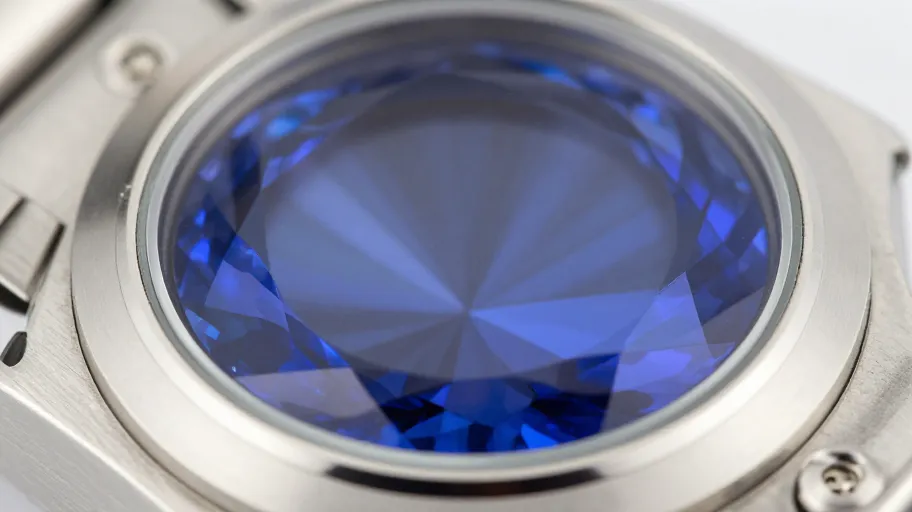
A sapphire watch crystal is a single-crystal synthetic sapphire (corundum) part, cut, ground, polished and — where specified — coated, to serve as the transparent cover glass of a watch. For B2B buyers, the hard part is not the material but the process: specifying geometry, finish and coatings precisely enough to compare quotes, then running a documented sample approval before production. This guide gives you a framework for both.
What you are actually specifying when you buy a sapphire watch crystal
When a supplier receives your enquiry, the quote they return is only as comparable as the specification you send. A complete sapphire watch crystal specification covers at least five variable groups:
- Material declaration. Confirm the growth method and grade the supplier quotes, and how material consistency is documented between the sample lot and the production lot.
- Geometry. Diameter, thickness, side profile (e.g. flat, domed, box-form, stepped), and how each dimension is measured and reported. Avoid stating a single "industry" number — your watch case dictates the values, and your drawing should state them with your own acceptance limits.
- Edge and fitting interface. How the crystal seats in the case: snap-fit, glued, gasket-sealed or bezel-clamped. Ask the supplier which interface they recommend for your case design and why.
- Surface finish and coatings. Polish quality on both faces, and whether anti-reflective (AR) coating is applied on one side, both sides, or not at all. Ask how coating adhesion and appearance are inspected.
- Features and decoration. Date-window apertures, magnifiers (cyclops), printed indices, mother-of-pearl or metal deposits, and their placement tolerances on your drawing.
None of these values can be assumed. Every one of them is a project-specific decision you should document in your RFQ, then confirm the supplier's capability against it in writing.
The S.C.A.L.E. framework: Specify, Confirm, Approve, Lock, Evaluate
To keep a crystal project from drifting, run it through five gates:
- Specify. Produce a drawing and written spec covering the five groups above, plus packing and inspection requirements.
- Confirm. Send the spec to candidate suppliers and ask each to confirm, line by line, what they can hold and what they would need to adjust. Differences between responses are your real comparison data.
- Approve. Order samples against the confirmed spec. Review them against written acceptance criteria — dimensional report, visual inspection under defined lighting, coating checks where applicable — not against impression.
- Lock. Once a sample passes, designate it the golden sample, agree the change-control rule (any deviation requires written re-approval), and record it before pilot production.
- Evaluate. After pilot and early production lots, compare received parts to the golden sample and the inspection reports. Document deviations while they are cheap to correct.
The framework's value is that approval becomes a documented gate rather than a feeling. If a dispute arises later, you have a spec, a confirmed response, an approved sample and a paper trail.
Decision table: how deep should your specification go?
| Project situation | Spec depth recommended | Sample approach | Approval gate |
|---|---|---|---|
| New case design, crystal not yet finalised | Full parametric drawing, interface discussion with supplier before case tooling freezes | Iterative samples during case development | Formal golden sample before case tooling is locked |
| Existing case, standard-fit replacement crystal | Fit-critical dimensions plus finish and coating spec | One sample round against written criteria | Single documented approval |
| OEM/ODM programme with a contract manufacturer | Full spec plus lot-inspection and documentation requirements | Sample round plus pilot lot | Two-stage: sample approval, then pilot-lot approval |
| Low-volume or bespoke watchmaker builds | Drawing plus explicit acceptance criteria agreed with the maker | Sample per design | Maker's recorded acceptance |
| Redesign of coating or finish only | Delta spec referencing the approved base crystal | Coating-focused sample | Targeted re-approval of the changed attribute only |
Sampling and approval: questions to ask before any sample is cut
Before you commission a sapphire watch crystal sample, put these questions to the supplier in writing and keep the answers:
Commercial and logistics
- What is your current minimum order quantity for this part, at sample stage and at production stage?
- What do you charge for samples of this specification, and what are the current terms for freight and any tooling?
- What is your current lead time for samples and for production, and what factors could extend it?
- What is your policy if the first sample does not meet the agreed specification?
All of the above are policy questions whose answers change over time. Do not rely on figures from forums, catalogues or past projects — confirm current terms directly for your specific part.
Technical and quality
- Can you confirm capability against each dimension on my drawing, and what measurement method and equipment will you use?
- What dimensional and inspection reports accompany a sample, and what accompanies each production lot?
- For AR coating: how is it applied, inspected, and how do you document coating quality between sample and production?
- How do you handle material traceability between the approved sample lot and production lots?
Documentation
- Will you sign off the golden sample and retain a reference copy?
- Who owns the tooling (if any) and the drawings?
- What marking, packing and labelling do you apply to production shipments?
Change control and the golden sample
Most crystal disputes trace back to undocumented change. Once your sapphire watch crystal sample is approved, three habits protect you:
- Tag and store the golden sample in conditions that will not scratch or degrade it, with the approval date and spec revision recorded.
- Version-control the drawing. Every revision gets a number, and the supplier confirms in writing which revision each shipment corresponds to.
- Treat every change as a re-approval. Even a "small" adjustment to a coating, edge profile or aperture position should produce a new sample and a new written sign-off before production resumes.
Ask your supplier how they manage revision control on their side. A supplier with a clear answer to that question is far easier to work with across a multi-year programme than one without.
Approval checklist
Run this before you release any crystal to production:
- Drawing and written spec issued, with revision number
- Supplier has confirmed capability against every spec line, in writing
- Sample received and inspected against documented acceptance criteria
- Dimensional/inspection report from supplier reviewed against the drawing
- Coating appearance and adhesion checks recorded, where coating is specified
- Fit verified in the actual case or case dummy
- Golden sample tagged, stored and signed off by both parties
- Change-control rule agreed: any deviation requires written re-approval
- Production-lot inspection requirements and documentation agreed
FAQ
Is sapphire the right crystal material for every watch project? Sapphire offers outstanding hardness and scratch resistance, but the right choice depends on your case design, target positioning, budget and assembly method. Compare sapphire against mineral glass within your own cost and quality targets rather than assuming one answer fits all projects.
Can I get a sample before committing to production quantities? Sampling arrangements, including any charges and freight terms, are supplier policies that must be confirmed directly for your specific part. Ask for the current terms in writing before any sample is cut, and treat the answer as part of your supplier comparison.
How tight can dimensional tolerances be on a custom sapphire watch crystal? This depends on the part's geometry, features and the supplier's process. Do not quote a number from memory or from another project — put your required limits on the drawing and ask each supplier to confirm what they can hold and how they measure it.
What documents should a supplier provide with a production shipment? At minimum, ask for a lot-referenced inspection report tied to your drawing revision, plus any coating or material documentation you agreed during approval. Agree the documentation package before production starts, not after.
What if the production parts differ from the approved sample? This is what the golden sample and change-control rule are for. Document the deviation, reference the approved sample and spec revision, and agree corrective action in writing. Deciding the dispute process before production is far cheaper than negotiating it afterwards.
Get the sourcing brief
Turn this guide into an enquiry-ready document. 获取采购 Brief — download the JadeZone Sapphire sapphire watch crystal sourcing brief, fill in your specification, and send it to us for confirmation against your drawing.
Or start lighter: download the free approval checklist above, run it against your current crystal project, and use it to structure your next supplier conversation.