
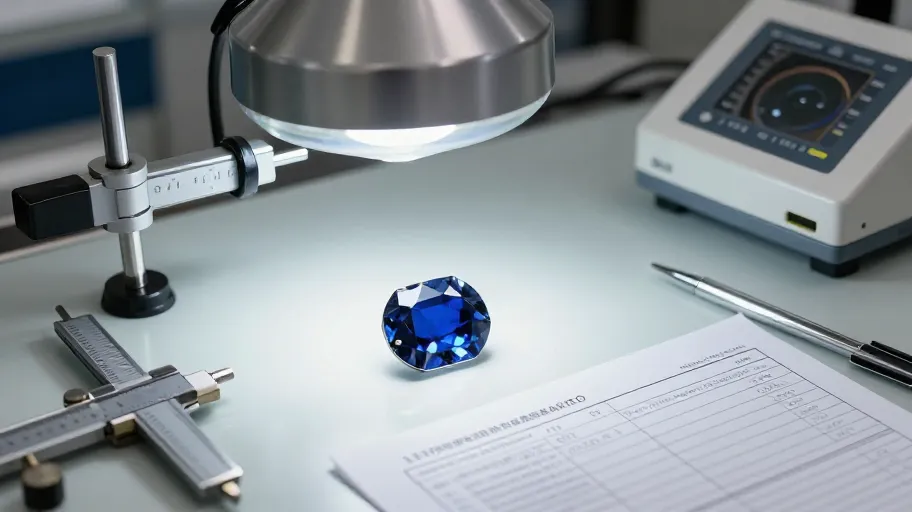
Calling a sapphire watch crystal manufacturer "the best" is a category error. For a private-label project, the best supplier is the one whose production evidence, engineering dialogue and approval documentation survive your verification process for your case shape, your volumes and your launch calendar. Use a structured vetting framework — Capacity evidence, Layer and coating verification, Engineering dialogue, Approval documentation, Reporting cadence, then Vet with a sample and pilot order — to convert an opinion into a documented decision.
Why "best" depends on your project, not a ranking
A sourcing manager at an established watch brand and an independent watchmaker launching a first private-label collection are solving different problems. The brand may prioritise documented inspection processes and change control across repeated orders. The watchmaker may prioritise responsiveness on one custom dome crystal and clarity on how a single part will be measured.
Any listicle claiming one manufacturer is objectively best skips the only question that matters: what evidence does this supplier provide that they can deliver your specific crystal, repeatably, and prove it in writing? A supplier that excels at flat crystals for a dress watch may be the wrong partner for a boxed sapphire on a diver model — not because of quality, but because the tooling, measurement methods and risk profile differ.
So treat "best" as an output of a process, not an input. The CLEAR-Vet Framework below is that process.
The CLEAR-Vet Framework for vetting a sapphire crystal manufacturer
C — Capacity evidence. Ask the supplier to show how they demonstrate production capability for parts like yours: process flow, quality control stages, and how inspection results are recorded and shared. The point is not a capacity number — which you must confirm directly — but whether the supplier can walk you through their process with specifics rather than adjectives.
L — Layer and coating verification. If anti-reflective or other coatings are in scope, ask how coating consistency is checked between prototype and volume production, what measurement instruments are used, and how results are reported per batch. Coating drift between sample and mass production is a real private-label risk; the supplier's answer tells you whether they measure it or hope around it.
E — Engineering dialogue. Judge how the supplier handles your drawing. Do they return a marked-up drawing with questions? Do they confirm achievable geometry in writing before quoting? Do they flag manufacturability concerns unprompted? Strong engineering dialogue predicts fewer surprises after tooling. Weak dialogue — vague confirmations, verbal agreements, unrecorded changes — predicts disputes.
R — Reporting cadence. Agree in advance on what updates you receive during production, at what milestones, and in what format. For a private-label launch with a fixed calendar, silent weeks between payment and delivery are a project risk.
Vet — Sample and pilot order. Nothing replaces physical evaluation. Vet with a sample against the agreed measurement method, then — if the project scale justifies it — a pilot order before full volume. Confirm current sample policy, cost, lead time and shipping terms directly with the supplier; these vary by project and are not assumptions you should import from other buyers.
Decision table: which supplier profile fits your private-label project
| Criterion | Dedicated sapphire component specialist | General watch-parts trading company | Vertical watch manufacturer offering crystals |
|---|---|---|---|
| Fit for custom geometry | Ask for drawing-review evidence and past custom shapes — confirm directly | Depends on which factory they place you with; ask them to name it | Strong if crystals are produced in-house; ask to verify |
| Engineering dialogue | Ask to test with a marked-up drawing response | A middle layer can help or blur communication; test with one RFQ | Direct access to production engineering; confirm who answers technical questions |
| Coating and process control | Request per-batch inspection method in writing | Request the underlying factory's documentation, not the trader's summary | Request the same documentation as any specialist |
| Accountability for defects | One accountable party; get the definition of non-conformance in writing | Clarify contractually who owns defect resolution | One accountable party; still get it in writing |
| Best fit when… | Your project is crystal-critical and spec-driven | You need sourcing bandwidth and have strong internal QC | You are bundling multiple components and want consolidated control |
None of these profiles is inherently superior. The table exists to show that the evaluation questions — not the category — decide.
Approval questions to put in writing before committing tooling
Send these before you approve anything:
- Which drawing revision will this quote and tooling be based on, and how are revisions controlled?
- How will each critical dimension be measured, with which instrument, and will measurement records accompany delivery?
- How is the golden sample defined, retained and used in subsequent inspection?
- If a delivered part does not conform to the approved definition, what is the resolution process?
- How is coating consistency verified between the approved sample and volume production?
- What production-stage updates will we receive, at which milestones, and in what format?
- What are the current MOQ, price, sample policy, lead time and shipping terms for this specific part? (Confirm directly — do not rely on published figures or other buyers' experiences.)
- Which factory location will produce this part, and can that be confirmed in the contract?
A supplier's willingness and speed in answering these eight questions is itself evaluation data.
Reading the sample: what to check against what was agreed
When the sample arrives, evaluate it against the documented method, not against impressions. Check dimensions with the agreed instruments. Inspect surfaces under defined lighting and magnification. Verify coating behaviour against whatever test method the supplier stated. Document everything — this record becomes your reference for the pilot order and for volume inspection.
If results diverge from the approval documentation, that divergence is the conversation. How the supplier handles a documented discrepancy during vetting is one of the most reliable predictors of how they will handle one during a production run.
FAQ
Is a sapphire crystal specialist better than a general watch-parts supplier for private label? Not automatically. A specialist can offer deeper crystal-specific process control, but only their documented answers to the CLEAR-Vet questions prove it. Some trading companies provide excellent coordination with strong underlying factories. Evaluate evidence, not category.
What should I verify about anti-reflective coatings? Ask how coating consistency is measured between sample and volume batches, which instruments are used, and whether per-batch results are reported. Confirm any performance expectations in writing with the specific supplier before approval.
Should I insist on a pilot order before full production? For most private-label launches with a fixed calendar, a pilot stage reduces risk — but the decision depends on your volumes, budget and timeline. If you skip it, weight the approval documentation and reporting cadence steps more heavily.
How do I judge a manufacturer I can only find online? Move the relationship offline fast: request a video walkthrough of the relevant process, a marked-up drawing response, written answers to the eight approval questions, and a sample. A genuine manufacturer engages with specifics; a listing-only operation sends price lists.
What makes a Shenzhen–Hong Kong manufacturing base relevant to sourcing? Geography alone proves nothing. What matters is whether the supplier's dual-base structure gives you the engineering and quality documentation you need, with communication channels you can rely on. Ask directly how each location is used for your specific part and confirm in the contract.
Before you shortlist another supplier, download the Supplier Scorecard — a structured evaluation sheet that turns the CLEAR-Vet Framework into a side-by-side comparison you can attach to your internal approval file.
Prefer to start smaller? Use the eight approval questions above as your RFQ checklist for the next supplier you contact — no download required.