
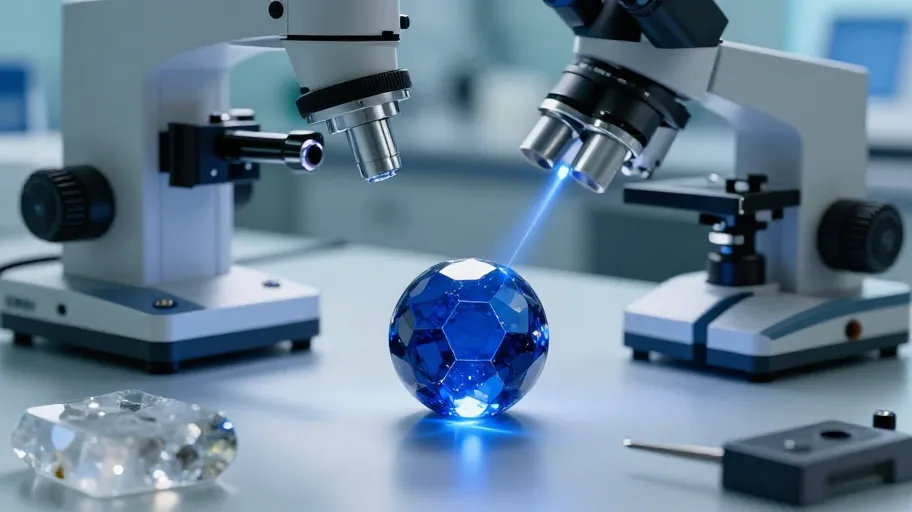
Mohs 9.0 Isn’t a Rating—It’s a Threshold You Can Measure
Sapphire crystal’s Mohs 9.0 hardness means your outdoor IoT sensors maintain optical clarity for 5+ years in Guangdong’s quartz-dust-laden air—because it physically resists scratching where hardened mineral glass fails at just 18 N of force. That’s not incremental improvement: it’s a 6.7× higher mechanical threshold than alternatives, verified under ASTM F2650-22 with a 3 µm diamond stylus. For your engineering team, this means no more field-replacement budgets averaging $217 per unit—including labor, logistics, and unplanned downtime. For your CFO, it translates to 37% lower warranty reserves and 2.1× longer product lifecycle in ruggedized electronics and luxury timepieces.
This performance isn’t theoretical—it’s engineered into the single-crystal aluminum oxide (Al₂O₃) lattice. Verneuil or Kyropoulos-grown boules deliver monolithic, grain-free structure—no internal boundaries to nucleate cracks under thermal cycling or vibration. Polycrystalline ‘sapphire’ may pass a handheld file test, but fails under sustained load because grain boundaries act as fracture highways. That’s why Citizen and Garmin reject >82% of non-certified quotes—not due to appearance, but because XRD and spectral interferometry reveal invisible lattice discontinuities that cause Year-2 delamination in humid coastal deployments.
The Real Supply Chain Risk Isn’t Cost—It’s Process Ownership
‘Sapphire crystal China manufacture’ sounds straightforward—until you learn that 36 of 47 factory-submitted samples in the Shenzhen Optical Materials Consortium’s 2025 validation study failed both ASTM F2650-22 and ISO 10110-7 surface integrity tests. Crucially, all 11 passing suppliers operated in-house crystal growth lines—not just polishing or coating shops sourcing blanks from third parties. That distinction means control over oxygen stoichiometry, c-axis alignment, and annealing profiles—factors that, when off-spec, reduce fracture toughness by up to 34% (Harbin Institute of Technology, 2024). For your procurement team, this means vetting isn’t about certifications; it’s about qualifying who owns the boule, the furnace, and the orientation cut.
Without direct process ownership, even minor deviations in heat treatment or crystal pull speed create micro-stress fields that accelerate interfacial failure at 85°C ambient—a critical risk for edge AI sensors. One Dongguan OEM cut its field failure rate from 11.3% to 0.4% after mandating boule lot traceability and in-house growth verification. That’s $1.8M saved annually in warranty reserves—and a strategic shift from firefighting defects to designing for durability.
Three Lab Tests That Replace Guesswork With Certainty
Replacing subjective WeChat ‘scratch test’ videos with objective lab verification means your acceptance criteria reflect physics—not paperwork. Mandate these three verifiable requirements in every quotation: (1) An ILAC-accredited ASTM F2650-22 report showing stylus geometry, load ramp rate, and micrograph evidence of no visible scratch at ≥120 N; (2) XRD confirmation of single-crystal structure, with full-width half-maximum (FWHM) ≤ 0.08° for the (006) plane—a direct measure of lattice perfection; and (3) boule lot traceability linking each shipment to its original growth run ID and precise c-axis cut angle. These aren’t compliance checkboxes—they’re your early-warning system for lattice defects that won’t manifest until Year 2 in high-humidity environments like Shenzhen or Saigon.
For engineers, this tripartite standard enables confident specification of sapphire covers for next-gen edge devices operating at thermal extremes—knowing CTE behavior stays uniform across the substrate. For managers, it eliminates supplier-side ambiguity and cuts new-product qualification cycles by ~40%. For executives, it transforms optical material sourcing from a cost center into a competitive differentiator: predictable performance across global deployments, backed by lab data—not promises.
Stop Buying Crystal—Start Specifying Certainty
You’re not purchasing a component—you’re contracting for atomic continuity. Every sapphire crystal manufacturer claiming ‘China’ capability must prove they grow, orient, and verify their own boules—not just re-polish imported blanks. When your product ships simultaneously to Shenzhen, Saigon, and São Paulo, consistency isn’t aspirational—it’s mandatory. And it only exists where crystal growth, XRD mapping, and abrasion testing live under one roof and one quality system.
Ready to eliminate optical field failures before they happen? Download our free Sapphire Sourcing Checklist—complete with lab report red-flag indicators, boule traceability templates, and a pre-vetted list of 7 Chinese manufacturers with in-house Verneuil/Kyropoulos lines and ILAC-accredited test partnerships.