
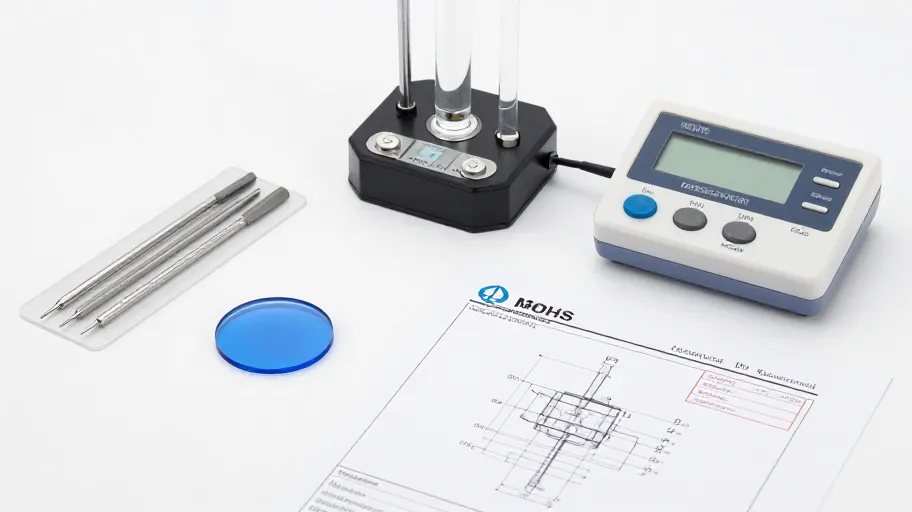
How to tell if a sapphire crystal is real? Verify material identity with a hardness test, a refractive/density check and — for production decisions — a laboratory or supplier-certified test report; then confirm conformance to your drawing, not just authenticity. Use a defined approval sequence before authorising mass production, and document every result.
That is the short answer. The rest of this guide turns it into a repeatable procurement process you can hand to your QA team and write into a purchase order.
Why this is a procurement question, not a curiosity
Consumer guides ask "how do I know my watch has sapphire?" Buyers ask a harder question: "how do I prove, with documented evidence, that every crystal in this shipment is the material, dimensions and finish I contracted for?" A single crystal that passes a casual test proves nothing about the batch. And authenticity alone is not enough — a genuine sapphire crystal with the wrong thickness, coating or edge finish is still a rejection.
So treat "is it real?" as two separate questions:
- Material identity: is this synthetic sapphire (corundum) rather than mineral or hardened glass?
- Specification conformance: does it match the agreed drawing, coating, tolerance set and cosmetic standard?
Buyers who merge these two questions approve shipments they shouldn't, or reject shipments that were fine.
The V.A.L.I.D. framework for sapphire crystal approval
Use the following five-stage framework for custom and OEM sapphire crystals:
- V — Verify material. Run non-destructive screening tests on incoming samples, backed by supplier documentation.
- A — Assess specs. Compare each sample against your drawing: thickness, diameter, edge profile, plinth height, date-window cuts, hole positions and surface finish.
- L — Lab-test. For new suppliers, new tooling or high-value programmes, commission or require independent confirmation of material identity and coating presence.
- I — Inspect batch. Apply a defined sampling plan to production shipments so approval is based on evidence, not the golden sample alone.
- D — Document. Capture results, reports and approvals in a signed record that becomes the reference standard for future orders.
Non-destructive field tests (and their limits)
These screening tests help a buyer or watchmaker make a fast judgement — none is a substitute for documentation.
1. Water-drop test. Place a small droplet on a clean, flat crystal face. On sapphire, water beads tightly; on most glass it spreads and flattens. Useful as a screen, not proof — coatings and surface cleanliness affect the result.
2. Hardness reference. Sapphire measures 9 on the Mohs scale; a hardened steel point or tungsten carbide scriber should not scratch it. A scratch appearing under a steel tip suggests glass. This test risks damaging a finished part, so run it on a designated sample, never on sellable stock — and confirm in advance with the supplier which unit may be sacrificed.
3. Visual and tactile cues. Sapphire has a distinct cool, dense feel and very high clarity, and AR-coated sapphire shows a faint colour tint (frequently blue or purplish, depending on the coating). These cues are impressions, not measurements.
4. Thermal conductivity. Some jewellers' thermal probes respond differently to sapphire versus glass. Availability and reliability of a suitable probe should be assessed by your QA team.
Limitations: every field test has false positives. Coated glass can mimic surface behaviour; a mixed shipment can pass on one unit and fail on another. Field tests prioritise; they do not approve.
Lab and metrological confirmation
For production decisions, move from screening to evidence:
- Material certificate / mill report. Ask the supplier to state the material origin and grade in writing, tied to your order reference, and to confirm what documentation they can currently provide.
- Refractive index and density. Sapphire's optical and physical constants differ from glasses; a metrology lab or equipped supplier QC can measure and report them.
- Coating verification. If anti-reflective coating is specified, ask how coating presence and uniformity are confirmed and reported — on the sample and on production units.
- Dimensional measurement. Confirm with the supplier which metrology equipment is used for thickness, parallelism and diameter, and whether measured data accompanies first articles. Do not assume any tolerance; agree the drawing tolerances explicitly for each project.
Which of these apply, and who performs them, is a project-specific conversation. Ask what is possible for your programme rather than assuming a fixed menu.
Decision table: reading your results
| Test / evidence | Interpretation | Buyer action |
|---|---|---|
| Water-drop beads; no scratch from steel tip | Consistent with sapphire | Proceed to spec and lab confirmation; do not approve on this alone |
| Scratch appears; droplet spreads | Material identity in doubt | Quarantine the lot; request supplier explanation and independent test before any commitment |
| Supplier provides written material documentation tied to the order | Stronger evidence chain | Cross-check against your own screening; file with the approval record |
| Independent lab confirms corundum | Material identity resolved | Shift focus to dimensional, coating and cosmetic conformance |
| Material confirmed but dimensions or finish outside the agreed drawing | Non-conforming part | Reject the lot formally; require corrected first article before production release |
| Mixed results across sampled units | Batch consistency problem | Escalate to full-lot review with the supplier; suspend approvals until root cause is documented |
Approval questions to put to your supplier
Ask these in writing before releasing tooling or production:
- What material documentation can you provide for our specific order, and how is it tied to our lot?
- Which tests do you run in-house, and which do you outsource or cannot provide?
- Can we receive first articles for our own verification before mass production, and what does that process require for our programme?
- What sampling plan do you apply to production shipments, and what records accompany each shipment?
- How do you verify AR coating presence and uniformity, if coating is specified?
- What is the process when a delivered lot fails our incoming inspection — repair, replacement, or other resolution, and how is it confirmed?
- Can a reference sample and inspection standard be agreed and retained by both parties as the acceptance baseline?
None of these presume any particular answer; they establish what is actually on offer for your programme.
Batch and documentation gate: approval checklist
Use this checklist at each release point:
- Field screening completed on designated sample units
- Material documentation received and matched to order reference
- Independent or supplier-provided lab confirmation reviewed (where agreed)
- First articles measured against drawing; results recorded
- Coating verified (if specified) and report filed
- Cosmetic/visual acceptance standard agreed in writing
- Sampling plan for production lots defined and documented
- Golden sample retained by buyer and supplier
- Non-conformance resolution process confirmed in writing
- Approval record signed and dated before production release
FAQs
Is one test enough to confirm a sapphire crystal is real? No. Combine at least two independent methods — for example a hardness screen plus documented material certification — and, for new suppliers, add independent lab confirmation. Single tests produce false results; layered evidence supports a defensible approval decision.
Can a supplier's word replace testing? Written documentation strengthens the evidence chain but does not replace your own verification at programme start. Once a supplier has a documented track record on your programme, you and your QA team can decide how much ongoing testing to retain.
Do coated crystals test differently? AR coatings can change surface behaviour such as droplet appearance and visible tint. Screen both coated and uncoated references where possible, and ask the supplier how coating is specified and verified for your parts.
What's the difference between authentic and conforming? Authentic means the material is synthetic sapphire. Conforming means the part also matches your drawing — dimensions, edge profile, coating and cosmetic standard. A shipment must be both before release.
How do I keep verification consistent across future orders? Anchor it in documents: a retained golden sample, a written acceptance standard, a defined sampling plan and signed approval records. That is the D in V.A.L.I.D., and it is what turns one-off checks into a repeatable process.
Next step
If you are specifying custom or OEM sapphire crystals and want a structured way to brief a supplier — covering material evidence, sampling and approval gates — 获取采购 Brief. It gives you the request-and-verify structure to take into your next sourcing conversation with JadeZone Sapphire.
Prefer to start smaller? Download the one-page incoming-inspection checklist above and use it on your next sample review — no briefing call required.