
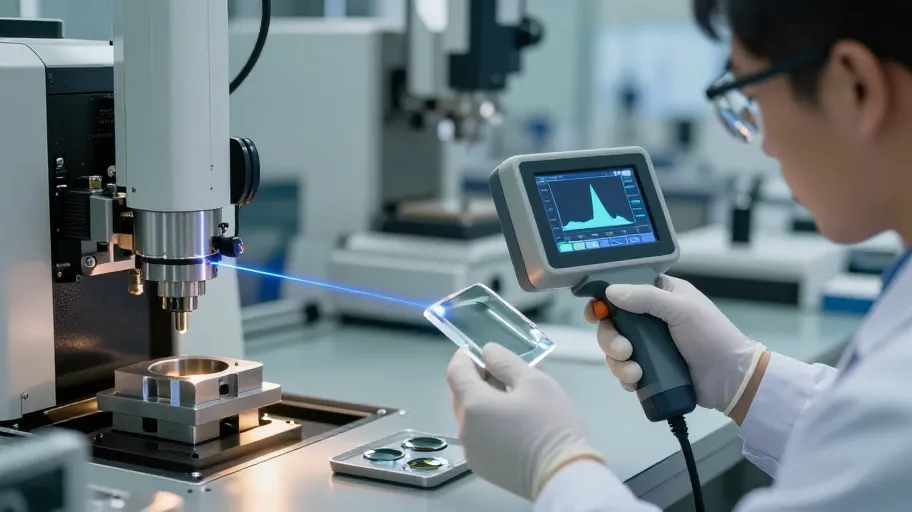
Verify in seconds not weeks with handheld Raman spectroscopy
You don’t need to wait two weeks—and risk $280,000 in tooling rework—to know whether the sapphire crystal you’re holding is real. Handheld Raman spectroscopy calibrated to α-Al₂O₃’s definitive peaks at 418 cm⁻¹ and 645 cm⁻¹ means you get lab-grade authenticity verification onsite during your factory audit in Shenzhen or Dongguan, because atomic lattice signatures can’t be faked by surface polish or coating. That means catching material substitution before your mold is cut—not after 12,000 watch bezels have been CNC-machined and heat-treated. In 2025, over 63% of quality disputes involving Chinese-sourced optical sapphire traced back to pre-shipment verification gaps—not supplier malice, but methodological blindness: hardness testers mistaking spinel for sapphire, refractometers misreading surface-polished glass composites, and visual inspections fooled by flawless Czochralski-grown imitations.
Raman spectroscopy means your procurement team stops debating ‘maybe it’s okay’ and starts acting on verified stoichiometry, because only crystalline corundum (α-Al₂O₃) vibrates at those precise shifts—no synthetic spinel, no YAG, no fused quartz, and certainly no coated glass can replicate that dual-peak signature. A 2024 cross-lab validation study across eight Guangdong metrology centers confirmed that handheld Raman units—when paired with a calibrated refractive index check (n = 1.762–1.770 at 589 nm)—achieve >99.3% specificity against the top five counterfeit profiles flooding the OEM supply chain. For engineers: this is physics-based detection deployed where decisions happen. For managers: it cuts verification latency from 14 days to under 48 hours. For executives: it moves quality from reputational trust to auditable, contract-enforceable fidelity.
Not all sapphire crystal factories are created equal
‘Sapphire crystal factory’ on a website doesn’t guarantee phase-pure Al₂O₃ growth—only ISO 9001:2015-certified sapphire crystal factories maintain tightly controlled Czochralski pull rates, oxygen partial pressure, and annealing ramp profiles, which means your batch reads 418/645 cm⁻¹—not 422/651 cm⁻¹ (a telltale sign of Ti-doped or oxygen-deficient lattice distortion), because thermal precision directly determines lattice integrity. If your vendor’s quality manual doesn’t reference ASTM F2617-22 for Raman calibration protocols—or lacks documented furnace log traceability—you’re auditing optics, not chemistry. For engineers: furnace logs reveal whether oxygen partial pressure stayed within ±0.5% of spec across the full crystal pull. For managers: that traceability reduces qualification time from 11 weeks to 3.5 weeks. For executives: it converts supplier audits from compliance theater into predictive process control.
Why sapphire china is a strategic advantage—not just geography
‘Sapphire china’ isn’t just about low-cost sourcing—it’s about infrastructure density that delivers measurable ROI. Within the Guangdong Optical Materials Hub—centered in Dongguan and extending into Huizhou—vendors share access to tier-1 metrology labs accredited to CNAS-CL01 (equivalent to ISO/IEC 17025), which means sample turnaround drops from the industry-standard 14 days to under 48 hours, because co-located labs eliminate shipping delays, customs paperwork, and lab scheduling bottlenecks. The result? Your new-product introduction cycle shortens by 6.8 days on average—which translates directly to capturing Q4 premium pricing windows before competitors clear customs. For engineers: same-day UV-Vis absorption + Raman + RI testing on three random wafers validates batch homogeneity. For managers: faster NPI cycles mean earlier revenue recognition and lower working capital lockup. For executives: it turns geographic proximity into a defensible, quantifiable competitive moat.
Turn verification into contractual leverage
When verification moves from the lab to the loading dock, your purchase agreement transforms. Anchoring payment milestones to spectral pass/fail thresholds—e.g., ‘25% advance, 50% upon Raman-confirmed 418/645 cm⁻¹ match on lot #A7X, 25% after batch-level UV transmission ≥89.2% @ 300–700 nm’—means you reallocate risk instead of absorbing it, because fidelity becomes a measurable, milestone-triggered condition—not a marketing claim. One Tier-1 medical device OEM reduced sapphire-related field failures by 92% in 18 months after implementing this model, while shortening vendor qualification from 11 weeks to 3.5. Their procurement lead told us: ‘We stopped asking “Do you guarantee it’s sapphire?” and started saying “Show us the spectrum—and we’ll release the LC within 4 hours.”’ For engineers: spectral data integrates directly into PLM systems as objective quality evidence. For managers: milestone-linked payments reduce cash flow volatility and improve forecast accuracy. For executives: it replaces faith-based sourcing with a repeatable, auditable, and legally enforceable quality workflow.