
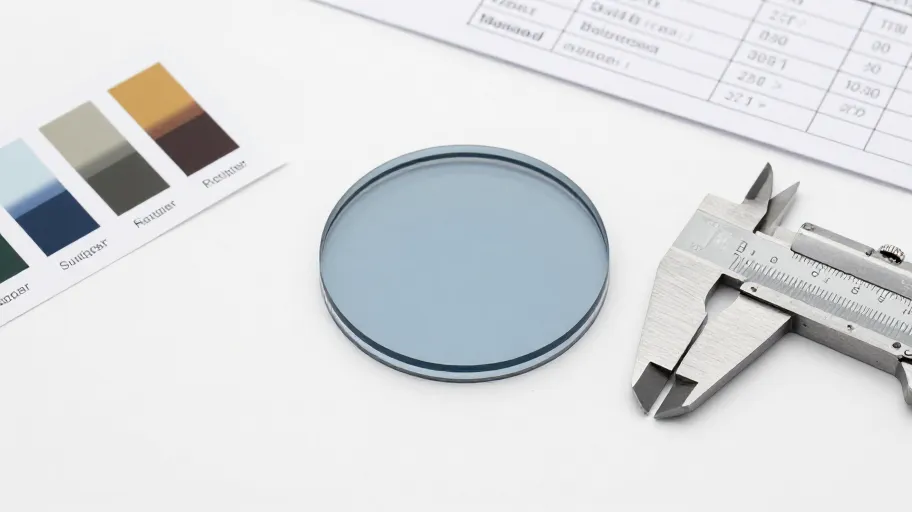
Synthetic sapphire lens price is not a single figure you can look up — it is the output of your specification. Diameter, thickness profile, dome or flat geometry, hole drilling, edge finish, coating type and quality acceptance terms each move the quote independently. To price accurately, freeze your drawing, request quotes against an identical spec from each supplier, qualify through samples, and approve against documented gates. Confirm the current policy directly on any commercial term.
Why identical lenses attract different quotes
When three suppliers return different numbers for what looks like the same sapphire crystal, the difference is almost never the raw material alone. It is the spec behind the number. One supplier may have quoted to a looser surface finish because your drawing did not state it. Another may have included a coating you did not name, or excluded inspection steps you assumed were included.
The buying problem, in other words, is not "what is the price?" but "what did each supplier assume?" That is the gap this guide closes.
The Spec–Sample–Gate framework
Use a three-stage framework to make synthetic sapphire lens price comparable and defensible:
Stage 1 — Spec. Freeze the drawing before contacting suppliers. Every element that affects cost must be on paper: material grade designation, geometry, surface finish per face, coating (if any), markings, inspection method and acceptance criteria. Anything left unstated becomes a supplier assumption, and assumptions are where quote variance lives.
Stage 2 — Sample. Qualify the frozen spec through samples evaluated against your acceptance criteria — not against a visual impression. Document what you measured, how, and what passed. A sample without a recorded evaluation cannot protect you at production stage.
Stage 3 — Gate. Define in writing what approval means: which drawing revision is approved, which sample batch it references, and what evidence the supplier must maintain for production parts. Without this gate, "approved" is an opinion; with it, it is a reference standard you can hold future batches to.
Price drivers you should interrogate in every quote
Ask each supplier to itemise their response against these drivers. No numeric values are given here because they are project-specific; the point is that each driver must appear as a named line in the quotation.
- Material: which sapphire grade and orientation is quoted, and how is it documented?
- Geometry: complexity of the shape — domes, steps, chamfers and holes each add operations.
- Surface finish: what finish is quoted per face, and how is it verified?
- Coating: is anti-reflective or other coating included, excluded, or assumed?
- Inspection: what measurement and acceptance steps are inside the quoted price?
- Yield risk: how does the supplier handle parts rejected against your acceptance criteria?
If a quote cannot be decomposed this way, you cannot compare it to another quote — you are comparing numbers attached to different unknowns.
Decision table: comparing supplier responses
| Evaluation question | Strong response | Weak response | Why it matters for price |
|---|---|---|---|
| Is the quote tied to a drawing revision? | Quote references your revision number. | Quote is verbal or "per your enquiry". | Prevents silent spec drift after approval. |
| Are price drivers itemised? | Each driver appears as a named line. | One lump figure. | You can see what you are paying for and challenge lines. |
| How is the sample evaluated? | Against your written acceptance criteria. | "We'll send a good one." | Sample evidence anchors future batch quality. |
| What is the approval artefact? | A signed approval referencing drawing and sample. | An email saying "OK". | Gives you a reference standard for disputes. |
| How are rejected parts handled? | A stated process you confirm in writing. | No defined process. | Yield risk is a hidden cost component. |
| Commercial terms (samples, shipping, fees)? | "Confirm the current policy directly" — answered in writing. | Vague or unstated. | Unverified terms distort total cost comparison. |
Concrete approval questions to send your supplier
- Which drawing revision does this quotation apply to, and how will revisions be handled in pricing?
- Can you itemise the quote by material, geometry, finish, coating and inspection?
- Which sapphire material designation and orientation will you use, and how will you document it?
- What inspection methods will you apply, and what evidence will accompany each batch?
- What process applies when a part fails our acceptance criteria?
- What exactly is approved when we approve a sample — and what artefact records it?
- For sample terms, shipping arrangements and any fees: confirm the current policy directly in writing.
Approval checklist before you commit
- Drawing frozen and revision-numbered.
- Acceptance criteria written and shared.
- All quotes received against the identical drawing revision.
- Each quote itemised by price driver.
- Samples evaluated against written criteria, results documented.
- Approval artefact signed, referencing drawing and sample batch.
- Rejection handling process agreed in writing.
- Sample, shipping and fee policies confirmed in writing — confirm the current policy directly.
Frequently asked questions
Is a higher synthetic sapphire lens price a sign of better quality? Not verifiable on its own. A higher quote may reflect tighter verification, more coating operations or higher yield risk — or simply different assumptions. Only an itemised quote compared against an identical spec tells you what the difference is.
Can I compare quotes before finalising the drawing? You can, but the comparison will not hold. Any geometry or finish change after quoting invalidates the comparison. Freeze the drawing first — this is Stage 1 of the Spec–Sample–Gate framework.
What should a sample approval actually contain? A reference to the approved drawing revision, the sample batch it came from, the criteria evaluated and the results. This becomes your reference standard for production parts.
How do I handle coating in the price comparison? Name the coating explicitly in the spec and require every supplier to quote it as a separate line. If coating is unspecified, quotes will diverge invisibly.
What if a supplier will not itemise their quote? Treat it as a comparison risk rather than a disqualifier. You can approve only what is documented; a lump figure gives you nothing to verify or challenge.
Compare quotes on equal ground
JadeZone Sapphire, a Shenzhen and Hong Kong B2B manufacturer of custom sapphire watch crystals and precision sapphire components, works from your frozen drawing through sampling to documented approval. [获取采购 Brief] to get the specification and approval framework before your next RFQ.
Or start lighter: download the Spec–Sample–Gate checklist above and use it to structure your next supplier conversation.