
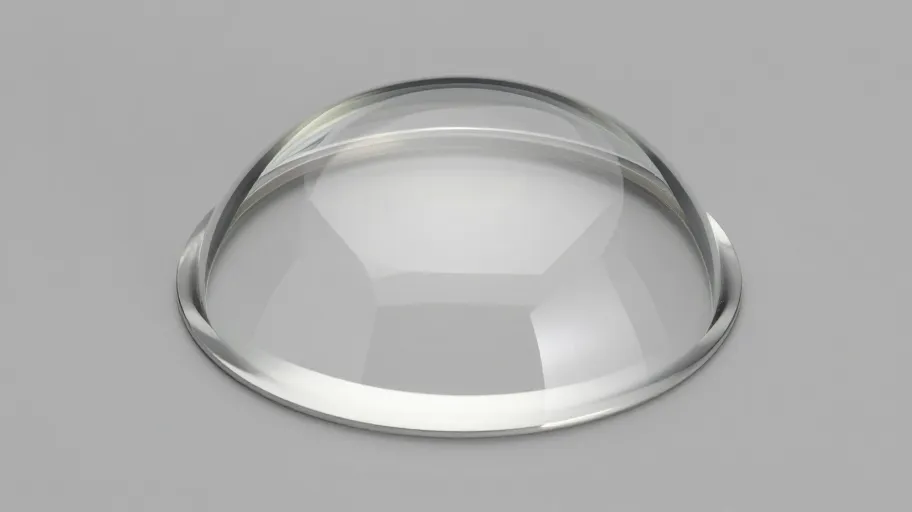
A domed sapphire crystal is a watch crystal made from synthetic sapphire, shaped with a raised, curved top surface rather than a flat one. For buyers, "domed sapphire crystal" means a specification job: define the curvature geometry, optical finish, coating and material proof, then verify each through samples before approving volume production.
Domed sapphire crystal meaning, in sourcing terms
The word "domed" describes the cross-sectional profile of the crystal: the top surface rises above the edge, forming a convex curve. Suppliers and brands use overlapping vocabulary here — domed, curved, vintage dome, box crystal, double-domed — and none of these terms is self-defining on a drawing. Two suppliers can read "domed" and quote two different geometries.
That is why the definition matters less than the measurable brief behind it. When you specify a domed sapphire crystal, you are specifying at minimum:
- The dome height or rise relative to a reference plane.
- The curvature profile — spherical, compound, or another defined curve.
- The base geometry — how the dome meets the sidewall, bezel seat or gasket.
- The thickness at centre and edge, which affects both optics and fit.
- The surface finish and coating on each face.
The D.O.M.E. Spec Framework
Use this four-part framework to brief any supplier of custom sapphire watch crystals:
- D — Define geometry. Provide a drawing that states dome height, profile, diameter, thickness at centre and edge, and the seat or gasket interface. Ask the supplier to confirm every dimensional input in writing and to state which tolerances they can hold for your specific part. Do not accept a verbal "we can do domed."
- O — Optics and coatings. Decide whether the dome is purely aesthetic or serves legibility at angles. Specify anti-reflective coating location (inner face, outer face, both) and require the supplier to confirm current coating options and how coating quality is inspected per batch.
- M — Material proof. Request evidence that the crystal is synthetic sapphire — ask what material verification the supplier offers and how it is documented, rather than assuming a certificate exists.
- E — Evaluation gate. Define in advance what a sample must pass before approval: fit in your case, gasket behaviour, optical check, coating check, and any brand-specific tests you run. Approve against written criteria, not impressions.
Decision table: matching dome specification to product intent
| Product positioning | Dome direction | Key spec decisions | Verification priority |
|---|---|---|---|
| Vintage-inspired model | High dome, pronounced rise | Profile drawing, edge thickness, seat compatibility | Fit with hands and bezel; case clearance |
| Modern sports model | Low dome or inner-curved flat | Coating choice, thickness at edge, gasket interface | Coating inspection; water-resistance fit in your own assembly |
| Dress model | Subtle dome, focus on optics | Surface finish, AR coating placement | Visual quality under varied lighting |
| Tool/industrial model | Minimal or flat with domed edge blend | Impact considerations, thickness plan | Your own functional testing after sample fit |
| Hybrid/box profile | Domed top with vertical side walls | Compound geometry definition | Dimensional report agreement before tooling |
This table is a planning aid, not a rulebook — your case design and movement height ultimately decide the geometry. Document what your design requires, then confirm feasibility with the supplier part by part.
Briefing a supplier: what to send and what to ask
A complete RFQ for a domed sapphire crystal should include your case drawing, the crystal drawing with all geometry callouts, the gasket or seat specification, target quantity range, and your inspection expectations. Then ask:
- Which dimensional tolerances can you confirm for this specific part, in writing?
- What curvature profiles can you produce, and how do you verify dome geometry on samples?
- What coating options do you currently offer, and how is coating quality checked?
- What material proof do you provide that the crystal is synthetic sapphire?
- What is your current sample policy — including any fees, shipping terms and whether sample terms relate to production orders? Confirm directly, as these terms are project-specific.
- What dimensional report or inspection data accompanies samples?
- How do you handle a specification change between sample approval and production?
Treat any answer you cannot see in writing as an open item. Sourcing managers who document supplier confirmations at RFQ stage avoid most disputes at approval stage.
Sample evaluation and approval gate
Run the approval in three passes:
- Pass 1 — Paper. Compare the supplier's confirmed drawing against your drawing. Every dimension must match. Resolve conflicts before samples are made.
- Pass 2 — Physical sample. Inspect fit, optics and coating against your written criteria. Record results per criterion, not as a pass/fail feeling.
- Pass 3 — Assembly trial. Fit the crystal into your actual case with your gasket and movement. A crystal that passes on the bench but binds in the case is a failed sample.
Only approve in writing, referencing the sample batch and the drawing revision. If geometry changes after approval, restart the gate.
Sample approval checklist
- Supplier confirmed every dimension and tolerance in writing
- Dome profile drawing agreed and revision-numbered
- Coating location and inspection method confirmed
- Material proof for synthetic sapphire received
- Sample fits target case with production gasket
- Optical and coating checks recorded against written criteria
- Assembly trial completed with movement installed
- Approval issued in writing, tied to drawing revision
- Current sample, fee, shipping and production terms confirmed directly with the supplier
FAQ
Is a domed sapphire crystal different from a curved one? The terms overlap, but they are not interchangeable on a drawing. "Domed" implies a convex top surface; "curved" can describe side curvature, underside curvature or compound shapes. Define the geometry numerically and confirm the supplier reads it the same way.
Does a dome affect how I specify thickness? Yes. A domed crystal has different thickness at the centre and the edge, and both interact with hand clearance and gasket seating. Specify thickness at defined points and ask the supplier which values they can hold and verify.
What should I check on a domed sapphire sample beyond fit? Check optical clarity across the dome, coating consistency under different lighting, edge quality where the dome meets the seat, and the presence of documented material proof. Record each result.
How do I avoid ambiguity when two suppliers quote the same "domed" part? Send the same numbered drawing to both, require written tolerance confirmation against each callout, and compare their dimensional reports against your drawing — not against each other's marketing language.
Who decides whether a sample passes? You do, against criteria you set before samples are made. Define the evaluation gate in your RFQ so the supplier knows what approval requires, and issue approval in writing tied to the drawing revision.
Next steps
获取采购 Brief — download the sourcing brief template and use it to structure your next custom sapphire crystal RFQ, from geometry callouts to approval criteria.
If you are not ready to request a brief, start smaller: run the sample approval checklist above against your current project and note which items you cannot yet document.