
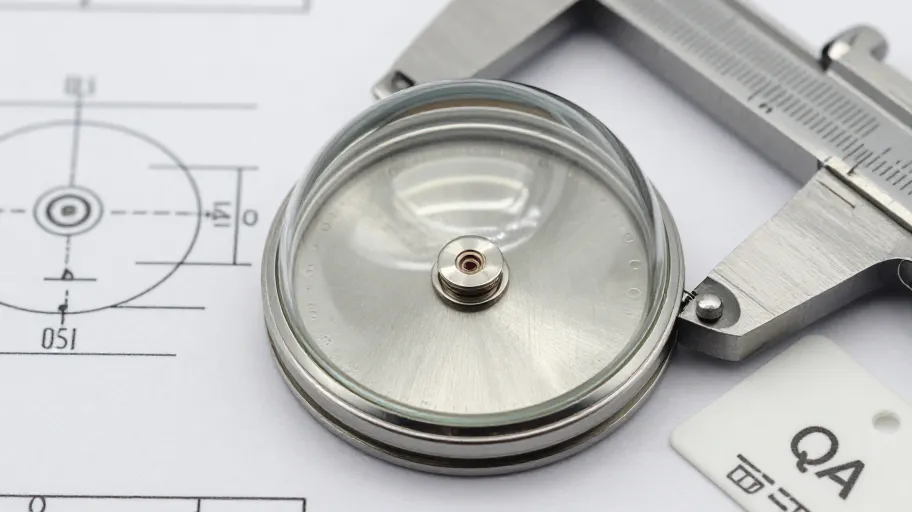
Domed sapphire crystal benefits combine sapphire's hardness and scratch resistance with a curved profile that improves viewing angles, reduces reflected glare at the edges, softens the watch's silhouette and creates the optical depth buyers associate with premium mechanical watches. For a sourcing team, the dome is a specified geometry with tooling, finishing and inspection consequences — so the benefit is only real if the spec, sample and approval gates are documented. This guide explains how to evaluate and approve one.
What a dome actually changes
A flat crystal and a domed crystal of the same diameter are different engineering parts, not just different looks. A buyer evaluating domed sapphire crystal benefits should separate four effects:
Optical. A curved surface changes how light enters and exits the crystal. Reflections that sit as a hard band across a flat crystal shift and break up across a curve, and viewing angles from off-centre positions can read more clearly. Whether that matters depends on the dial design, handset length and the watch's intended use.
Ergonomic and tactile. A dome removes the flat shelf at the top of the watch. That changes how the watch feels under a cuff and how it sits visually on the wrist — a design decision as much as a functional one.
Aesthetic and brand. A dome reads as a deliberate design statement with strong associations in watchmaking. If the brand story references vintage or high-end references, the dome is part of that language. That is a legitimate business benefit, but it should be documented as design intent, not assumed.
Geometric and production consequences. Dome height, base thickness, edge thickness, the transition to the case and whether the part is single- or double-domed all affect material use, polishing time, inspection method and how the part seats in the case or bezel. These are precisely the variables a supplier quote will be built on — and none of them should be left as verbal agreement.
The SSA-3 framework: Spec, Sample, Approve
For buyers who need to move a custom domed crystal from concept to signed-off production, a three-gate structure keeps decisions auditable:
- Spec. Freeze the drawing: diameter, dome height profile, thicknesses, edge treatment, coating sides, printing or date-window cut-outs if any, and inspection criteria. Everything ambiguous becomes a supplier question, not an assumption.
- Sample. Evaluate physical parts against the frozen spec. Measure, photograph and document deviations in writing.
- Approve. Sign off a golden sample, agree what production parts must match, and record the reference samples retained by both sides for future batch comparison.
The framework's value is that each gate produces a document. When a dispute arises months later, the question is not "what did we discuss" but "what does the approved record say."
Decision table: matching design intent to crystal attributes
| Design intent | Dome attribute to specify | Key supplier questions | Approval evidence to hold |
|---|---|---|---|
| Vintage-inspired sports or dress watch | Moderate dome height, polished side profile | How is dome height defined on the drawing? What measuring method is used? | Dimensioned drawing with dome profile and measurement method stated |
| Maximum legibility across angles | Dome geometry plus anti-reflective coating side(s) | Which side(s) can be coated? How is coating verified per batch? | Coating specification and agreed inspection method |
| Slim case, subtle curve | Low dome with defined base thickness | How is edge thickness controlled relative to dome height? | Cross-section reference or agreed inspection report |
| Robust field or tool watch | Dome plus thickness strategy for impact | What impact and hardness verification is offered? | Test method descriptions the supplier can evidence |
| Replacement crystal for existing case | Exact base and seating geometry matched to case | What case dimensions or old samples do you need from us? | Confirmed fit on the actual case, documented in writing |
Writing a supplier-ready specification
A specification that a supplier can quote accurately answers these questions before any sample is cut:
- Nominal diameter and any case-specific seating features
- Dome height and how the curve profile is defined (single arc, compound, double-domed)
- Base, centre and edge thickness relationships
- Edge treatment and how the part locates in the case or bezel
- Coating: which side(s), and the verification method
- Any printing, logo or date-window requirements
- Inspection criteria and what documentation accompanies each batch
Note that numeric tolerances, MOQ, pricing, sample fees, shipping terms and lead times were not supplied for this article, and should never be assumed from a guide. Each is a project-specific point to confirm in writing with the supplier you select — including JadeZone Sapphire, whose current policies you should request directly through the channels below.
Sample evaluation and approval questions
When physical samples arrive, evaluate them against the frozen spec with these questions:
- Does the dome profile match the drawing, measured the agreed way?
- Do coatings and finishes match the spec on all requested surfaces?
- Does the part seat correctly in the actual production case, not a prototype stand-in?
- Are there visible defects — and against what written acceptance criteria are they judged?
- Has a golden sample been signed, dated and retained by both parties?
- What per-batch documentation will production parts carry so future lots can be compared to the approved reference?
FAQs
Is a domed sapphire crystal more difficult to source than a flat one? It involves more defined geometry — dome height, profile and thickness relationships — so the specification burden on the buyer is higher. Difficulty is managed by freezing the drawing and using a sample/approval gate rather than verbal agreement.
How do I judge domed sapphire crystal benefits against a flat crystal for my collection? Write the design intent first (legibility, vintage cue, cuff comfort, brand story), then use the decision table above to map that intent to attributes. If no attribute serves the intent, the dome is decoration — a valid choice, but document it as such.
Should anti-reflective coating be on one side or both? Each option changes appearance, cost structure and verification needs. Confirm with the supplier which configurations they produce, how coating is inspected per batch, and record the answer in the specification rather than leaving it open.
What should I hold back until samples are approved? Any production commitment. Approve against written criteria, sign a golden sample, and only then move to batch terms — which you should also confirm in writing, since pricing, MOQ, lead times and shipping policies vary by supplier and must be requested directly.
How do I compare two suppliers offering domed crystals? Give both the identical frozen specification and sample requirements, then compare responses on completeness, documented inspection methods and how precisely they answer the approval questions above — not on claims.
Next step
获取采购 Brief — request the sourcing brief to structure your domed sapphire crystal specification, sample evaluation and approval records before you contact suppliers.
Low-friction alternative: if you are not ready to brief a supplier, work through the six sample-approval questions above with your current drawings. If you cannot answer all six today, that gap is your next sourcing task.