
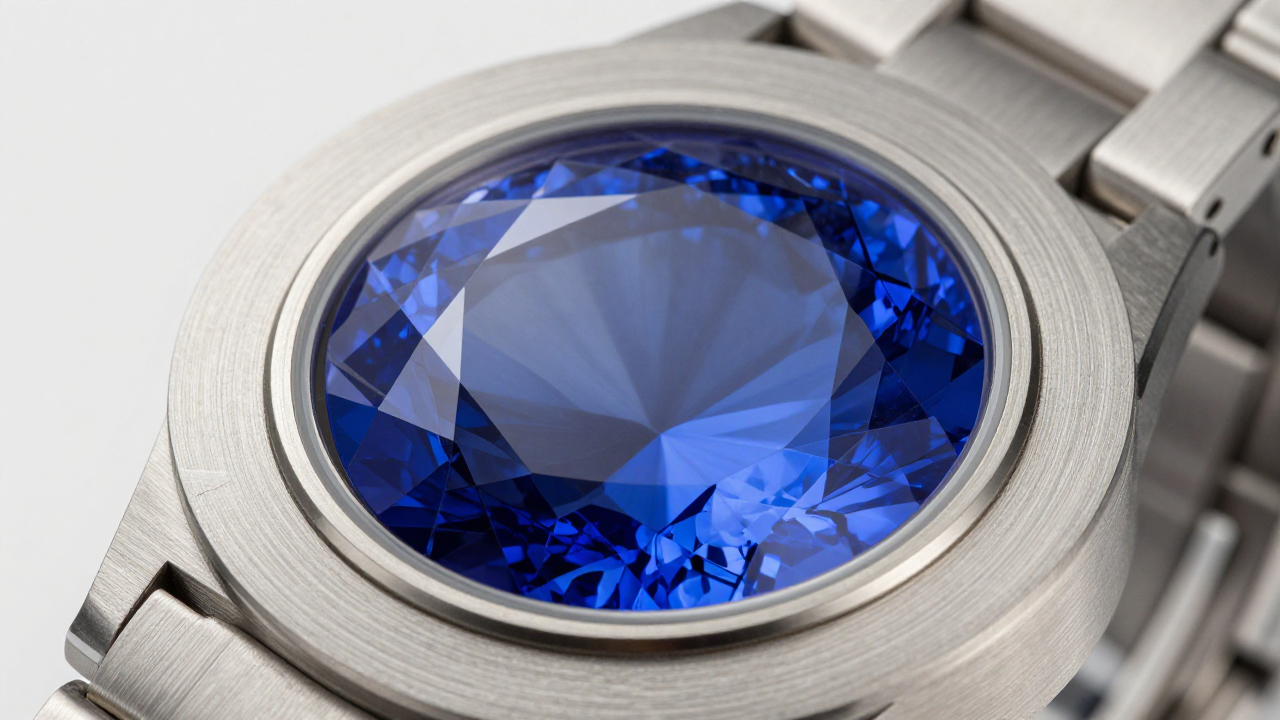
In 2026, the biggest shift in the sapphire watch crystal business is not the crystal.…
It is the 250 to 400 nanometers of nano-laminated anti-reflective coating sitting on top of it, which now decides optical clarity, warranty cost, and who wins the mid-tier spec sheet.
The Biggest Change of 2026 Is Measured in Nanometers
Corundum itself hasn't moved. Mohs 9. Roughly 2,000 Vickers. Fracture toughness near 2.2 MPa·m^0.5. Those are the same numbers we were quoting to Swiss buyers in 2012, back when Jadezone Optical was two years old and running a single polishing line in Shenzhen.
What changed is everything wrapped around the crystal — the coating stack, the growth route, the shape menu, and the paperwork that ships with each carton.
Walk the floor of a New York watch fair in late 2025 and you can see the tip of it. One chiming piece on display had sapphire gongs cut from the same block as the front glass, which tells you the crystal stopped being a window and started being a component. That is a small sentence with large implications for anyone who cuts, coats, and ships watch glass for a living.
The Coating Stack Quietly Became the Product
The anti-reflective stack is now the most engineered part of a sapphire watch crystal, and in 2026 it is where brands win or lose optical claims.
Bare sapphire reflects about 7.7% of light per surface at 550 nm, because its refractive index sits near 1.77. A five-layer SiO2/TiO2 stack deposited by ion-assisted deposition drops that below 0.5% per surface. The whole stack is thinner than a bacterium. Get it wrong by 30 nm and a $2,800 watch reads hazy under boutique lighting.
Temperature is where this gets expensive. Ion-assisted deposition runs at 120–180°C. Push hotter and thin domed lenses — 0.8 mm at the center, tapering to 0.5 mm at the edge — start to warp. Warp shows up as a faint double image on a printed dial, and the customer sees it before your QC does.
We learned that one the hard way. In March 2025, a wearable company in Boulder, Colorado, returned 6,200 domed lenses for haze. Our first read was the polishing slurry. Wrong. The lab came back with roughly 40 nm of residual cerium oxide trapped under the first oxide layer, left behind by a pre-clean step that looked fine on a flat lens and failed on a dome. We rebuilt the wash as a two-stage alkaline process and the haze rate went from 4.1% to under 0.3% by June.
Here is the part most spec sheets still miss: sub-wavelength surface texturing — moth-eye structures etched directly into the corundum — remains a lab story in 2026. I've seen the micrographs. I have not seen a production line that survives the economics. Do not specify it this year.
Eco Claims Now Have to Survive a Utility Bill
Regulators did not force sapphire producers to go green. Purchasing departments did.
Sapphire grows at roughly 2,050°C, and a 30 kg Kyropoulos boule takes 10 to 14 days of continuous power. Industry benchmarks put that run in the neighborhood of 2,000 kWh before you cut a single lens. Coating, polishing, and cleaning add more.
In Q3 2025, two of our US customers added a product carbon footprint field to their RFQ forms, both referencing ISO 14067. A year earlier, that field did not exist. That is the real driver — not marketing copy.
Recycled feedstock is the visible response. Cracked boule scrap and off-spec lenses get re-melted, and in our shop that stream went from about 6% of input in 2021 to roughly 20% in 2025. It is genuinely lower-carbon.
It is also where I get skeptical. Swapping to a "low-carbon" alumina supplier while running a 62% polishing yield is theater. A three-point yield gain on a 200-lens boule saves more energy and more material than most feedstock switches I've audited. When a supplier leads with chemistry and won't show you yield data, ask why.
Custom Cuts Stopped Being a Novelty
Custom sapphire geometry moved from sampling-room curiosity to standing line item between 2023 and 2026, and the order sizes tell the story better than any trend report.
Our average custom order ran around 3,000 pieces in 2019. In Q4 2025 it was 480. Minimums fell because femtosecond laser engraving got cheap enough to run on small batches — and because engraving the inner face, under the coating, means the mark never touches skin and never wears.
What buyers ask for now: box-domed crystals at 1.2 mm, sapphire casebacks with printed indices, dyed sapphire dials, chamfers cut to a specific radius rather than "standard."
The constraint nobody advertises is material loss. A 1.2 mm box dome off a 2-inch boule throws away roughly 30% more material than a flat lens of the same diameter. That is why custom pricing hasn't fallen as fast as minimums have. Anyone quoting you flat-lens prices for a deep dome is either eating margin or cutting the dome angle when you aren't looking.
Why I Think the Durability Race Is Pointed at the Wrong Target
Most scratched sapphire crystals I've inspected were never scratched. The coating failed.
The arithmetic is not subtle. A TiO2/SiO2 AR stack lands around 6 to 7 on the Mohs scale. Corundum is 9. So the soft layer sits on the outside, facing the world, and takes the abrasion that customers blame on the crystal.
Our own return data from 2025 — 1,140 warranty returns across watch and wearable lines — breaks down like this: 71% edge chips, 22% coating abrasion, 7% actual face scratches. Edge chips dominate because sapphire is brittle, not soft. Fracture toughness near 2.2 MPa·m^0.5 means it resists scratching beautifully and chips when it hits a tile corner.
Apple's product split says the same thing quietly. The stainless and titanium Apple Watch models get sapphire; the aluminum ones get Ion-X glass. That is a drop-performance decision, not a scratch decision, and it has held for years.
So the entire industry markets hardness while the failures cluster at the edge and in the coating. Chamfer radius, edge polish quality, and coating abrasion resistance move real numbers. "Mohs 9" sells watches and explains nothing.
Quote ranges reflect our own 2025 book of business, not a market index. Volume, dome depth, and coating count move them by a factor of two.
What's Already Happened and What I'm Betting On
Already settled: the coating stack drives optical claims, recycled feedstock is a line item on US RFQs, and small-batch custom geometry is normalized.
My forward calls, each with a way to check me. By Q4 2026, at least two mid-tier brands will publish coating abrasion test data alongside hardness claims — watch for a Taber or steel-wool figure in a press kit, because that number has never been there before. Second, recycled feedstock share across Asian sapphire cutters clears 25% only if polishing yield improves; if yield stays flat, treat any 30% claim as accounting. Third, moth-eye texturing stays out of production through 2026.
If none of those land, my read on the coating-first market is early rather than wrong, and I'll say so.
What to Do in the Next 3, 6, and 12 Months
Next 3 months. Audit your current crystal spec for two numbers it probably doesn't have: chamfer radius and coating abrasion resistance. Ask your supplier for a pre-coat cleanliness report. If they can't produce one, that is your haze risk in writing. On the buying side, stop accepting "sapphire, AR coated" as a spec line. Next 6 months. Run a yield audit before you sign any sustainability claim into a contract. Get kWh per finished lens and polishing yield side by side; the second number usually explains the first. On the design side, prototype one small-batch custom crystal — 500 pieces, laser-engraved inner face — and see what your supplier actually quotes versus what they promised. Next 12 months. Move coating durability into your warranty terms, not just your marketing. A crystal warranty that covers abrasion, priced against your real return rate, is a defensible premium in a category where everyone claims the same hardness. And if you're building a 2027 lineup, budget for edge geometry work — that is where the next round of claims will be won.Frequently Asked Questions
What is a sapphire watch crystal made of?
A sapphire watch crystal is synthetic corundum — crystalline aluminum oxide grown from melt at roughly 2,050°C, then sliced, domed, polished, and usually coated with a multi-layer anti-reflective film. It shares the same crystal structure as natural sapphire, rating 9 on the Mohs scale.
How much does a sapphire watch crystal cost?
For a 40 mm lens, flat uncoated sapphire runs about $4 to $9 at volume. Domed sapphire with a five-layer anti-reflective coating runs $9 to $22, driven by dome depth, coating count, and polishing yield rather than raw material cost.
Is a sapphire watch crystal worth the upgrade?
Yes for scratch resistance — sapphire measures roughly 2,000 Vickers against about 550 for mineral glass. But sapphire chips at edges because fracture toughness sits near 2.2 MPa·m^0.5, so a hardened glass with better edge design can survive drops that crack a thin crystal.
How long does a sapphire crystal last?
The corundum itself effectively lasts decades. The anti-reflective coating is the limiting layer, sitting around 6 to 7 on the Mohs scale, and typically shows abrasion before the crystal does. Coating quality, not crystal hardness, usually determines replacement timing.
How do I choose the best sapphire crystal for a watch?
Specify four things: chamfer radius, edge polish level, coating layer count, and a measured abrasion figure. Hardness alone tells you almost nothing about field failures. Ask for pre-coat cleanliness data too — residual polishing compound under the stack is a common haze source.