
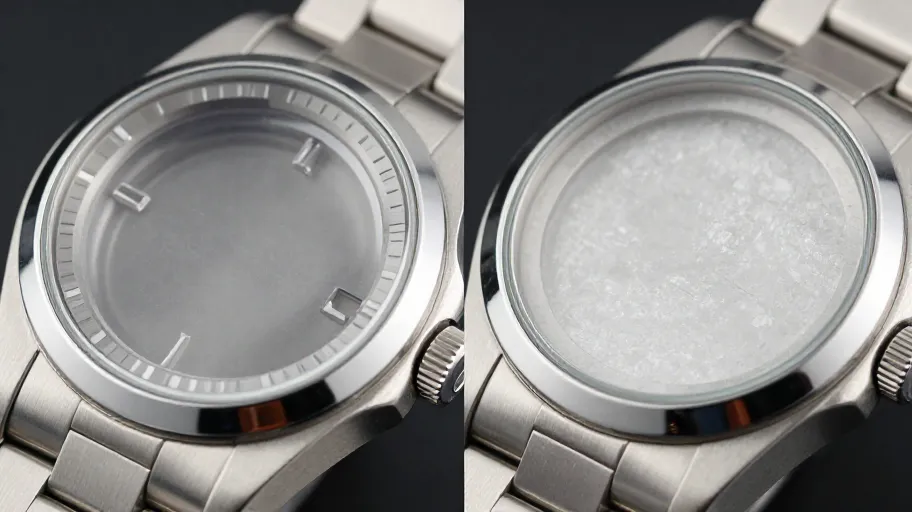
For B2B watch programmes, sapphire is the stronger choice where scratch resistance, brand positioning and long-term optics justify the material investment, while mineral crystal suits cost-sensitive or entry lines. Neither is universally better — the right answer depends on your collection's positioning, target price architecture and the specs you can document and approve with your supplier.
Frame it as a product-line decision, not a material ranking
If you are a sourcing manager or product developer asking "what is better, sapphire or mineral crystal?", the honest answer is that the question is incomplete. The better question is: for this specific collection, at this positioning, with these durability claims in our marketing, which crystal can we specify, sample and approve with confidence?
Sapphire and mineral crystal serve different commercial jobs. Sapphire offers exceptional hardness and scratch resistance, which supports premium positioning and durability claims. Mineral glass offers a lower material cost base and easier substitution in entry-level or fashion programmes where the crystal is not a selling point. The trade-offs — cost structure, processing complexity, coating options, availability for unusual shapes — are project-specific and must be quoted and confirmed per project with your supplier.
To make this decision defensible rather than intuitive, use the SPEC–SAMPLE–SIGN-OFF framework:
- SPEC — define every technical and commercial parameter before requesting a quote.
- SAMPLE — request and evaluate physical samples against documented criteria.
- SIGN-OFF — approve in writing against a fixed checklist, so production has an unambiguous reference.
Stage 1 — SPEC: the decision table
Use this table in your internal product-line review to decide which material to pursue before any RFQ goes out.
| Decision factor | Favour sapphire when… | Favour mineral when… | What to confirm with the supplier |
|---|---|---|---|
| Brand positioning | Scratch resistance and "sapphire crystal" are part of the collection's story | Crystal is functional, not a marketing point | Whether both materials are available for your shape and size |
| Durability claim in marketing | You plan to advertise scratch resistance | Durability messaging is minimal | What test methods and documentation the supplier can provide to support any claim |
| Shape complexity | Standard round, cushion or boxed shapes | Highly unusual geometries drive cost or feasibility questions | Feasibility and tooling approach for your specific drawing |
| Coating requirements | AR coating on one or both surfaces is specified | Coating is optional or unspecified | Which coating options are offered and how they are specified and inspected |
| Cost architecture | Material cost is absorbed in premium pricing | BOM cost is the binding constraint | Current quoted pricing for your volume and spec — never assume |
| After-sales exposure | Scratched returns damage brand reputation | Replacement crystals are cheap and available | Availability of spare crystals for service parts |
| Programme longevity | Multi-year platform with stable design | Short-run or fast-changing fashion line | MOQ, lead time and re-order terms for your project |
Two boundaries to respect here. First, no numeric tolerance, price, MOQ or lead time can be stated generically — these are quote-specific and must be confirmed in writing for your exact drawing. Second, do not accept verbal assurances on coating or hardness; ask which measurement methods the supplier uses and what documentation accompanies each lot.
Stage 2 — SAMPLE: how to evaluate before committing
Once you have chosen a direction, samples are where the decision becomes real. A disciplined sample evaluation protects both sides and prevents disputes at production.
Concrete approval questions to use during sample review:
- Does the sample match the approved drawing on every dimension you specified, measured with the method agreed in advance?
- Is the surface finish free of defects at the inspection magnification and lighting you documented in the spec?
- If AR coating was specified, does the coating match the agreed reflectance behaviour and coverage, and how was it verified?
- Does the crystal fit your case and gasket as intended in a real assembly trial, not just on paper?
- Are the markings, date-window cut-outs or applied elements positioned correctly?
- What documentation accompanies the sample — inspection report, material confirmation, coating record — and is it sufficient for your quality file?
- If this is a pre-production sample, what is the agreed process for resolving any deviation before mass production begins?
During this stage, also confirm the supplier's current sample policy directly: whether samples are charged, how they are shipped, and on what terms. Do not rely on any assumption — ask for the policy in writing as it stands today.
Stage 3 — SIGN-OFF: document the approval
Sign-off is where informal sourcing becomes professional procurement. A formal approval fixes the reference standard for production and gives you a basis for any future quality discussion.
Sample approval and production sign-off checklist:
- Approved drawing revision number recorded and dated
- Retained golden sample labelled and stored by both parties
- All dimensions confirmed against the agreed measurement method
- Surface quality criteria stated with inspection conditions (magnification, lighting)
- Coating spec, if any, documented with verification method
- Material confirmation (sapphire or mineral) recorded for the part
- Packaging and handling requirements for transit agreed
- Commercial terms — MOQ, pricing, lead time, re-order process — confirmed in writing for this project
- Deviation and rework process agreed before mass production
- Named approver on both buyer and supplier sides
Verifying the supplier themselves
Material choice matters less than supplier discipline. Whether you are evaluating JadeZone Sapphire or any other manufacturer in Shenzhen, Hong Kong or elsewhere, the verification questions are the same:
- Can the supplier walk you through their production and inspection process for crystals matching your spec?
- Will they provide documentation — not just verbal claims — with samples and production lots?
- How do they handle a reported defect, and what is the agreed resolution path?
- Can they support your required shapes, coatings and volumes, evidenced by a quotation for your actual drawing?
- Are their commercial terms — sample policy, MOQ, lead time, payment — stated clearly and in writing?
Treat every answer as something to verify and document, not to assume. A supplier that welcomes specific questions and written confirmation is easier to work with across a multi-year programme than one that offers only general reassurance.
FAQ
Is sapphire always the right choice for a premium watch? Sapphire supports premium positioning through scratch resistance, but "right" depends on your shape requirements, coating plan, cost architecture and the supplier's ability to document quality. Verify each of these for your specific drawing before deciding.
Can we mix sapphire and mineral crystal across one collection? Many brands tier materials across a range, but the decision should be made per reference with your supplier's input on feasibility and cost for each size and shape. Confirm availability for every variant you plan.
What should we ask about AR coating before approving a sample? Ask which coating options are offered, how reflectance and adhesion are verified, whether coating is on one or both surfaces, and what documentation accompanies each lot. Require the answers in your approval record.
How do we compare two sapphire crystal suppliers fairly? Give both the same drawing, the same spec sheet and the same approval checklist, then compare quotations, sample quality, documentation completeness and responsiveness. Structure, not price alone, is the fair basis.
What is the single most common approval failure to avoid? Approving a sample without a fixed checklist and retained golden sample. Without a documented reference, later quality discussions rest on memory rather than evidence.
Next step
获取采购 Brief — get the procurement brief and take the SPEC–SAMPLE–SIGN-OFF framework into your next supplier discussion, with every verification question ready.
If you are not ready to contact a supplier yet, start with the sign-off checklist above: adapt it to your collection, circulate it internally, and use it as the baseline for every crystal RFQ you issue. That single step costs nothing and materially improves every comparison you make afterwards.