
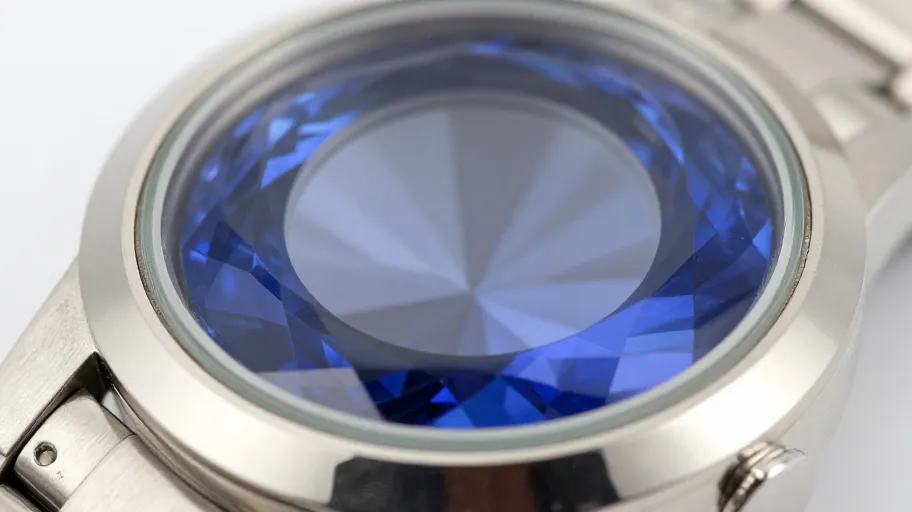
Yes — a sapphire watch crystal is real sapphire, in the material sense. It is synthetic single-crystal corundum (aluminium oxide, Al₂O₃), grown industrially and cut and polished to your drawing. It is not natural gemstone, and it is not glass. The material is chemically the same crystalline substance as natural sapphire; the honest sourcing question is not "is it real?" but "can the supplier prove it, batch after batch?"
That distinction matters more in B2B than in consumer marketing. A watch brand that prints "sapphire crystal" on a dial commits to a material claim. If a batch arrives that is coated mineral glass, the cost lands on your warranty line, not the supplier's. This guide gives you a framework to verify authenticity and engineering fit before you approve production — not after.
"Real sapphire" vs "natural sapphire": the distinction buyers should document
Sapphire, as a material, is corundum. Natural sapphire forms in the earth over geological time and contains trace elements and inclusions that make it unsuitable for precision optical components. Synthetic sapphire is grown in controlled conditions as a single crystal, then sliced, ground and polished into watch crystals, windows and other precision parts.
So the accurate answer to the primary question is: a sapphire crystal is real synthetic sapphire, not natural gemstone. In watchmaking, that is the preferred form — synthetic corundum delivers consistent hardness, optical clarity and dimensional behaviour that natural stone cannot.
The risk for a sourcing manager is different: some products in the market are sold with sapphire-adjacent language while being hardened mineral glass, sometimes with a coating applied to resist scratching. Those are legitimate materials at their own price points, but they are not sapphire. Your job at the approval stage is to make the material identity contractual, not implied.
The S.P.E.C. framework for verifying a sapphire crystal supplier
When we work through supplier qualification with buyers, we recommend a four-gate framework we call S.P.E.C.:
- S — Substance. Confirm the material is synthetic single-crystal corundum, not glass or composite. Ask what the crystal growth method is and where the raw boule or blank is sourced.
- P — Proof. Ask for material documentation: composition data, hardness evidence, and any test reports or certification scope the supplier can currently evidence for your specific part — not for a generic brochure part.
- E — Engineering. Confirm the part meets your drawing: dome geometry, thickness profile, coating type and placement, gasket-seat finish, and print or logo requirements. A correct material with a wrong edge finish still fails assembly.
- C — Contract. Confirm in writing how the supplier defines a sample, what approval changes, and what happens if a production batch differs from the approved sample. Every one of these points is project-specific — do not assume a policy; ask for it stated in your quotation and purchase order.
The framework's purpose is simple: it converts a trust question ("do we believe this is sapphire?") into a documentation question ("can we approve this against evidence?").
Decision table: evaluating a sapphire crystal claim
| Evaluation point | What to ask for | Strong signal | Weak signal — investigate before approving |
|---|---|---|---|
| Material identity | Crystal description: synthetic single-crystal corundum (Al₂O₃) | Supplier states growth method and can discuss boule sourcing | Vague "sapphire-like" or "sapphire-coated" language with no material definition |
| Hardness evidence | Test method and result for your part family | Named test approach with documentation offered for review | "9H" or "scratch-proof" claims with no method or report |
| Optical quality | Clarity, inclusions, birefringence behaviour across the batch | Willingness to supply inspection criteria and reject boundaries | No defined visual acceptance criteria |
| Coating (if specified) | Coating type, side, purpose, and how it is verified | Coating stated on drawing and inspection plan | Coating mentioned in email only, absent from documentation |
| Sample-to-production consistency | Golden-sample retention and batch comparison process | Signed sample retained by both parties with comparison protocol | Sample approval treated as a formality with no retention |
| Dimensional control | Inspection plan against your drawing | Measurement reports per your specified checkpoints | "We always hit tolerance" with no inspection output offered |
| Commercial terms | Sample policy, fees, shipping, lead time, MOQ in writing | Clear written statement you can reference in the PO | Any of these described verbally or left to assumption |
Specs and samples: a practical approval workflow
Material authenticity is one gate; fit-for-purpose is the other. Before approving a custom crystal, we recommend this sequence:
- Freeze the drawing. Define dome profile, thickness, diameter, edge geometry, coating and any printing. Ambiguity in the drawing becomes ambiguity in the sample.
- Define acceptance criteria in advance. Decide what you will measure and how — material verification, dimensional checkpoints, visual inspection limits, coating checks — before the sample exists, so approval is evidence-based.
- Verify the sample material independently if the application warrants it. Buyers with high-value programmes send samples to a third-party lab for composition or hardness confirmation. Whether you do this depends on your risk position, not on the supplier's preference.
- Retain a signed golden sample. Both parties keep a reference sample. Production batches are compared against it.
- Document deviation handling. Agree in writing what happens if a production batch differs from the approved sample — rework, replacement or another remedy. Confirm the supplier's current policy directly rather than assuming one.
Approval questions to put in writing before you commit
Send these to any supplier — including us — before approving a custom sapphire crystal:
- What is the crystal growth method, and what material documentation can you provide for our specific part?
- What test or inspection evidence accompanies each batch?
- What is your sample policy for this part — cost, shipping and what approval changes?
- What dimensional checkpoints will you report against our drawing?
- How is a golden sample retained and used for batch comparison?
- If a production batch deviates from the approved sample, what is the remedy?
- What is the current lead time and MOQ for this specification, and what quantities change the unit economics?
- What coatings and printing options are available for this geometry, and how are they inspected?
A supplier who answers these in writing, without friction, is easier to work with than one who answers everything smoothly on a call. Documentation is the product in B2B sourcing.
FAQ
Is a sapphire crystal a natural gemstone? No. Watch crystals use synthetic sapphire — lab-grown single-crystal corundum. It is the same crystalline material as natural sapphire but grown for consistency and optical quality. Natural gemstone is not used for watch crystals in precision manufacturing.
How can a buyer verify that a crystal is sapphire and not coated glass? Ask for material documentation, verify hardness and composition through an agreed test method, and — for higher-risk programmes — use a third-party lab on retained samples. Make the material definition part of the purchase order, not a verbal assurance.
Does "9H" or "scratch-resistant" mean sapphire? Not on its own. Hardness ratings and marketing terms do not identify a material. Glass products can carry coatings that resist scratching. Only material documentation and testing confirm sapphire.
What is a double domed sapphire crystal? A crystal with curvature on both the outer and inner surfaces, which affects optical behaviour and hand clearance. It is a geometry question as much as a material question: verify both the dome profile on the drawing and the material itself.
What should a sample approval actually cover? Material verification, dimensional measurement against your drawing, visual and optical acceptance, coating or printing checks, and retention of a signed golden sample — with every commercial policy confirmed in the quotation.
Get the sourcing document before you approve anything
If you are qualifying suppliers for custom or OEM sapphire crystals, request our purchasing brief. It consolidates the S.P.E.C. framework, the decision table above and the written approval questions into a document you can send to any supplier — including us at JadeZone Sapphire, where we expect to answer it like everyone else: in writing.
[获取采购 Brief]
Prefer to start smaller? Download the one-page sapphire crystal approval checklist and use it on your next sample review — no conversation required.
[Get the approval checklist]