
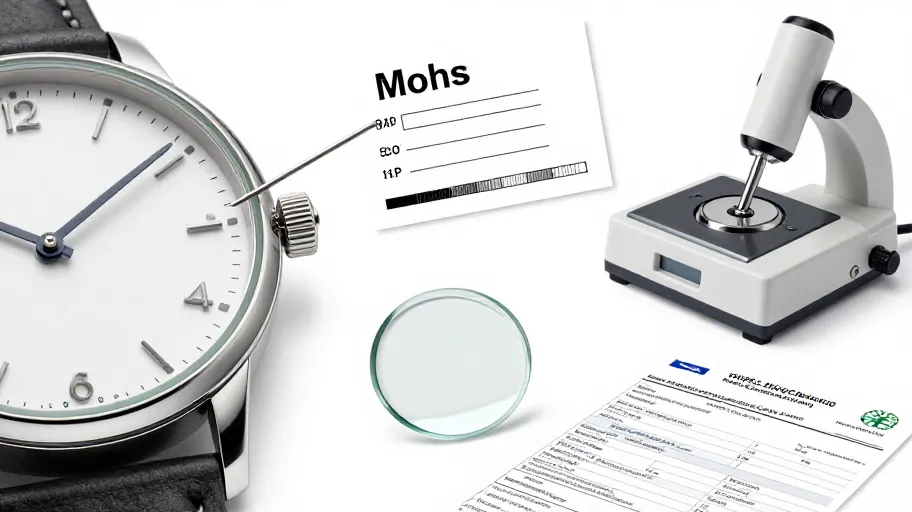
To test if a watch crystal is sapphire, combine ranked physical tests with documented material evidence rather than relying on any single check: verify hardness behaviour, request material certification from the supplier, compare against a retained golden sample, and, for production decisions, commission independent laboratory confirmation before granting approval. Informal tests alone should never gate a production order.
That paragraph is the short answer. What follows is the working method — a repeatable approval process you can apply to any sapphire crystal supplier, whether you are launching a new watch line or qualifying a second source.
Why verification is a procurement task, not a workshop curiosity
When a consumer asks how to test if a watch crystal is sapphire, a water-drop test is a curiosity. When a sourcing manager asks the same question, the answer determines whether a production run of thousands of cases carries the wrong glass. The commercial risk is not just material substitution — it is approving production on evidence that would not survive an internal audit or a customer complaint six months later.
This guide uses the VERIFY framework to structure verification the way a buyer needs it: as a sequence of evidence-gathering steps that end in a documented approve/hold/reject decision.
The VERIFY framework
| Step | What you do | Evidence produced |
|---|---|---|
| V — Verify material claim | Ask the supplier to state the material in writing: synthetic sapphire (single-crystal Al₂O₃), mineral glass, or glass with sapphire coating. | A written material declaration you can hold the supplier to. |
| E — Evidence the documentation | Request material certificates, origin documentation and any test reports the supplier holds. Ask which laboratory issued them and whether they are per-batch or one-time. | Traceable paperwork, or a documented gap if none exists. |
| R — Rank surface tests | Apply the practical tests below in order, recording each result. | A test log that supports or contradicts the claim. |
| I — Inspect the sample | Examine edge finish, chamfer geometry, dome profile and coating behaviour against your drawing. | A sample inspection record tied to your spec. |
| F — Formally agree specs | Freeze dimensions, coatings, printing and tolerance references in a signed specification document before ordering. | A single agreed reference for disputes and inspection. |
| Y — Yield documented approval | Approve a golden sample, retain it under seal, and define what each production batch must match. | An approval record that gates payment and shipping. |
The framework's value is that every step produces a document. If a step produces nothing — for example, the supplier cannot provide any material paperwork — that absence is itself a decision input.
Ranked tests: what each one proves, and what it doesn't
No single informal test is decisive for procurement. Ranked by evidential weight for a buyer:
| Test | How it works | What it can indicate | Limits for B2B approval |
|---|---|---|---|
| Hardness scratch behaviour | Sapphire resists scratching by steel; glass does not. Conduct only on a sacrificial sample. | A strong differentiator between sapphire and soft glass. | Destructive; unsuitable for sellable units; coated glass can confuse interpretation. |
| Water-drop / surface behaviour | A drop beads differently on sapphire than on glass. | A quick screening signal. | Highly operator-dependent; affected by AR coatings and surface cleanliness. Never a sole basis. |
| Weight and density comparison | Compare the sample against a reference crystal of identical geometry. | Consistency signal across a batch. | Requires a verified reference sample first. |
| Visual edge and chamfer inspection | Sapphire's machining and chamfer finish differ from pressed glass under magnification. | Indicates the manufacturing route. | Requires an experienced eye and a reference part. |
| Thermal and acoustic cues | Tap and thermal responses differ between materials. | Informal corroboration only. | Subjective; unsuitable as recorded evidence. |
| Independent laboratory identification | Third-party material analysis of a supplied sample. | The decisive evidence for production approval. | Adds cost and time; scope and cost are project-specific questions for the lab and supplier. |
The practical rule: screening tests rank suspicion; laboratory evidence resolves it. Use in-house tests to decide whether to escalate to paid verification, not to approve a production order.
Sample approval: separating "is it sapphire?" from "is it what I ordered?"
Material identity is only half the approval. The other half is conformance to your drawing.
- Qualify the material. Run the VERIFY steps until the material question is closed with written and, where warranted, laboratory evidence.
- Inspect geometry. Check the sample against the agreed drawing — diameter, thickness profile, dome shape, chamfer, hole positions, printing alignment. Note that specific dimensional tolerances are project-defined and must be fixed in your specification document, not assumed.
- Assess coatings. If anti-reflective coating is specified, agree in writing how coating conformance will be verified on samples and on batches. Coating performance claims without a defined test method are not approvable statements.
- Approve and seal a golden sample. Both parties retain sealed, signed reference samples. Every future batch is compared against them.
- Define batch-level checks. Agree in the purchase documents what evidence accompanies each batch — inspection reports, batch traceability, sampling method. What a supplier can provide is a question to confirm directly; do not assume any policy.
- Record the gate. Approval exists only when a named person signs it against a dated specification. Emails saying "sample looks good" are not an approval record.
Approval questions to send any sapphire crystal supplier
Copy these into your RFQ or supplier qualification document:
- Will you provide a written material declaration identifying the crystal as synthetic sapphire?
- What material certificates or test reports can you supply, from which laboratory, and are they per-batch or one-time documents?
- What inspection documentation accompanies each production batch, and can we agree a batch sampling and verification method?
- Can we jointly seal golden samples, and what process applies if a batch deviates from them?
- What dimensional tolerances can you commit to for this specific drawing, and how will they be measured and reported?
- If coating is specified, how is coating conformance tested, and what evidence is provided per batch?
- What is your process for handling a disputed batch — what does your current policy say, and where is it documented?
None of these questions presumes any answer. They exist to convert a supplier's marketing claims into written, comparable commitments.
Decision gate: proceed, hold or reject
| Evidence position | Decision | Action |
|---|---|---|
| Written material declaration plus lab evidence plus conforming golden sample | Proceed | Sign the specification, seal golden samples, define batch evidence requirements. |
| Declaration and screening tests pass, but no independent evidence | Hold | Commission third-party verification of the sample before any production commitment; confirm costs directly with the lab. |
| Contradictory test results, or supplier declines to document material | Reject or re-qualify | Stop the qualification; seek a supplier who provides the evidence trail. |
| Material verified, but geometry or coating conformance undocumented | Hold | Freeze tolerances and coating test methods in the spec before ordering. |
Frequently asked questions
Is the water-drop test enough to confirm sapphire for a production order? No. It is a screening signal affected by coatings and handling. For a production commitment, use it only to decide whether to escalate to documented or laboratory verification.
What is the strongest evidence that a watch crystal is sapphire? A written material declaration from the supplier combined with independent laboratory identification of a sample, referenced to a sealed golden sample that production batches must match.
Should I test every crystal in a production batch? Define this with the supplier in the purchase documents. Batch-level verification through agreed sampling and inspection reports is an approvable approach; the sampling method must be agreed in writing as part of your specification, not assumed.
How do I verify anti-reflective coating as well as the material? Coating needs its own test method, agreed before ordering. Ask the supplier how coating conformance is measured, on what evidence basis, and how that evidence is delivered per batch — then record the answers in the specification.
Can I rely on the supplier's own test reports? Supplier reports are a starting input, not the approval itself. Check who issued them, when, whether they are per-batch or one-time, and whether an independent check on a retained sample closes the remaining risk for your application.
Your next step
If you are qualifying a supplier for custom or OEM sapphire watch crystals, 获取采购 Brief — a structured brief that turns everything in this guide into a document you can send to suppliers and file with your approval records.
Prefer to start smaller? Download the low-friction sapphire crystal verification checklist — the VERIFY steps, the approval questions and the decision gate in one page you can use on your next sample review.