
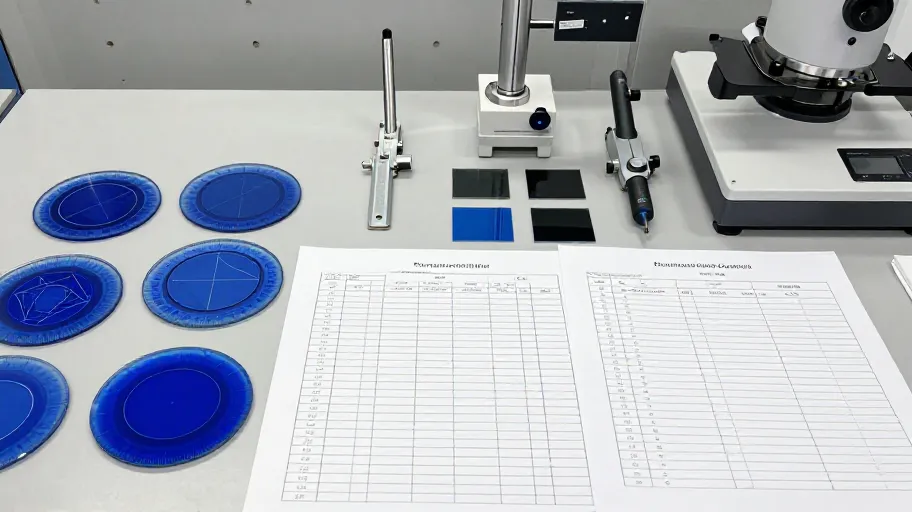
Before you shortlist suppliers in the sapphire glass market, compare four things in writing: whether each supplier can confirm your crystal specification (diameter, thickness, geometry and coating), whether they document their approval and measurement process, whether their quality controls match your acceptance criteria, and whether their communication and revision protocol fits your project schedule. Rank candidates against the same questions — never against marketing language alone.
If you are a sourcing manager, product developer or watchmaker preparing to buy custom or OEM sapphire crystals, the shortlist stage is where most procurement risk is created. Not because suppliers misrepresent themselves, but because buyers compare candidates on different bases: one supplier's polished pitch against another's detailed drawing review, one quote with coatings included against another without. This article gives you a single framework — C.A.M.P. — so every candidate is measured against the same documented questions before you invest time in samples or negotiations.
Why unstructured comparison fails in the sapphire glass market
The sapphire glass market serves several industries at once — watchmaking, optics, electronics, industrial instruments — and suppliers position themselves very differently even when their product catalogues overlap. A supplier who describes themselves as serving "watch brands" may or may not have experience with your specific crystal geometry, your coating expectations, or your documentation requirements.
The failure mode is predictable: a buyer shortlists three or four suppliers based on website scope and responsiveness, then discovers only after weeks of sampling that one cannot hold the drawing interpretation you intended, another cannot provide the measurement reports your quality team requires, and a third's revision process doesn't fit your development calendar. None of these suppliers did anything wrong. The buyer simply never asked the same questions of each of them, in writing, before shortlisting.
The solution is not to distrust suppliers. It is to standardise what you ask, so that the differences between candidates become visible and comparable.
The C.A.M.P. Framework: four comparison dimensions
C — Crystalspec. Can the supplier, in their own written response, restate your crystal specification accurately? Include diameter, thickness, edge treatment, geometry (flat, domed, bevelled, shaped), hole or date-window cut-outs, and any coating expectation such as anti-reflective treatment. Ask each candidate to confirm each line item rather than reply "yes, we can do it". A supplier who restates the spec correctly has actually read your drawing.
A — Approval. What is the supplier's approval workflow from drawing to first article to production release? Ask who signs off dimensional and visual inspection, what happens when a first article doesn't match the drawing, and how revisions are documented and priced into the project. You are not looking for a specific answer — you are looking for the existence of a described, repeatable process.
M — Measurement. Ask what measurement and inspection equipment is used, what reports accompany a first article and production batches, and whether reports can be formatted to integrate with your incoming inspection requirements. A supplier who can describe their measurement chain in writing gives your quality team something concrete to evaluate; one who cannot leaves you to discover gaps during production.
P — Partnership. How does the supplier handle communication across the project: who is your point of contact, how are engineering questions routed, what is the escalation path when a spec is ambiguous? For custom work, engineering communication quality matters as much as production capability, because ambiguity in a drawing is resolved either at the desk or on the part.
Decision table: comparing sapphire crystal suppliers before shortlisting
Use this table with every candidate. Score each cell from your written exchange with the supplier — not from their website.
| C.A.M.P. dimension | What to ask each supplier | What a strong, verifiable answer looks like | Red flag |
|---|---|---|---|
| Crystalspec | "Please confirm each line of the attached spec, item by item." | A written restatement of your specification with any questions raised | A generic "we can produce all sapphire crystals" with no reference to your drawing |
| Crystalspec — coatings | "Which coating options can you offer and how are they specified and verified?" | Named options with a described verification method | Coating treated as an afterthought or "same as everyone's" |
| Approval | "Describe your approval workflow from drawing to production release." | A stepwise written process with named checkpoints | "We'll confirm after you order" |
| Approval — revisions | "How are drawing revisions documented and re-approved?" | A revision protocol with re-confirmation of dimensions | No defined revision process |
| Measurement | "What measurement reports accompany first articles and production batches?" | Specific report types your quality team can review | Verbal assurance only, no written reports offered |
| Measurement — equipment | "What inspection equipment do you use for dimensional and visual checks?" | Equipment named and linked to the relevant spec items | Equipment description avoided or vague |
| Partnership | "Who is the engineering contact and how are spec ambiguities resolved?" | A named contact and a described resolution path | All communication routed through sales with no engineering access |
| Policy — sample, cost, MOQ, lead time | "Please confirm your current sample policy, pricing basis, MOQ and lead time for this spec." | A direct written confirmation of current terms | Terms deferred or left implicit |
Note on the final row: no sample policy, cost, shipping arrangement, MOQ or lead time can be assumed in this market. Each supplier's current policy differs and changes; confirm all of it in writing before comparing quotes, and confirm it again before releasing an order.
Concrete approval questions to send before RFQ
Send this exact question set to every candidate, then compare the responses side by side:
- Please restate our crystal specification line by line and flag anything ambiguous or missing.
- Which items on this drawing do you consider the most challenging, and why? (A supplier who says "nothing is challenging" has not studied the drawing.)
- Describe your first-article process: what do you produce, what do you measure, and what do you send us to approve?
- What documentation accompanies first articles and production batches, and can it be tailored to our incoming-inspection format?
- How do you handle a first article that does not match the drawing — correction, re-approval, or unilateral adjustment?
- Please confirm your current sample policy, pricing basis, MOQ and lead time for this specification, in writing.
- Who is our engineering contact, and what is the process for resolving spec ambiguities before production?
- If we later modify the design, how are revisions quoted, documented and re-approved?
Treat the responses as your real shortlist data. Two suppliers with identical capabilities will produce very different answer sets, and the difference is precisely what you are buying when you choose a custom partner.
Red flags that should pause a shortlist
- A supplier who will not restate your specification in writing before quoting.
- Quotes that omit coating, measurement reports or first-article steps, leaving them to be "discussed later".
- No named engineering contact, or engineering questions answered by sales staff without confirmation.
- Any numerical tolerance, MOQ, lead time or policy stated verbally but refused in writing.
- Pressure to skip first-article approval and move straight to production.
None of these signals proves a supplier is unsuitable. Each one means you should pause, ask the question in writing, and document the answer before advancing the candidate.
FAQ
What should I compare first when evaluating sapphire crystal suppliers? Start with Crystalspec: ask each supplier to restate your specification item by item. This single exercise reveals who has genuinely reviewed your drawing and surfaces ambiguities before any money or schedule is committed.
How do I compare quotes fairly in the sapphire glass market? Only compare quotes that respond to the identical written question set — same specification, same approval expectations, same measurement-report requirements, and each supplier's current sample, pricing, MOQ and lead-time policy confirmed in writing. Quotes built on different assumptions cannot be compared.
Do I need first-article approval for custom sapphire crystals? For any custom or OEM crystal, a documented first-article step gives you something concrete to measure and approve before production. Whether and how your supplier structures this is one of the questions to confirm directly; do not assume it is included in any supplier's process.
How do I handle drawing revisions during development? Before shortlisting, ask each candidate how revisions are quoted, documented and re-approved. A supplier with a defined revision protocol protects both parties; the absence of one is a reason to ask further questions, not an automatic disqualification.
What documentation should I request with samples or batches? Ask what measurement and inspection reports accompany first articles and production batches, and whether the format can align with your incoming-inspection requirements. The specifics are project-dependent — confirm directly with each supplier what they can provide.
Your next step
下载核对清单 — get the full supplier comparison checklist with the C.A.M.P. question set, decision table and red-flag list, ready to send to every candidate on your shortlist.
Ready to apply the framework to a live specification? JadeZone Sapphire welcomes documented, spec-driven enquiries for custom sapphire watch crystals and precision sapphire components from Shenzhen and Hong Kong. Send us your drawing and question set and we will respond against each item in writing.