
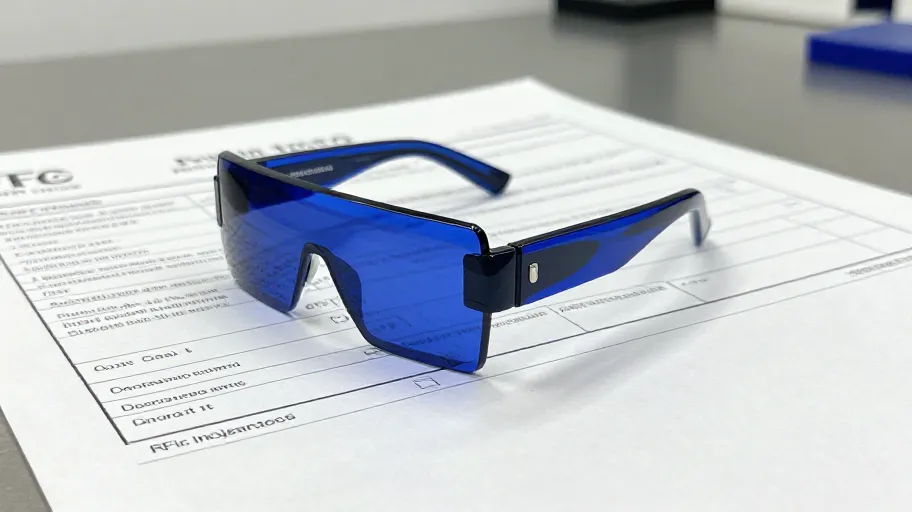
Before you issue an RFQ into the europe sapphire glass market, settle your crystal specifications first. Buyers who lock dimensions, edge profiles, coating callouts, material orientation and acceptance criteria in writing receive quotes they can compare like-for-like. Buyers who leave gaps open receive quotes built on different assumptions. This article sets out exactly what to decide, and what to confirm with every supplier, before your RFQ leaves your desk.
Why specification work comes before supplier selection
Sapphire watch crystals are engineered components, not catalogue commodities. A single crystal design involves interdependent decisions: case geometry, gasket or bezel retention method, coating application, surface finish and inspection criteria. When an RFQ specifies only diameter and thickness, each supplier fills the remaining gaps from their own process preferences — and the quotes that come back describe materially different parts.
The consequence is not just price variance. It is delayed sampling, misaligned edge profiles that do not seat correctly, coating applied to surfaces your assembly process did not intend, and acceptance disputes that could have been prevented with one written page of criteria.
Preparation, in this context, is leverage. The buyer who arrives with a complete specification pack controls the comparison. The buyer who arrives with a part number and a hope does not.
The SPEC-LOCK framework
To make preparation repeatable, we use a framework called SPEC-LOCK. Each letter represents a specification area that should be documented before an RFQ is issued:
- S — Scope. Define what the crystal must do: fit, retention method, water-resistance contribution, and the reference drawing that governs.
- P — Profile. Specify the geometric form: flat, domed, double-domed, or a custom curve, with the drawing tolerance callouts that your design team has approved.
- E — Edge. Settle the edge treatment and seating geometry, because edge configuration determines how the crystal interfaces with the gasket, bezel or adhesive bed.
- C — Coating. Decide where anti-reflective coating is applied — outer, inner, both, or none — and how coating presence and quality will be verified at inspection.
- L — Lubrication and handling. Document assembly constraints: whether gasket lubricants, adhesives or cleaning agents used in your process are compatible with the crystal surfaces, and any handling requirements.
- O — Orientation. Sapphire is anisotropic; if your optical or hardness requirements depend on crystallographic orientation, state it in the drawing rather than leaving it to supplier default.
- C — Confirmation. Confirm that the supplier can measure and report every specification you have written. A specification the supplier cannot inspect is a specification you do not have.
- K — Keeping criteria. Define acceptance: what counts as a pass, what counts as a reject, how inspection is evidenced, and what happens when a lot does not conform.
The framework's value is not complexity — it is completeness. Each element converts an unstated assumption into a documented decision that both parties can price, produce and inspect against.
Decision table: what to settle, who owns it, what is at risk
| Specification | Settle before RFQ? | Decision owner | Risk if left open | What to document |
|---|---|---|---|---|
| Crystal scope and reference drawing | Yes | Product development | Quotes built against different interpretations of the part | Drawing number, revision, governing document |
| Geometric profile | Yes | Product development | Suppliers quote nearest standard shape, not your design | Profile callout on the drawing with approved tolerances |
| Edge treatment and seating geometry | Yes | Product development with watchmaker input | Crystal does not seat correctly in case or gasket | Edge detail, seating diameter references |
| Coating position and callout | Yes | Product development | Coating applied to unintended surfaces; inspection ambiguity | Coating zones, verification method, inspection evidence |
| Crystallographic orientation | If functionally relevant | Engineering | Optical or hardness outcomes differ between lots | Orientation requirement on drawing, if applicable |
| Assembly compatibility (adhesives, lubricants) | Yes | Watchmaker / assembly lead | Assembly issues attributed to the crystal without evidence | Compatibility notes shared with supplier |
| Inspection and acceptance criteria | Yes | Sourcing with quality function | No objective basis to accept or reject a lot | Written pass/fail criteria and evidence format |
| Commercial terms (MOQ, samples, lead times, fees) | At RFQ stage | Sourcing | Budget and timeline surprises | Written confirmation from each supplier — confirm current policy directly |
Approval questions to put to every supplier in writing
Before approving any supplier, ask these questions and keep the answers on file:
- Can you manufacture and measure every specification on this drawing, including the coating callout and any orientation requirement? Please confirm in writing.
- How do you inspect each specified characteristic, and what evidence will accompany each delivered lot?
- What is your current minimum order quantity for this part, and what is your current sample policy — including any fees and shipping arrangements? Confirm your current policy directly.
- What is your current lead time for samples and for production quantities of this specific design? Confirm the current estimate in writing.
- If a delivered lot does not meet the acceptance criteria we document, what is your corrective process, and how is it recorded?
- Which certifications or quality management documentation can you provide current evidence for? Please share documents rather than descriptions.
None of these questions presumes an answer. Their purpose is to move every commercial and technical claim from conversation to record — the difference between an expectation and an agreement.
Frequently asked questions
What is the minimum information an RFQ for a custom sapphire crystal should contain?
At minimum: a dimensioned drawing with revision control, the geometric profile, edge and seating details, the coating callout, any orientation requirement, the intended assembly method, and your acceptance criteria. Commercial questions — order quantities, sample policy, lead times and fees — should be asked alongside, and every answer confirmed in writing as each supplier's current policy may differ and may change.
Why do quotes for "the same" sapphire crystal differ between suppliers?
Because "the same" rarely is. When specifications are incomplete, each supplier prices their own interpretation: a different profile, a different coating arrangement, a different inspection regime, or different commercial terms. Completing the SPEC-LOCK elements before the RFQ removes most of that variance by making every quote describe the same part.
Should anti-reflective coating be specified in the RFQ or decided after sampling?
Specify it in the RFQ. Coating position and verification method affect both manufacturability and inspection, so leaving it open means your samples and your quotes carry an unexamined variable. If you are undecided between coating options, quote each variant as a separate line item so the decision is made on comparable information.
How do we set acceptance criteria without prior sapphire sourcing experience?
Start from function. List what the crystal must do in the finished watch — seat correctly, present the specified optical appearance, withstand your assembly and testing process — and write pass/fail criteria for each. Then confirm with the supplier that they can inspect and evidence each criterion. If a supplier cannot measure a requirement, discuss how it will be verified before you order.
What should we verify about a supplier before approving them?
Ask for current, documentable evidence of the certifications they claim, their inspection methods against your drawing, and their written answers on quantities, samples, fees, lead times and corrective process. Approve on records, not assurances.
Prepare your RFQ with the Sapphire Sourcing Checklist
Before your next RFQ, download our checklist. It walks your team through every SPEC-LOCK element, includes the supplier approval questions above, and provides slots to record each supplier's confirmed policies — so your comparison is built on documents, not assumptions.
[下载核对清单]
Or, if you would like to discuss a specific crystal design with JadeZone Sapphire, share your drawing and we will confirm what we can manufacture, measure and evidence against your specification.